
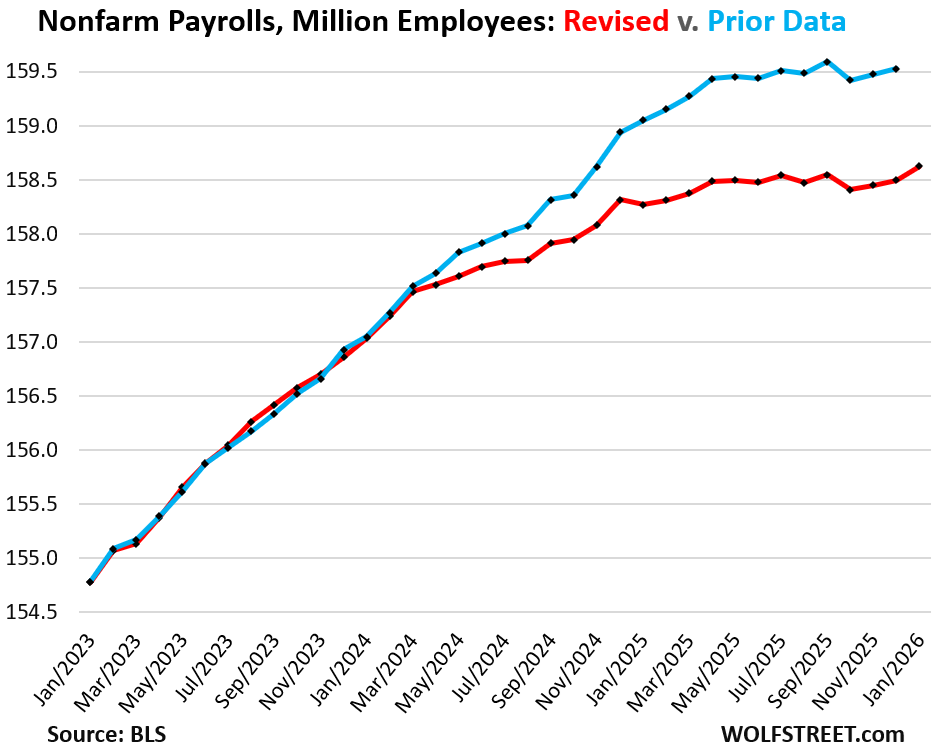
Total nonfarm employment is 1.03 million jobs lower than previously estimated.
By Wolf Richter for WOLF STREET.
The preliminary annual benchmark revisions of nonfarm payrolls were initially announced by the Bureau of Labor Statistics in September as a lumpsum figure (discussed here), but it was not calculated into the monthly nonfarm employment figures at the time.
Today, the BLS announced the final benchmark revisions and recalculated its monthly data going back years. It also revised seasonal adjustments back many years.
The revisions had the effect of reducing two-years’ worth of nonfarm payroll growth by 1.03 million jobs as of December, with far slower job growth in 2024 and 2025 then previously reported. The chart shows the prior data through December 2025 (reported in January) in blue; and the revised figures through January in red.
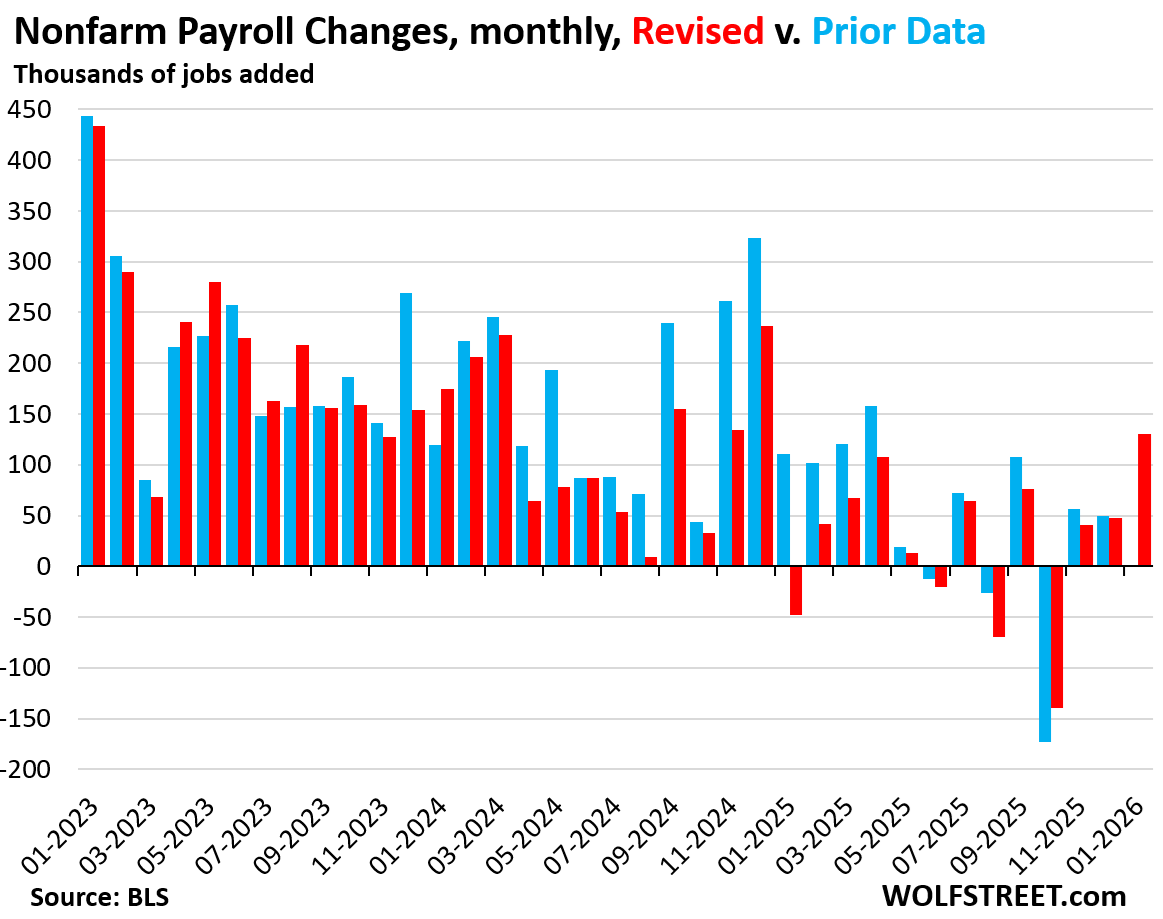
The chart below shows the month-to-month changes of nonfarm payrolls: The figures as reported a month ago in blue, and today’s revised figures in red.
The big changes in 2024 and 2025 were due to the benchmark revisions. The smaller changes in 2023 were due to revisions of seasonal adjustment factors and other revisions.
The BLS tracks nonfarm payroll jobs in two different ways:
Monthly data from employers via surveys. Every month, the BLS asks 10s of thousands of employment locations about their payrolls as part of its Current Employment Statistics (CES). It then uses the data, plus a model for estimating the employment effects of firms having shut down (“deaths”) and firms having been created (“births”) during the period, to estimate the nonfarm payrolls for that month. It then seasonally adjusts the data. These preliminary data are then revised several times in the following months as more data become available.
Quarterly payroll tax data. Employers file quarterly payroll tax reports with the Unemployment Insurance (UI) tax system. These reports contain all their employees and wages and give a count of total payrolls in the US. This data is collected by the BLS in the Quarterly Census of Employment and Wages (QCEW) and supplemented with additional data.
But this UI data is quarterly with filing deadlines well after the quarter ends, so it’s useless for monthly reporting.
To provide more current data on a monthly basis, the BLS uses the survey-based data. And then once a year within the January release, it adjusts (“benchmarks”) the survey-based data to the employment count of the QCEW.
The QCEW is the gold standard for US nonfarm employment, but it’s not available on a timely basis – hence the big annual benchmark revisions.
Obviously, these adjustments should be made quarterly, rather than annually which would be a huge improvement.
Detailed discussion of the employment report coming up shortly.
Enjoy reading WOLF STREET and want to support it? You can donate. I appreciate it immensely. Click on the mug to find out how:


Why does anybody (i.e. Fed) care about what the BLS reports monthly if their revisions are so wild? Are these two last years just super unusual or should they just retire the way they calculate this metric monthly.
As this always comes up: BLS publishes the standard sampling error. For month to month changes, the error is roughly plus or minus 120,000. This is well known by economists and others who use this data, but always causes confusion for everyone else.
The average benchmark revision is 0.2 percent. This year’s came in at -0.6% which is higher than usual, though not extreme.
Many in the media thought that this admin would manipulate the jobs numbers. Surprisingly it was Biden admin that inflated the job numbers. This BLS has corrected going back to 2024 and 2025. People need to recognize that they are doing their job correctly
I posted this chart a year ago, same issue:
https://wolfstreet.com/2025/02/07/huge-upward-adjustment-of-employment-labor-force-as-wave-of-immigrants-is-finally-included-unemployment-drops-wage-growth-accelerates-the-annual-revisions-are-here/
Can you not read the graph? The disparity increased by a large amount in Jan 2025 when a certain someone took office.
Exactly
Bullshit. Political brainrot shows through. The chart I posted just above both of your idiotic comments is for the revision a year ago for the Biden years.
These are ANNUAL revisions that each go back two years, you goofballs.
So then why is it being revised down when that administration is in office?
Or maybe I just don’t understand what you are inferring by your comment.
That was just a response to “Surprisingly it was Biden admin that inflated the job numbers.”. A counter example. Possibly no inferring.
Anyone can spin the numbers to fit their narrative.
Dec2024 (initial) = 159.6M
Dec2024 (Jan25 revision) = 158.9M
Dec2024 (Jan26 revision) = 158.3M
Dec2024 to Dec2025 (initial) = 584K jobs added
Dec2024 to Dec2025 (Jan26 revision) = 181K jobs added
Show me again where the jobs numbers have been inflated to fit your narrative?
Friggin Carter Administration!
If he didn’t farm all those peanuts!
😡
then –> than
“with far slower job growth in 2024 and 2025 *than* previously reported”
Would deporting millions of the uninvited “help” or “hurt” these stats?
https://wolfstreet.com/2026/02/11/private-sector-ramps-up-hiring-job-losses-mount-at-federal-state-governments/
Wolf, I’m aware you’re going elaborate more on the employment report that came out this AM. I’m already completely cynical about the reporting because of the delay and Trump’s “yes-men” fingerprints all over the report to twist a better than actual narrative. Am I wrong to have that gut feeling?
Maybe a better question….what is the value of that gut feeling?
If it makes you dig into the details to make an informed opinion, good.
If it blinds you or alters your perspective regardless of the data (or makes you not search that out), probably not so good.
On that vein Wolf does a great job relaying factual data. Sadly a lot of news/info is filtered thru a biased lens or even just a flat out opinion.
Yes.
BTW, the new nominee for commissioner of the BLS is BLS long-time employee and data nerd Brett Matsumoto, a total professional. I might disagree with him about his treatment of the health insurance CPI, whose patching up he was involved in, but he is not a political creature.
“So uhhhh yeah people were fired”
Reporter: “where did you get the job numbers strategy?”
“Well see Krispy Kreme donuts called us, said ‘load em up, apologize later’”
/s