
Rendering reliance on it for indications of employment trends useless.
By Wolf Richter for WOLF STREET.
The ADP National Employment Report data, released today by payroll processor ADP, was massively revised going back to 2010, now showing erratic and massive month-to-month job gains and losses going back to 2010 that are completely different than the data for the same period released a month ago, rendering reliance on the report for indications of employment trends useless.
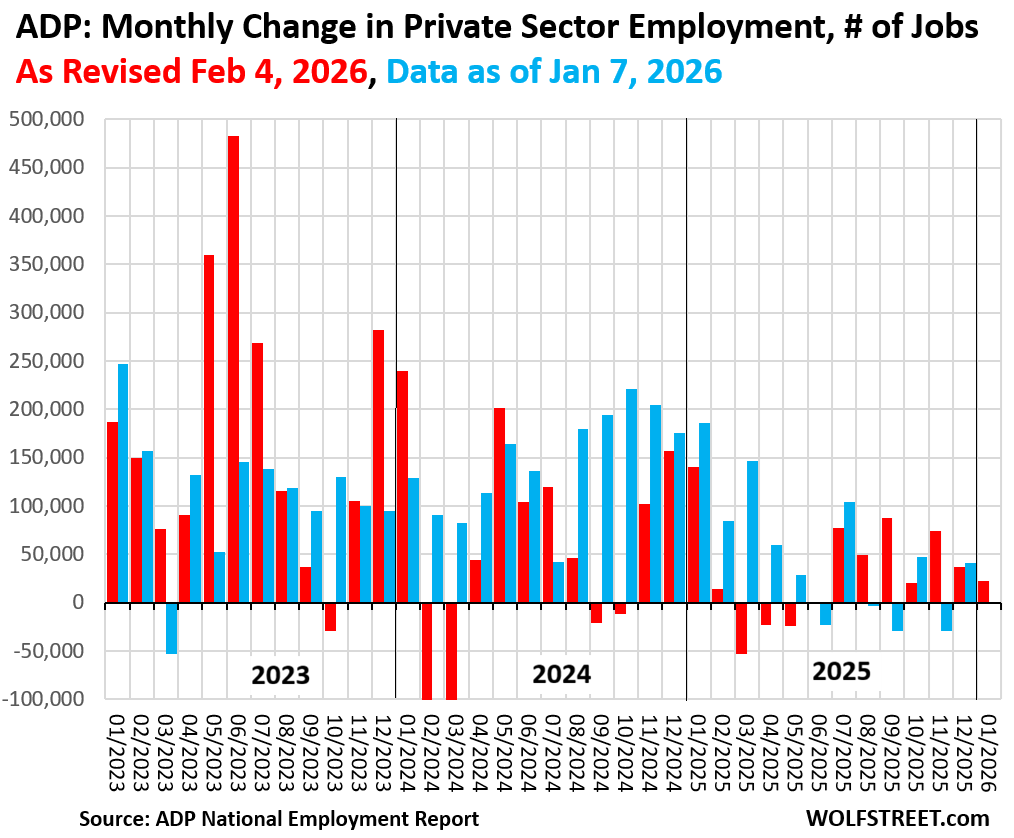
The chart shows ADP’s new revised data of the month-to-month changes in employment (red columns), and the prior data released on January 7, 2026 (blue columns).
There is hardly any correlation between the red columns and the blue columns. And these erratic differences between new data and the prior data go all the way back to 2010, when ADP began this data series.
For example:
In 2025, the new version (red) shows job declines in March, April, and May, when the old version showed substantial job gains (blue).
Then for the second half of 2025, the new version (red) shows much bigger job gains of 345,000 for June through December, than the old version (131,000).
For 2024, the new version shows big job losses in February and March (red), while the old version showed moderate gains (blue).
And then again in September and October 2024, the new version showed job losses (red), when the old version showed massive job gains (blue).
For 2023, the new version shows huge job gains for May, June, and July, while the old version showed much smaller job gains.
These massive differences go back all the way back to 2010.
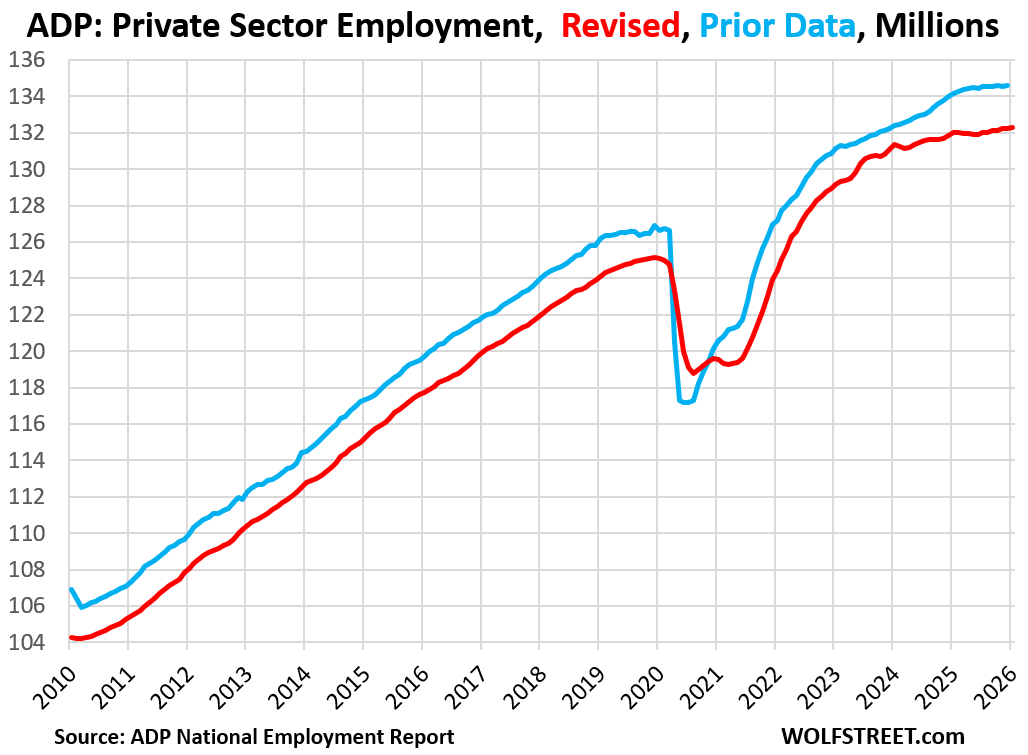
The entire data set was massively revised.
ADP’s entire data series going back to 2010 was heavily revised, and shifted down by about 2.5 million jobs across the entire period.
In the press release, ADP said about the revisions:
“The January 2026 report reflects a scheduled annual revision of the ADP National Employment Report. The data series has been reweighted to match the Quarterly Census of Employment and Wages (QCEW) benchmark data through March 2025.
“Beginning this month, in addition to the annual benchmark revision, the ADP National Employment Report also will reflect data from the most recent QCEW release.”
The QCEW is produced by the Bureau of Labor Statistics and is based on companies’ quarterly employment tax filings. The BLS adjusts its own nonfarm payrolls data to the QCEW on an annual basis.
ADP gets its data from the payrolls it processes. But many companies use other payroll processors, and many companies process their own payrolls, and ADP has no data on them, including some very large employers. ADP then extrapolates its limited and possibly skewed sample to the national population. It then periodically adjusts this data to the government’s data, the QCEW by the BLS.
The QCEW is the gold standard for US payroll data, but lags far behind because it’s based on quarterly tax filings with delayed filing deadlines; and it is not complete either.
Enjoy reading WOLF STREET and want to support it? You can donate. I appreciate it immensely. Click on the mug to find out how:


Run two MACDs that are Fib related harmonics (pick your periods) and when they diverge, look for a turn. Works for Cumulative Tick Indicator and the Adv/Decl and Up/Dn Vol ratios as well.
Eat two MacDs and look for a de Fib relator
This is witty funny response to $&!?/
Nice! Super Clever!
CRYPTO ‘ASSETS’ LOSE $1.7 TRILLION IN VALUE…
I wonder when crapto’s image is a pile💩. Not a gold coin. Hey it is what it is.
I know Wolf barely comments on crypto (reasonable) but I wonder what’s causing this latest dip.
I actually included three paragraphs about crypto.
The general theory of the article is summarized in the subtitle: “Pulling the rug out from under the “debasement trade.” It’s mostly about Warsh, and then briefly about some asset categories.
https://wolfstreet.com/2026/01/30/markets-reaction-to-warsh-silver-collapses-gold-plunges-dollar-jumps-treasuries-yawn-stocks-drop-already-battered-cryptos-sink/
The most convincing theory I’ve heard about BTC is that rather than being a hedge against inflation or a store of value it’s been a levered bet on Tech. Perhaps also a indicator of market liquidity. But who knows really.
It’s now below MicroStrategy’s average BTC cost basis. A lot of the other “Treasury” companies have even higher cost basis in BTC and maybe they are already being forced to liquidate. Maybe the bottom for BTC gets put in when Strategy is forced to liquidate. That would tend to drive the whole complex down toward 30k.
I don’t own BTC, but it’s interesting to watch and interesting to follow the debates.
It’s ironic that the new narrative around AI (as of 3 days ago it seems like) is that the first implementors – Tech – are now the first big victims.
The fact that Bessent had to announce that the U.S. couldn’t bail out Bitcoin, as though it was even reasonable to suggest it, shows how far the moral hazard rot has gone.
Had you suggested taxpayers bail out a pile of electrons 30 years ago, you would have been laughed at.
^^^This. I was shocked it even needed to be said.
Also though I’ve met many people recently in their early 30s who have told me that sure the stock market or other things may have pull backs but the govt will always bail us out so there’s really no risk in investing anymore. They’re highly leveraged, but so far it’s worked out for them and they’ve made lots of money taking on risk I wouldn’t even touch. I guess this is what happens when we intentionally avoid recessions for almost 20 years.
they have never been in a real recession we have had constant growth since this report shows the covid gap was a brief realignment that was followed by free everything cheap money and do not worry about paying it back so if you are under 35 you have no idea what a recession is or adjusting your spending to save you just vote socialist and tax the rich …
Right, or even a manufacturer of cars! (30 years ago)
BUT, we the people, ended up buying a couple of auto companies, some banks and I can’t remember what else.
All for the sake of repealing the business cycle?
LOL, yes, but I can promise you someone made a lot of money.
No one ever went broke booking profits. Buy low, sell high. Same as it ever was….
Huh. I knew other companies were competing with ADP but I’m surprised they did this. Thanks for posting it.
MW: Why AMD’s stock is diving toward its worst day in years after earnings
AMD -16.55%
I love how you have just become background noise that everyone on here ignores but Wolf tolerates. Like a chihuahua that your second girlfriend has
One girlfriend is plenty. Add a Chihuahua to the mix and it might be time to be single.
I have never found the ADP Report to be useful, because it never seemed close to accurate, and totally ignored it. And now ADP itself has confirmed my view. The changes made may cause it to be (close to) accurate on a going-forward basis, but it will take years to see if that is the case. So, for the next few years, at least, I’ll continue to ignore it.
Confirmation bias 😬
Bingo!
The main problem with ignoring it is that it is not ignored by vast multitudes who drive equity prices. Most “investors” do not educate themselves and follow the herd. If ADP says “workforce down”, people eat it up as gospel. Ignore what they do at your peril. Reality has lost its place in considerations, until it bites them in their assets.
At this stage in my life when I see major revisions of the past (such as this one which seems outlandish without a detailed explanation) I ask myself “Are the revisions to increase factual recounting of the past or is this to rewrite history for the sake of the present?”
I would bet money on someone found a bug in a spreadsheet or SQL query. Maybe during an audit by AI. GIGO as they say.
Pulled from Google:
“There are three kinds of lies: lies, damned lies, and statistics,” a phrase popularized by Mark Twain and attributed to Benjamin Disraeli, highlights how data can be manipulated to mislead, support weak arguments, or disguise the truth. While numbers themselves are objective, they can be taken out of context, cherry-picked, or presented improperly to deceive, often obscuring the underlying reality.
Periodically adjusts? You mean like clockwork every 16 years? What triggers this and when did they do it the last time?
Hi Wolf,
Possible typo in the title: ‘ Revised to 2010 ‘
Best wishes to you.
I’m not seeing the typo. What’s wrong with it?
(I took out the “back” because I was out of room, but it’s still in the URL. Title works fine without it)
When first I read ‘to 2010’ I thought it was a forward revision, ie all data up until 2010.
That’s just the way my mind works.
Best wishes!
This is a good reminder of why investors and business people need a well-staffed, not-politically-influenced set of national statistics agencies.
The private sector data is guesswork at best.
This is what is what we’d be left to rely on when we can’t trust the BLS or Census or BEA. Frankly, at that point, I’d just diversify into various developing nations.
I wish there was a way to rec posts here.
What you did works.
As they say: “Never trade on ADP”
Those August – November 2024 revisions are pretty striking… not that we had anything going on during that period 🤔
Just like no fed cuts no way not needed you crazy but they snuck one in right before the national vote … if they could have given away free sneakers they would have with ballots … guess the gop figured out the ways they “influenced” the 2020 election
Nela Richardson, Chief Economist at ADP was on CNBC-Tv earlier today with Steve Liesman. I wasn’t glued to the screen, but it seemed to me they were all smiles and giggles about the data.
Kevin warsh said his mentor Stanley Druckenmiller taught him to depend on the quality of data. Does that still exist?
Googl announce more record cap ex tonight. Smart people have to be asking where is all this liquidity coming from that Meta , Googl and company needs. If you think of liquidity as oxygen; then they are literally Sucking the oxygen out of a room. What happens to everyone else in the room? Are they stealing future liquidity needed for stock market gains? Is yield on sovereign debt going to go up? The questions are rhetorical. The gig is up and every person who still has a brain knows this. I do question how many people still have their marbles.
Apparently it’s a flight to Schwab D (SCHD) – y’all seeing this?
Craziness
my buddy just pointed out SDY today, its the same story different name of ETF. At global aggregate their is liquidity top in, but underneath money is moving fast chasing. its the end of “Extraordinary Popular Delusions and the Madness of Crowds”. i gave up watching CNBC they just try to program you on the fundamentals, growth and earning are accelerating buy risk, lets smoke the crack pipe of risk assets together. I just make charts and look at them 10000 plus hours in charting land. I’ve been saying for a month wait for the $vix to close above 18.52 and $tnx above 42.71, the first couple of times nothing happen with $vix, we closed above 18.52 tonight and $TNX above 42.71. either stocks or bonds will be the victim maybe both tomorrow. when Willshire 5000 breaks 68.1K the levy should fail!
Yep yep same genre. I do believe risk may be off ladies and gentlemen. They’re crowding into dividend stocks because they have expenses that aren’t covered and jobs are for “suckers”.
The FIRE may have burned out. That would be a trend towards a deflationary event that (pulls out crystal ball) would be solved by the government giving out cash to inflate the savior balloon 🎈
The $vix only closed above 18.52 once and than dropped below the next day. my memory was off.
Jnk and HYG is trading down after hours. I think tomorrow may be the day. No circut breakers for crypto, gold and SLV will lose their bounce, retail dip buyers will get swallowed up. I am saying this seeing futures are green. Semiconductor are up big post Googl, reversals are known to happen
Yeah tomorrow or Friday.
Hmm – I have serious concerns about the metals crash you don’t easily shake off that kind of loss; if what we’re seeing now is the dead cat bounce of precious metals and the Vix hits 25 you can stick a fork in it but likely that steak is well done.
This is way worse than meme stocks!
All the “all in” yolo diamond hands crowd won’t survive this… 🫣
Or the market could brush it off again 🤷♂️
I heard a rumor the expression Diamond hand was the name of an actual retail trader who stayed with a series of short trades post the financial crisis through multiple margins calls over years until the account was empty, a Malibu beach house in $$$ vanished because of his ego was in denial. Sort of like the Seinfeld episode of driving a car until it was empty. He shucked 1 million oysters for atonement for his wrongdoing. Ha I love trading folklore.
For the record – VIX did not hit 25. Today, the DOW hit all time highs and Bitcoin bounced back.
We had a sell-off in global gold and bitcoin and the response for the U.S. markets the next day was a “meh”. Safe to say with global golds decline the U.S. does not appear to have been the loser.
U.S. equities resilient? 🤔
It’s all over now Baby Blue, the back test failed. By the end of the month all SP 500 gains under Trump 2nd term will be gone. The buy and hold crowd will be crying, we got the foreshadowing by Memet OZ to keep working instead of retiring. That’s the new reality from this upcoming bear market! It’s all perfect, unfortunately for most Americans. Nothing left to say! Will the inflation rate will get higher than the unemployment rate? Perfect storm to bring the casinos down. Get back to what’s important, community! Being kind to your neighbors.
Wolf will be writing about the yen carry trade unwind next week. The world financial markets will be obsessed with the value of the yen! How high will the yen go? How much risk is bought from borrowed yen? The expiration date on the last Friday of this month will hit Crypto hard! February option ex will be total meltdown in risk, the POTUS state of the union will freak the world out! Ha and so it goes. The beat goes on and on.
De about I –
True statement. CAPEX for years in manufacturing has been reduced with the exception of required spend for process safety or strategic business opportunities. Seems like AI is starting to be prioritized as well. There will be a short reprieve before the stated returns on spend are expected then it’s going to hit the fan.
Google has been running data centers of such massive scale that they require their own power plants for over a decade now. They have budgeted this kind of capex before and they ARE DEFINITELY doing it better than the other newbies. Alphabet will be stronger after this tornado blows through.
Its coming from gaming their search algo so bad that it forces everyone to over spend while their AI is trained had to adjust my account it jumped this last year use to spend $2 a click it went up to 4.50 set it all to manual took me 2 hours with ai help they have made it so hard now … sure part is a recession coming increased ad spend but the rest is google squeezing the other large companies for the internet.
“Smart people have to be asking where is all this liquidity coming from that Meta , Googl and company needs.”
The smart people aren’t very smart.
Look at the 10-K and 10-Q statements of cash flow. In 2024, Google generated $125 billion in cash from operations.
125B is not enough, Alphabet (GOOGL) has announced an aggressive increase in its 2026 capital expenditures (CapEx), with projections of $175 billion to $185 billion.`
googl is paying a yield and are doing stock buybacks plus cash flow can change quickly! Also, when their stock falls their debt-to-equity (D/E) ratio changes.
yeah, we will see! they are risking insolvency when the long term collapse happens, debt is fixed! whoever hits quantum will be the winner everyone else will be crushed forever. that’s what this rare minerals fixation is about, what does Quantum need? is it only in China? Maybe
I thought this ADP data was from payrolls; these companies have got to know who they are paying. Otherwise all I can see is money would have to be skimmed from payrolls somehow or ADP is extrapolating from thin air.
I would imagine that truflation will do this someday.
ADP numbers were always considered close to useless.
Initial BLS numbers are about the same. BLS revisions might be closer to reality. I don’t have much faith in government-generated statistics, but I have to live with them.
The data may have been correct before this, or it might be correct going forward.
Most likely neither sets of data are correct.
All that is known for certain is that any trust for data which has to undergo such treatment is, on it’s face, unreliable.
I have a phone call scheduled tomorrow with the ADP team that works on this data. I reached out to them this morning before I published the article, but only got the media person, and she recited what the press release said, which I already knew. She kind of blew me off. Then later she saw this article and came back to me, offering a phone call with the team that puts this data together, which is great. Tomorrow I will talk with the people who actually know what is going on here, hopefully.
Feet to the fire! 🦶 🔥
Answers!
/s 😁
Get em!
awesome! Ausgezeichnet …. popcorn bowl awaitin!
I appreciate your efforts. With those revisions, how can they be believed in the future?
This is incredibly instructive. You want to command respect and answers from people in your field? Set up a public entity (like a renowned website) and write about it. Or vlog about it. The more your reputation is respected, the more access you’ll get.
Good on ya Wolf!
Thanks once again for your work to keep us as informed as possible Wolf!!
EXACTLY WHY we send you the $$$ every year, and continue you provide our money’s worth…
VintageVNet,
Thank you!!
Wolf Street has a new mailing address (me fighting services inflation).
So please update your payee info in your bank account. New address:
Wolf Street Corp
P.O. Box 475183
San Francisco, CA 94147
I would love to understand how much of the problems with job numbers tie back to the “gig” economy (driving and deliveries)
By definition these are already questionable whether they are or are not jobs. The underemployed data was always of lower quality bc its difficulty to identify. Is that the uncertainty bleeding into headline job tracking?
The Washington Post just laid off 30% of their employees. The entire Sports division was abolished. Empolyees who were staying home becasue of the ice storm were told to stay home permanently, Bezos has wrecked the newspaper. He is proud of his accomplishment.
With all due respect, the WP wrecked itself long before Bezos got there. He tried to keep afloat a sinking ship, and found out that that job was going to require WAY more dollars than he wants to spend.
WaPo wrecked itself long ago.
Katherine Graham would be ashamed of what it became after she passed away in 2001.
Story after story completely wrong, or quashed b/c of one-sided political bias.
Journalism must come before advocacy, and reality must take precedence over politics.
As a nation, we cannot fix anything that is wrong if we can’t openly look at all sides and have a proper dialogue about it.
I hope a better news organization rises from the ashes.
The WAPO was just another pitiful and worthless rag and should be shut down entirely like its ‘sports’ department already has been.
I have a few old WAPO that were thrown on my property that I save for some important use. I use them to clean up the dog s$it that sometimes get deposited on my lawn by dog walkers.
Go Woke Go Broke they do not cover the news anymore or even come close to offering two sides it is all outrage theater with 5% truth to make their story … legacy media, hollywood, TV all have serious problems as we all just tune out and the ones left are hard to keep happy … meanwhile free open source AI keeps improving 100x a year the videos out this month wow!
“was massively revised going back to 2010”
This is why having at least a passing acquaintance with methodologies/the guts of how “things” are compiled is very, very important.
This applies to the G as much as anybody else (ADP) even if you tend to think the G is likely to be more honest/open/etc.
More than rarely, the “headline” numbers (heavily promoted by the media, pumped out by interested parties, etc.) simply diverge markedly from what they superficially seem to say – titles get slapped on “things” in a lazy or hop-headed or intentionally misleading way.
And, anyway, many times the “more specific” individual components that yield the aggregated, promoted metrics – tell a more insightful story anyway.
Unfortunately, it is more work to dissect the chicken entrails (and just not “interpret” the gross results…as it were). Sadly, this is frequently necessary for the reasons given above.
And…I think the preceding is also a good reason not to treat dissenters/skeptics/etc. with immediate contempt or cries of stupid “conspiracy theorist” when they object (mildly or loudly) to “conventional wisdom” or what “everybody knows.”
Putting up with those dissenters is *also* a lot of work, but the more specifics the dissenters supply, the more possible it is that they actually on to *something* (maybe not even the thing *they* think they are on to initially).
So, don’t treat them like sh*t right off the bat.
Your whole comment is your usual exasperating BS because you never read anything. Every statistical release publishes the methodology. All you have to do is read it, instead of making up conspiracy BS
In terms of ADP, go to their main report:
https://adpemploymentreport.com/
Scroll down to “Technical Notes” and click on the “+” and read it.
Your sense of humor may not be evident to some but I I thought this would give you a few ROTFL moments.
as seen on Yahoo
“Can bitcoin protect investors during market volatility?”
a snippet of the transcript:
00:37 Speaker A
So Bob, what are you making of these huge moves in both crypto and Bitcoin as well as well as well Bitcoin, crypto metals? Do you sort of see this or see Bitcoin as a hedge in this market?
00:48 Speaker B
Well, I I used to before it started all this volatility here. And look,
00:54 Speaker B
Let’s face it, you know, some of this volatility is being driven by leverage. It’s being driven by margin, it’s being driven by people who uh, you know, got late to the party.
01:03 Speaker B
Especially that’s the case with silver and gold, but uh as far as a Bitcoin is concerned, I do think it’s a viable uh investment. I I I it it really got established when the Bitcoin futures market opened up and they started trading.
01:21 Speaker C
Yeah, 2018.
01:22 Speaker B
It gave it some legitimacy, right, Jared? So for so I I think that um that Bitcoin here, uh if it trades around this 76 to $78,000 level is is a very important level.
Wolf,
Some observations on the data that may be just my imagination. If you look at the red and blue, you see increases for the spring, peaking in summer months, decreasing in fall, and then increasing for the Christmas shopping season, followed decreases or very low for the winter months. The magnitudes are different however. This trend seems to apply up until 2025, when both seem very inconsistent, especially for spring onward.
The blue seems weird for early fall 2024, in which it shows a definite large spike centered around Oct 2024. This would be consistent with the large increase in federal spending (contractors) during the last year of the Biden administration, and of course increased holiday spending. It is much easier for the feds to hire contractors when they need people quick. I worked for the federal government for a few years, and it would generally take about a year to go through the job posting, interviews, selection process, and actual hiring. Contractors could be hired in about 30 days if the money was available.
A smaller, but still abnormal blue spike occurs around March-April 2025. This one does not make sense to me. In fact, neither red nor blue data make sense for 2025. It is almost like they are missing something in their 2025 data that was present in the earlier years.
It might be interesting to use the CORREL function in Excel see if a correlation exists for each data set vs date, and also for each data set against each other.
Brain fart on correlating the data sets vs date. A plot already does that for you.
MW: Bitcoin crashes below $70,000 for first time in over a year. Is crypto headed for a market reset?
BTCUSD -7.66%
MW: Opinion: Trump’s misguided crypto policies threaten America’s banks, writes Nouriel Roubini
CRYPTO COLLAPSE: BITCOIN SELL-OFF CONTINUES…
STOCKS UNDER PRESSURE…
FEAR GAUGE SURGES…
LAYOFFS WORST SINCE 2009!
You were doing OK until you dragged into here this stupid-ass lie: “LAYOFFS WORST SINCE 2009!”
It’s a stupid-ass lie because “announcements” of global layoffs (not just in the US) by US companies in January at 108,000 were the highest not “since 2009,” but since October 2025 (153,000), which had been the highest since March 2025 (275,000).
These stupid-ass lies getting spread around the interest are really exasperating.
Sir John James Cowperthwaite enters the chat.
I looked up the ADP jobs report on their website but I’m not seeing a blurb about the revised data? Where did they state that
Download the PDF of the press release. The passage is toward the bottom of the PDF. I cited the passage from the PDF.
How do you even stumble upon that, that’s crazy.