
The Fed should look at private-sector employment. Layoffs at the government are a political decision, not the result of economic weakness.
By Wolf Richter for WOLF STREET.
The job losses at the federal government and at state governments have hit nonfarm employment all year, and hard. In 2025, the federal government shed 274,000 jobs, and state governments shed 45,000 jobs, combined 319,000 jobs, according to the Bureau of Labor Statistics today.
In December, as well as in November, federal government jobs edged up, possibly on large-scale hiring by ICE, after the plunge in October when the federal government shed an upwardly revised 179,000 workers, largely the result of workers who’d volunteered to quit earlier in the year but who, as part of their incentives to quit, had continued to receive their salaries until September 30. Civilian employment at the federal government in December and November, at 2.74 million, was the lowest since 2014.
Companies that lost government contracts, or whose contracts were reduced or paused, also laid off people, and those were private-sector jobs included in private-sector employment below.
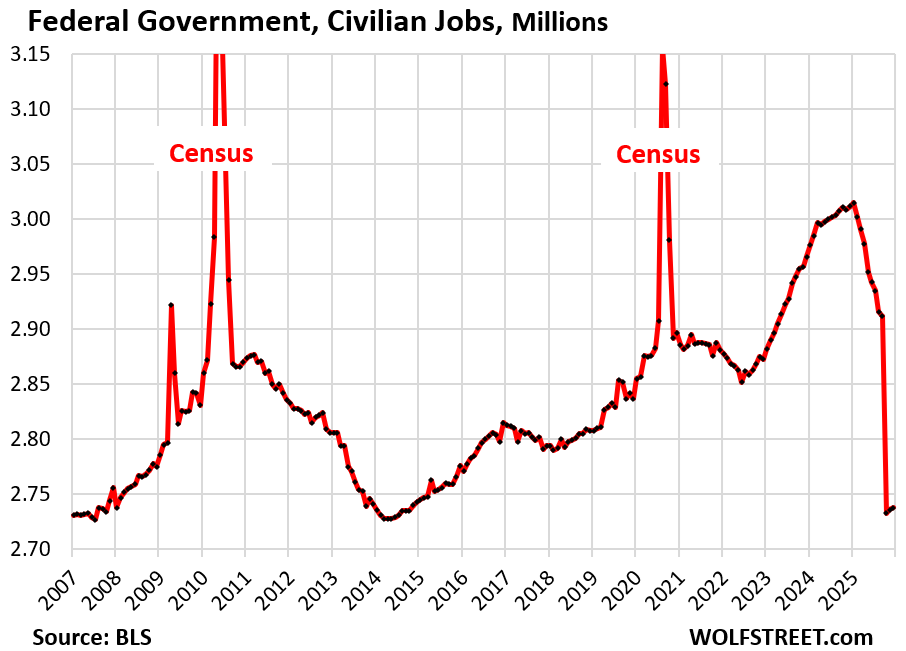
The Federal Reserve needs to look at private-sector jobs. Layoffs at the government impact consumers and the economy, obviously. But those layoffs are a political decision by the White House, and are not the result of weak demand, slow consumer spending, or other economic changes. The Federal Reserve can do nothing to stimulate hiring at the federal government. So for its monetary policy decisions, the Fed should look at private-sector employment.
State governments shed 45,000 jobs in 2025, including another 7,000 in December, after the surge in the prior two years.
State government jobs are dominated by jobs at state universities, which are huge employers. For example, the University of California system employs 267,000 faculty and staff (data via University of California), nearly half of the state government’s total employees of 551,000 (data via BLS).

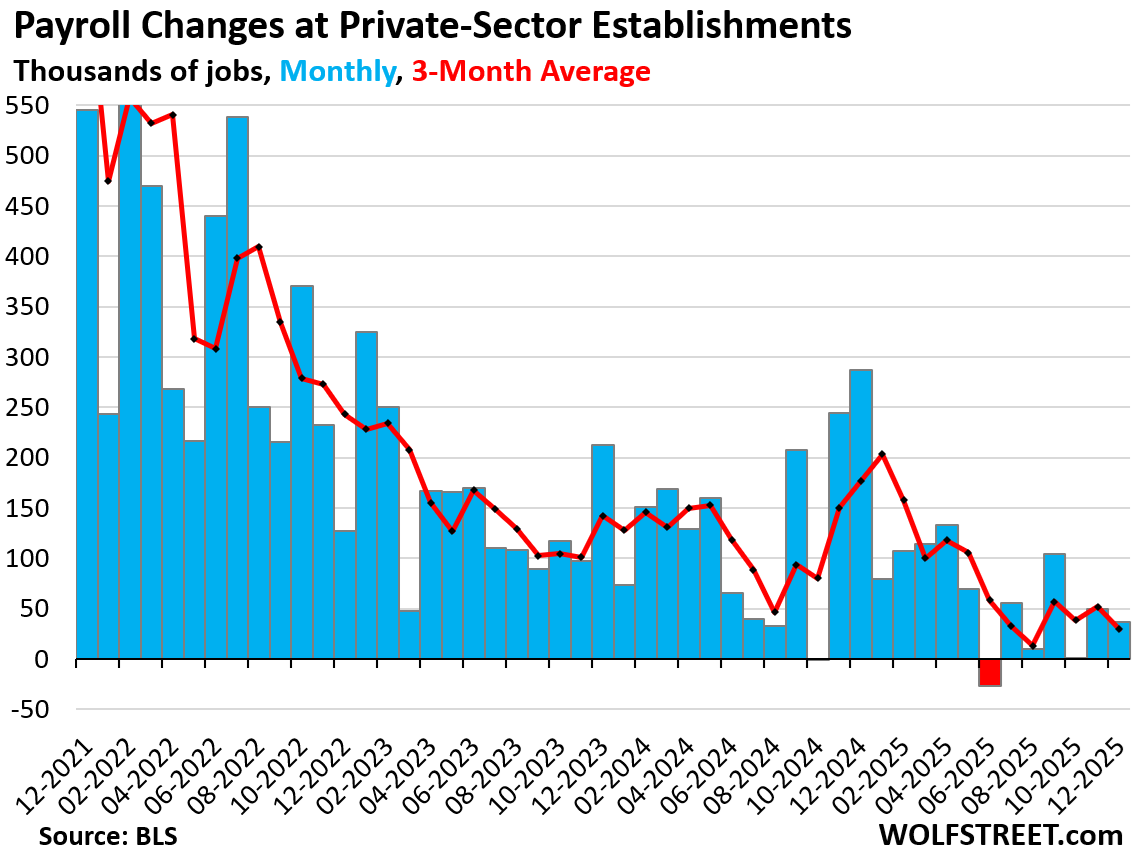
Job creation in the private sector has been weak, but positive in recent months.
Nonfarm private-sector jobs rose by 37,000 in December and by 50,000 in November. Over the past three months, they rose by 88,000 combined (even as total payrolls dropped by 67,000 over the same period).
The three-month average in December rose by 29,000 jobs (red line):
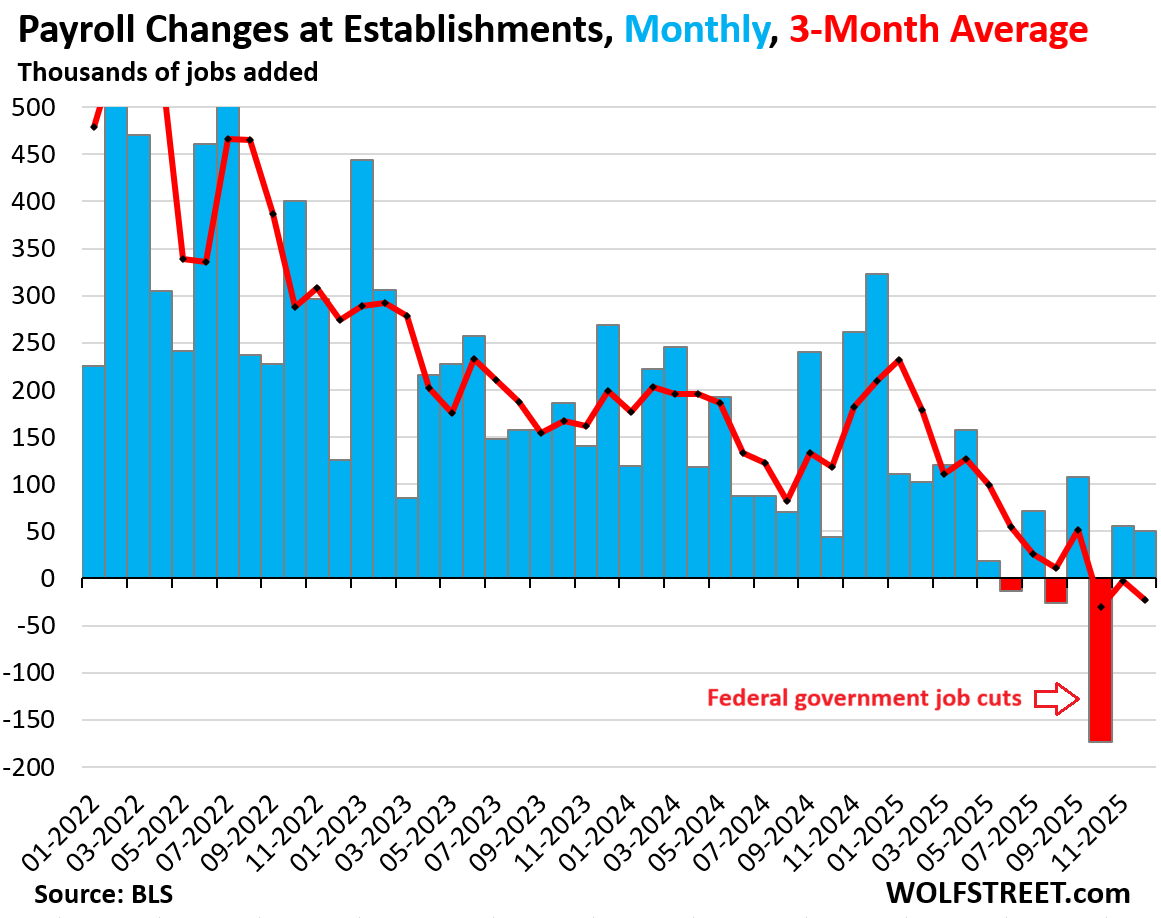
Total nonfarm payrolls, including government employment, rose by 50,000 in December from November.
October had been hit with the 179,000 federal government job cuts, which had caused overall nonfarm jobs in October to plunge by 173,000.
For the past three months combined, total nonfarm payrolls lost 67,000 jobs; the three-month average job loss in December was 22,000 (red line in the chart below).
Average hourly earnings rose by 0.33% in December from November (+4.0% annualized).
Three-month average hourly earnings rose by 4.1% annualized, at the top end of the 12-month range (red line):

Year-over-year, average hourly earnings rose by 3.8% in December.

The Household Survey data in the Jobs Report.
The above data is from the survey of establishments, which submit much of the data electronically every month. So a lot of the October data was collected, and the BLS backfilled it.
But the data below on the unemployment rate, labor force, etc. is collected via surveys from households. Surveys were not conducted in October during the government shutdown, and the data is missing forevermore. The November and December surveys were conducted.
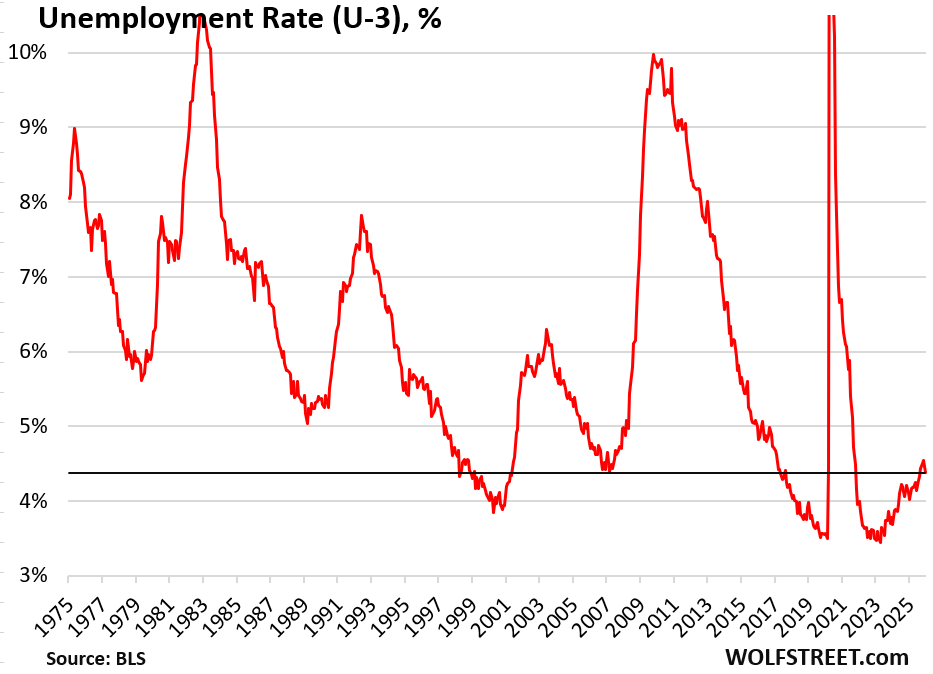
The unemployment rate dropped to 4.38% in December, the lowest since August – at the low end of the historical range.
The unemployment rate reflects the number of unemployed people who are actively looking for a job divided by the labor force (people working or looking for a job).
The decline in the unemployment rate was a function of declines of both, the unemployed and the labor force:
- Number of unemployed: -278,000, to 7.50 million, lowest since August.
- Labor force: -46,000 to 171.5 million.
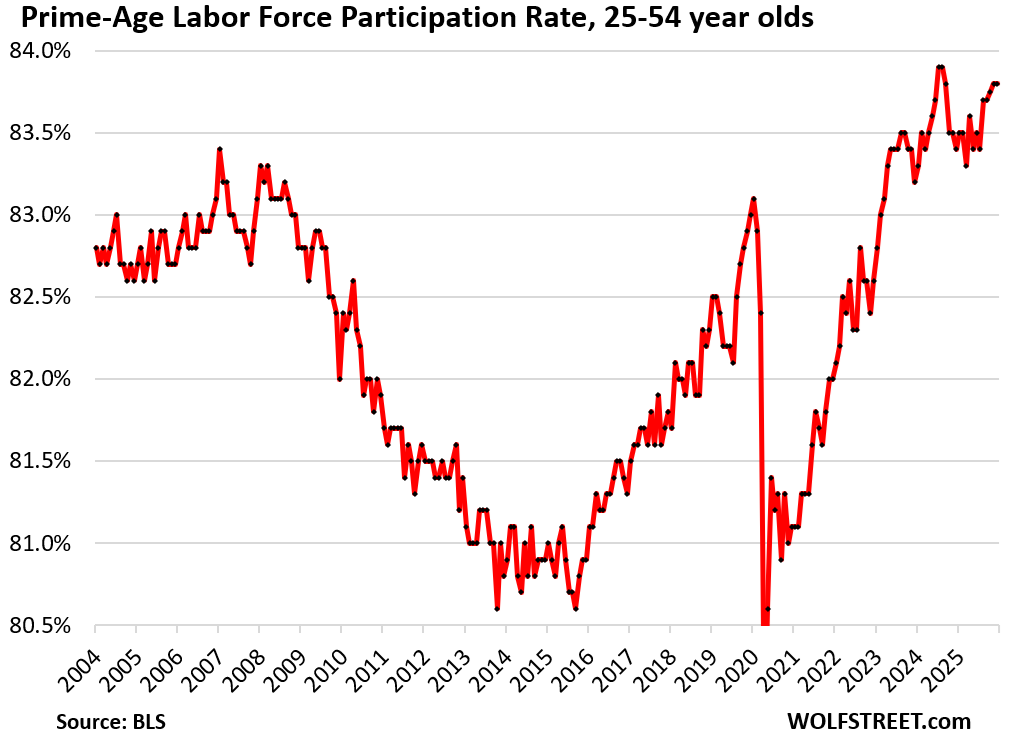
The prime-age labor force participation rate (25-to-54-year-olds) remained at a historically high 83.8% in December.
The prime-age labor force participation rate eliminates the issue of the retiring boomers. The overall labor force participation rate shows the percentage of the population that either has a job or is looking for a job. When people retire and stop looking for a job, they exit the labor force but remain in the population until they die. The surge of boomer retirements, which started about 15 years ago, has pushed down the overall labor force participation rate, as these retired boomers are still in the population but no longer in the labor force.
This very high prime-age labor force participation rate is a strong positive in the labor market.
Enjoy reading WOLF STREET and want to support it? You can donate. I appreciate it immensely. Click on the mug to find out how:


I read several reviews about the employment numbers and Wolf was the only writer that had an honest analysis. Other purposely omitted or just too lazy to do the work. Wolf is a national treasure.
100% agree.
As best as I can tell Wolf is apolitical.
He just helps us try to understand the numbers.
Wolf said, “The job losses at the federal government and at state governments have hit nonfarm employment all year, and hard. In 2025, the federal government shed 274,000 jobs, and state governments shed 45,000 jobs, combined 319,000 jobs, according to the Bureau of Labor Statistics today.”
The recessionary effects of the loss of 274000 solid government jobs would normally trigger an appropriate response. But no, we all are keeping our mouths shut because big tech is spying on us, a so far legal peeping tom.
Howdy Ervin. The Lone Wolf is AOK. Taught this old fool quite a bit…..
Thanks Lone Wolf…
And sadly political slant and tribalism has taken over reporting information and even sadier has been mostly taken over by liberal slant (I voted for obama and clinton so slow your roll) – yes large federal and state government hiring was unsustainable especially in blue zones that added large increases to social services offered as well and sadly we are not even in a recession yet as they keep spending (California increases their budget for next cycle by 39 billion).
While that may be true, it’s relevance to Wolf’s article is questionable.
Wolf Street Journal beats Wall Street Journal on most days!
I agree ! sort of, mostly, kind of, sometimes ……
Dang,you will fit in great on 4 chan business!
Economic weakness is one symptom of employment losses, Wolf, but the multiplier effect of job losses whether in the public or private sector is another probably larger indicator. The absorption rate of the public employees into the private sector will be interesting particularly if many of the furloughs were buoyed by comfortable severances.
Comfortable public sector employee severance package!? Wait why wasn’t I informed of this? Jk, but seriously, my experience as a federal-grant dependent biomed researcher has been overworked and underpaid. The fear among my colleagues is palpable and many are taking early retirement or returning to their home countries. One the brightside I see strong growth in the biomed industry
Maybe maybe not but to say that large hiring increases by state and federal governments ballooning budgets the last 5 years would not have to unwind is childish – and most are on track to spend way more this next cycle (CA 39 billion increase up to 10 billion deficit) is a bad sign when we do really have a recession
Well said of the practical understanding of the relationship between the concentration of well paid blue collar workers and government employees in a big fish in a small pond environment.
The loss of our government employees, the kindest group of people is temporary. A new government seems likely to be selected during the mid-terms whether only the House but also the Senate.
Unfortunately, the democratic control of both the house and the senate are from New York and are not about to oppose the financial schemes that have swindled America.
Private employment grew by 700k this year, down from non-recession averages of 1.5 to 2 million in the last decade or two. And in the 8 months since April, it’s only 300k.
This would ordinarily be extremely weak, but as we’ve discussed here before, the 25-54 employment rate is still very high and the unemployment claims are very low.
So the new normal continues: very slow job growth, but no increased unemployment, which (assuming the data is now correct) means very slow population growth.
“Private employment grew by 700k this year, down from non-recession averages of 1.5 to 2 million in the last decade or two. And in the 8 months since April, it’s only 300k.”
Pretty accurate.
But it should be mentioned that pre-2002 (China Entry) 2 million net new jobs per year was very common (in non-recession years) and…more importantly, it didn’t take the 2012-2022 ZIRP’ing of interest rates to generate those 2+ million jobs year in and year out.
Even leaving aside housing bubble/bust 1.0 and the pandemic, the US labor markets have been pretty darn weak (relative to 1950-2000) – so the Mystery of the Pissed Off American really isn’t much of a mystery.
But you would basically never learn about these things from the Old Media.
Population growth in 2025 was very small — and some estimate that it might have been negative due to deportations and self-deportations. So how much does the job market need to grow when the population is growing only very slowly? You cannot compare that to decades ago when population growth (through births and immigration) was far bigger.
Well, I agree. My economic education became obsolete at roughly the same time. Pre-China.
Adam Smith is clear in his memoir that under no circumstance should a country allow the merchant class to determine economic policy
The usual suspects have been cherry picking old Adam Smith for decades now, which is why his observations of the sort that you shared so rarely see the light of day, let alone that Smith considered himself first and foremost to be a moral philosopher.
Accordingly you can rarely go wrong by keeping in mind JK Galbraith’s quip:
“The modern conservative is engaged in one of man’s oldest exercises in moral philosophy; that is, the search for a superior moral justification for selfishness.”
EG,
Sure…but the Left might be viewed better by the general public if there weren’t so many “non-profit” employees making 6 figure salaries – frequently lecturing much harder working people making 50% or less of “non-profit” salaries about “greed”.
If the health care and education industrial complexes honestly cared about the liberalism that they have performatively postured about for 60+ years, those sectors would not consume the enormous amounts of GDP that they in fact do.
Doctors would not be the richest class of proessionals by far, tenured college professors would not be earning six figure salaries for 6 in-classroom hours per week (for 36 out of 52 annual weeks).
The palpable phoniness of the Professional Left plays a very big role in turning the majority of the country against more liberal solutions/institutions – who the public sees as mostly just “talking their book” while basically just play-acting larger societal concerns.
If the Left truly cared about the “unaffordability” of medical care and education – they could immediately take pay cuts to address the situation. Immediately – no DC action required.
But what actually happens in practice is that the Professional Left endlessly lobbies for ever greater subsidies, financed by an ever more debilitated macro-economy, dangerously propped up by money printing that harms lower earners the most.
We received a “second notification” of a BLS jobs survey in the mail for our startup, never received a first notification, though the USPS delivery may be why. I went online to complete it. The NAICS designation was in our letter, but online was “NAICS 11111” and there was no where to upload the spreadsheet template that contains: job title, hourly wage, number of jobs. I get the sense from other’s replies to these workforce analysis posts, that govt. employees are expendable.
… Erika McEntarfer
Ringo – “there was no where to upload the spreadsheet template”
Your problem is normal becasue you’re supposed to enter your data MANUALLY online – The spreadsheet is for your prep work.
Misreading the instructions isn’t the government’s fault; it’s a user error.
This is basic compliance stuff, not a mystery.
Good luck with your startup.
There’s a new yard sign gaining popularity with the DOGE crowd.
“Government workers and dogs, keep off the grass”
Typical of my understanding of the DOGE ethos. Which I disclaim any responsibility for reporting the public opinion of them:
“Entitled p and c ‘s, eager to get rich willing to do anything. Sociopaths which I”
Government workers are usually very skilled with high level understanding of available tech and understanding of resolving problems. Should they not be well aqualified for work in the private sector? I see them as an asset waiting to be used by the private sector.
I’m a contractor embedded in a government organization, and I haven’t seen any workers like those you speak of.
Or is my sarcasm detector broken?
I agree and think biomed industry is poised for a breakout
What are you smoking? Signed everyone that has had to get a private sector job and deal with public sector employees … I have for 30 years you are laughably and completely wrong …
Totally different views of the structure of an economic Goliath, the government workforce.
I come down on the side of the employees
the fruit of the tree. The mechanical competence that industry sells.
The govt workers that are highly skilled are the contractors. Most are now gone.
I appreciate the clarity and design of your charts and site. Subtle, efficient, spartan elegance.
Most economists lean towards no recession in 2026.
Those big government layoffs?
That’s POTUS taking bold action to finally trim the bloated DC bureaucracy after decades of fiscal mismanagement and kicking the can down the road by past admins.
Naysayers screamed that his bold policies would tank the economy, but he’s righting the ship with smart risks that cut waste today while setting up stronger growth for years ahead—proving the critics wrong without dropping the ball on current stability and growth.
No recession?
Well we’re due buddy. 2022 called. Said it’s been 3 whole years.
📞, pick that up.
Cuz it says stock loss! 📉
It’ll be ok tho, just prob will erase any 2024 and 2025 gains. You know for a nice fresh start! ☀️
You’re trying to tell a cult member that their deity is a crackpot and scam artist, that almost never works. Eventually, you’ll get to say “I told ya so”, but it will be cold comfort. As the smart people say – hedge accordingly.
@Sufferinsucatash – 📞, pick that up.
@SANDY – You’re trying to tell a cult member
Sandy – Name calling — so predictable – Rachel Maddow is taken, sorry. Nanny Nanny Nanny – Weak
Sufferinsucatash – Three years of “any day now” isn’t foresight — it’s just waiting around, hoping the clock bails you out.
Naysayers also said these were economic WMDs that would blow everything up immediately: OOPS
Broad tariffs — supposed to spike prices and ruin Christmas. DIDN’T.
Trade war with China — allegedly economic suicide. NOT.
Regulatory rollbacks — warned it would unleash chaos. NOPE.
Tighter immigration rules — predicted labor collapse, dirty houses, uncut lawns, runaway inflation. NADA, Señor.
Oh, the economy’s about to crash? Funny — prices stayed steady, jobs held up, and the stock market just keeps hitting record highs. Looks like the “doom” missed the call.
Just one man’s POV – BofA CEO Brian Moynihan, says: “We see a robust U.S. economy next year, driven by strong fundamentals and contributors like consumer demand and AI investment, with markets valuing that future growth.” But hey – Hedge Accordingly…
And those who cry crash, reset, recession EVERY year, then pat themselves on the back when it finally happens, still sit on the sidelines missing the bounce — just like they missed the last three years of growth.
So keep dialing “I told you so” as eventually is right around the corner, it’s Sandy.
This is a really stupid post. I’m not sure who it’s directed to, as I don’t think anyone who reads this forum is “on the sidelines,” but most of the “growth” in the past year or two is based on AI hopium. It certainly hasn’t been general growth that has improved the U.S. economy as a whole. Nearly all of what we have had has inured to the benefit of the top 5–10%, which is why the economic mood is so lousy.
Inflation is still at 3%, housing is still unaffordable, and health care and child care are a big problem.
If this is what you call a “good economy,” I’d like to see what you call a bad one.
Most economists are not any better at predicting the future than any of the rest of us. The business cycle doesn’t much care who is President. There is a massive bubble building in US stocks, it’s as plain to see as it was in 2001 for anyone who is paying attention. It could go on for 6 months, or 1 month, or 3 years, no one knows, but bubbles inevitably pop. Hedge accordingly.
The Financial Industry Regulatory Authority (FINRA) and the Securities and Exchange Commission (SEC) should raise margin requirements.
I know, these prices are ridiculous.
It’s just animal spirits bidding them up and a whiff of something wrong will send the hordes for the exits. 🏃🏼➡️🏃🏼♂️➡️🏃🏼♀️➡️
Happy1 – no one knows
That is exactly right – no one knows but most projections for 2026 are bullish.
And losses don’t just come with a crash.
They also come with all the upside you missed by a panic hedge.
Sure hedge away – as needed and SWAN but hedging isn’t exactly savings 100%.
2026- Bullish forecasts galore.
When all forecasts are bullish is exactly when you should worry.
Do you really think an economy is strong when 75% of the people think it sucks?
“cut waste”
I’d suggest you read some other articles on Wolf’s site. The only difference between the current administration and the last one with regard to spending is where they’re spending. Which side you sit on in the culture wars will decide whether you support one approach or the other. Neither is smart economics.
Rick Vincent – I’d Suggest.
Thanks, I have read.
My mention of cuts?
Like the federal roster — billions trimmed, waste gone, spending smarter, not on DEI or fluff, but on what actually delivers.
Add AI and fed IT modernization and we are out of the dark ages and more efficient than ever. Go Elon.
POTUS’ spending is INVESTING not splurging like a teenager with dad’s credit card and expects ROI beyond re-election.
What a laugh,
He wants to increase military spending by 50% (half a TRILLION) despite the Pentagon not being able to pass an audit 8 times in a row.
Interesting how DOGE completely ignored Pentagon and DoD. That’s the honey pot where a lot of waste is and yet appears you (and they) are-ok with it.
Please, wave your red pom-poms elsewhere. We deal in the real world here.
I think that the economic question is philosophical about what kind of America are we willing to tolerate.
Pharoah had better labor participation rates: The old men folks were stomping straw in the mud pits making bricks, old women were applying grease so that megalith stones could be slid into place. The final full employment was achieved by denying the “employees” straw to make bricks, leading to the order: “your women and children will glean the fields for stubble at night, but you tally shall not diminish by one.” Full employment and full shift employment as well, the Federal Reserve’s dream. Labor participation was so high that Moses had to fix it. Reference: The Ten Commandments movie.
Bullish take; new highs, Stock market continues with trying to broaden the companies participating in the bull. Yen made a new 52 week low. Willshire 5000 close out at 69,650. 69,000 was a quad top for resistance now it’s support, but we are less than 1% above 69Trillion on the willshire, so not to confident.
Bearish take. Majority greater than 75% of the trading days have sold red the last 15 minutes of each trading day. This is a bad sign. Institutional and smart money are selling the close for weeks now.
Buy the rumor sell the news with SCOTUS tariff? At close today and for week we had exactly 66.6% of SP 500 close above their 200 EMA according to StockCharts.(bearish IMO) I am still in 36 year cycle of the super bear like Japan 1989 and we had Panama 36 years ago. History is saying hello, pay attention to me! Enjoy :)
There is no time in history that the stock market valuation has been so dear
A collapse is just as likely as new highs IMO because the valuation model evolved from the sober discounted cash flow model into the greater fool model.
I think that is indicative of excess liquidity.
“Layoffs at the government are a political decision, not the result of economic weakness.”
and also an excuse to push for lower interest rates.
Didnt hear much about the 4.4% unemployment rate and any questioning of the rationale behind the last cut. Lower unemployment and higher GDP……..Meanwhile, Bessent calls for more cuts. Inflation may ease, but the harmful embedded pricing remains.
US market valuation as measured by Case Schiller PE ratio is nearing all time high. The market is priced for perfection. History suggests that the next 10 years will have much lower market returns. As to how or when the change begins, no one knows, it’s impossible to know, but people would be wise to hedge a little in this environment, at least if they are depending on income from investments in the next 10 years. There is an entire generation that has no memory of the lost decade after 2001, and the Fed has conditioned everyone to “buy the dip” because they will crush all alternatives to the stock market at the slightest dip. I would suggest that cannot continue indefinitely.
At some point, you crush all alternatives and foreigners are no longer willing to buy our debt, which would be the end of the Fed’s power.
Is there any data on ‘job quality’? I’ve seen a lot of comments about the gig economy and white-collar layoffs, but it’s hard to tell if they’re true. Are these workers actually becoming Uber drivers and the like?
The top two-thirds of the article, through the hourly-wages part, tracks employees employed by nonfarm companies and governments. Gig workers are not included. This data from the establishment survey (data from companies) that tracks employees not gig workers.
Gig workers are included in the lower one third of article. That data is from the household survey, which tracks all workers, employees and gig workers, farm and nonfarm. This data produces the stats on the labor force, the number of unemployed, the unemployment rate, the labor force participation rate, etc.
QQQ a triangle ? SPX might rise to 7.1K/7.2K, before dropping 1K pts
to the 6,200 area. No recession. If it’s A-B-C down: SPX [1M] RSI will
enter negative territory 17Y/ 18 years after Feb 2009 and stay there
for a while. 17Y from 1932 to 1949. 17Y from 1949 to 1966. 17Y going
sideways. 17Y from 1982 to 2000 and 17Y from 2009 to 2027.
Often the most unpredictable events are the most formative in determining the course of ones life
There’s always rules. Plenty of social platforms started with a no rules philosophy (free speech!) but very quickly pivoted to removing speech they didn’t like.
Finding the balance between not enough rules and too many rules is Achilles heel of every ruling administration.
SPX can rise in 2026, after testing 2025 high. No recession in 2026/27.
SPX [3M], after reaching #9 in Apr 2025 (June close), can cont up for years.
Not at all disputing Wolf’s overall take on the resilience of labor and the economy, but decoupling public/private payrolls is complicated.
On the one hand I agree with the assessment that public sector “layoffs are a political decision by the White House, and are not the result of weak demand…”. On the other hand, those public workers have to wind up somewhere, either in retirement or on private payrolls.
I was speaking to a talent acquisition person just last night who made the anecdotal case that while the hiring freeze (still in place) means they can only shuffle existing public workers between one position and another, “essential positions” were being filled with more contractors without any real reductions in headcounts. I wonder if some of the private sector health is a reflection of this.
I had trouble finding details on month to month changes in contractor employment but did come across an OPM letter from late November titled “Everyone Has a Plan – Until You Step Into the Ring”.
It contains gems like that the contractor workforce is 2x the size of the public employee workforce at 3x the cost. Another line states “we have expanded our use of contractors well beyond [prudence] and have a permanent shadow class of FTEs essentially cloaked as contractors.”
When I worked in IT at a big bank, it was similar. We had a guy making over $1000 a day who had been there for ten years. Yes, he was very, very good, and was the key man in many important areas. When new management came in, they decreed that contractors were to be limited to two years.
asset price drops DO lead to lower rates
Gold, commodities, coins, market, housing.
✅ Demand-driven or financial stress downturns
Examples:
• Stock market crashes
• Housing busts
• Credit crunches
Typical response:
• Central banks cut rates
• Bond yields fall
• Investors seek safety → Treasury prices rise → yields drop
2008 and 2020 are classic cases.
The U.S. job market has flipped for a long time— offshoring gutted factories, AI and automation are replacing routine work, Gen Z chases flexibility priority, and the population pyramid is upside down with boomers retiring and prime-age labor shrinking.
Yet we still measure jobs and unemployment like it’s the 1990s —
Payroll surveys, household interviews, even phone calls (who answers those?), missing gig work, remote roles, and flexible arrangements.
The numbers get questioned, corrected months later, and politicized — while the real workforce moves on.
This process needs some attention for sure so more debate to follow.