
The GDPNow algo is to be taken with a teaspoon of salt, but it shows that a big improvement of the trade deficit pushes up GDP growth.
By Wolf Richter for WOLF STREET.
The US trade deficit in goods and services dramatically improved in October, with the negative trade balance improving by $19 billion in October, to $29 billion, the least terrible trade deficit since 2009, according to data from the Census Bureau today (all figures are seasonally adjusted, but not adjusted for price changes).
The huge US trade deficit has for decades been one of the factors weighing on economic growth. The trade deficit (negative “net exports”) reduces GDP growth. October’s much smaller trade deficit will have a positive impact on Q4 GDP growth. Conversely, the huge spike in the trade deficit in early 2025 was a big factor in pushing GDP growth into the negative for Q1 2025.
Exports of goods and services in October rose (improved) by $8 billion from September, to $302 billion, while imports of goods and services fell (improved) by $11 billion to $331 billion.
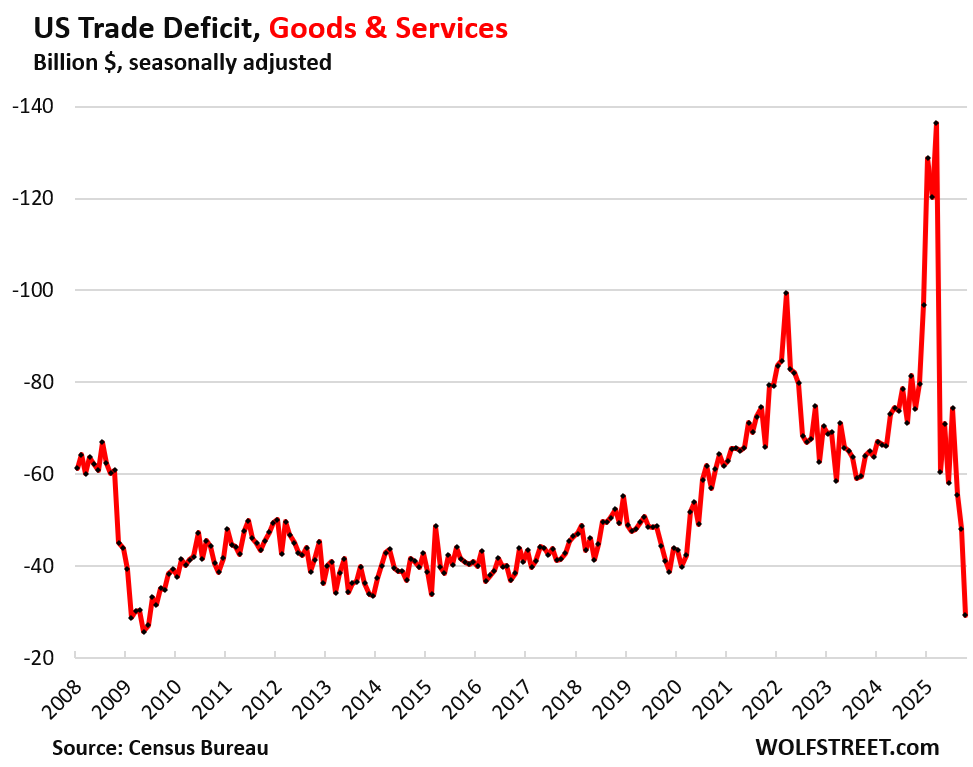
This improvement in the trade deficit in October and prior months comes after the huge spike of the trade deficit in January through March 2025.
The spike in Q1 was caused by:
- Efforts to frontrun the tariffs, especially with pharma products.
- Massive imports of nonmonetary gold (gold that investors buy).
But trade of nonmonetary gold is considered an investment, such as stocks, and is not included in GDP, though it is included in the raw trade data here under “industrial supplies.”
So the gold imports didn’t impact Q1 2025 GDP. And gold exports, currently running at a high rate, won’t impact Q4 2025 GDP either.
Year-to-date, the trade deficit was $783 billion, still $56 billion worse than a year earlier, after the huge spike in the first three months of the year, including the massive imports of nonmonetary gold at the time.
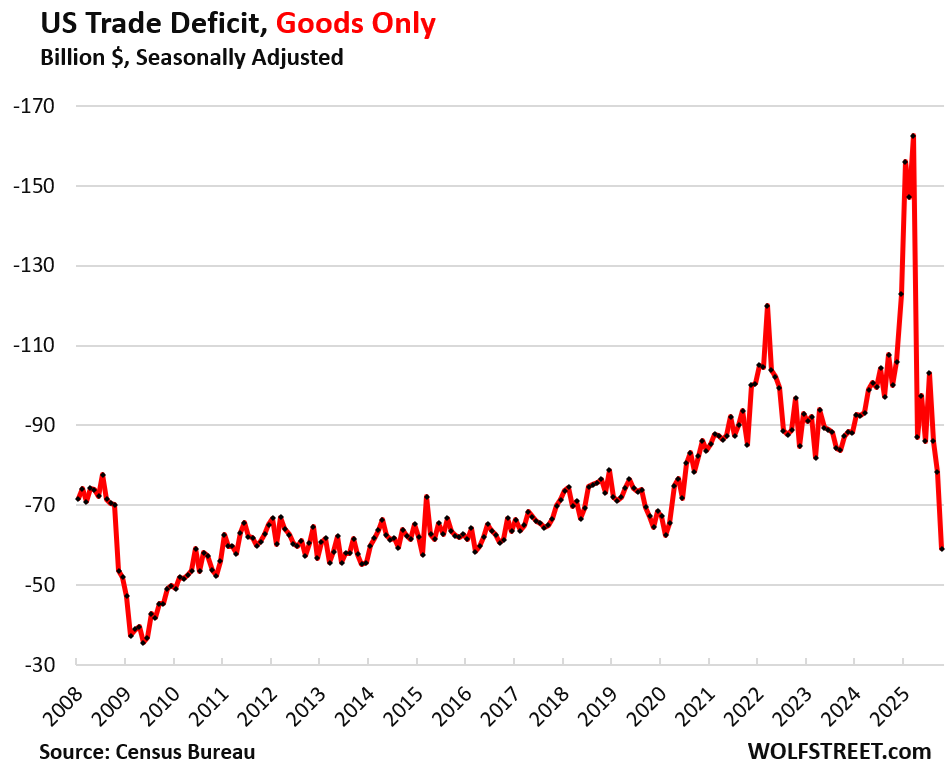
The trade deficit in goods improved by $19 billion in October from September, to $59 billion, the least terrible goods deficit since March 2016, seasonally adjusted, but not adjusted for price changes.
Exports of goods increased (improved) by $7 billion to $196 billion. The increase in October was due to the surge in exports of nonmonetary gold, which won’t count in GDP
Imports of goods fell (improved) by $12 billion in October from September to $255 billion, with:
- Pharmaceutical products: -$14 billion
- Industrial supplies: -$3 billion, including -$1.3 billion nonmonetary gold, which won’t count in GDP
- Capital goods: +7 billion
Year-to-date, after the gigantic spike in January through March, the goods trade deficit was still $76 billion worse than a year ago.
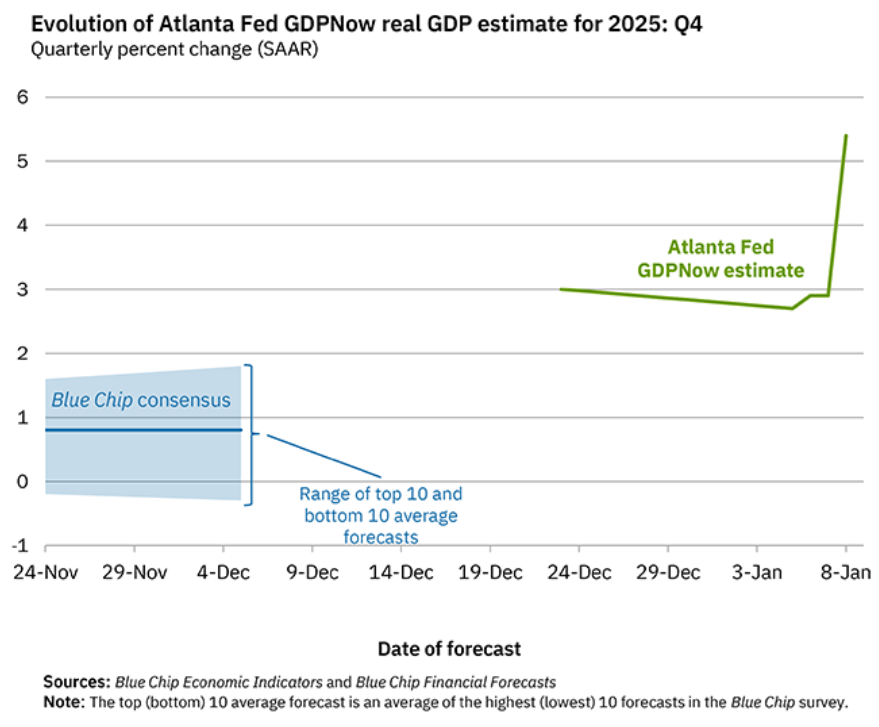
The Atlanta Fed’s GDPNow, after taking in today’s trade data, doubled its forecast for Q4 GDP growth to +5.4% today, from +2.7% two days ago.
The GDPNow algo is to be taken with a teaspoon of salt, after the trade of nonmonetary gold blew it up in early 2025.
But this is the new and improved GDPNow, which is supposed to account for the gold trade properly – but maybe they didn’t get the new version right either.
No way that Q4 GDP growth will be 5.4%. But this is just the beginning of the delayed flow of Q4 data. The GDPNow algo takes in the data points of Q4 as they’re released, and so the GDPNow estimate for GDP growth in Q4 will change over the next six weeks.
The Bureau of Economic Analysis, which is in charge of the actual GDP calculations, will release its first estimate of Q4 GDP on February 20. That’s the figure that the Atlanta Fed’s GDPNow attempts to forecast.
But what the Atlanta Fed’s GDPNow algo does show is that a big improvement of the trade deficit pushes up GDP growth substantially.
Enjoy reading WOLF STREET and want to support it? You can donate. I appreciate it immensely. Click on the mug to find out how:


Tariffs work.
It’s just a Zig zag, we can get the trade deficit down but down the road their will be less trade surplus $usd being reinvested in out markets and that will hurt for decades. We are on new money fumes coming in now, all quiet before the plunge is what it feels like to me. The Supreme Court tariffs decision may pop the market if they rule them illegal but it will be short lived when $tnx spikes( Zig Zag) as a result of less money coming into our treasure department. Supreme Court outcome is a wildcard honesty can’t even guess what will happen, feels like a black swan setup. A $vix close above 18.52 should be the start of the risk plunge unless Supreme Court market put happens before market opens. Any day now fireworks, guessing rabbits out of the hat are running low.
New money fumes is a heck of a way to spin corporations offshoring labor to dirt poor wages in developing countries. Tariffs are balancing the scales in our favor after having been shafted by the previous few administrations.
“trade surplus $usd being reinvested in out markets and that will hurt for decades”
I think that China’s trillions in accumulated trade surpluses from the US mostly got “reinvested” into US Treasuries – manifesting *three* friggin macro pathologies…
1) *Decades* of hugely imbalanced trade that Chinese domestic policies were designed to keep in place indefinitely/until the US industrial economy completely collapsed,
2) That “recycling” of Chinese trade surpluses into US Treasuries did little more than feed DC’s 55 year heroin addiction to deficit spending…by enabling it…the same way a pimp “turns out” new whores (see US Congress)…by getting them addicted.
3) Chinese foreign direct investment into the US (read US job creation) was dwarfed by that US Treasuries pimpery *and* US FDI into *China* (thereby financing/building Our Master’s House)
SCOTUS will likely end the tariff festival
Not it wont. It’s only the tariffs under IEEPA that are at risk in the case. None of the tariffs based on other laws are included in the case. The administration has already outlined how it will replace the IEEPA tariffs with new tariffs based on other laws, in case of a negative ruling. In the end, it won’t look much different.
Are you rooting for China?
Its too easy to look at things and say this is good and this is bad. That being said, If I can speak frankly Tarrifs against China are good Tarrifs against Canada are very bad in my opinion, Canada fought beside us in every major war since WW1. After 911 Canadian flew old glory behind their pickups and next to their maple leaf flag. To the Canadians readers you are my brother and sister and I respect you! Because I know you. Just from a money flow perspective our stock markets outperformed global markets because the ROW reinvested their USD in our risk markets. 10 or 20 years from now we will see evidence one way or the other. If the willshire 5000 underperform the Global Dow, that was one opportunity cost that tariffs cost us. I think tariffs are a tool to be used just not to force our neighbors up north to bend a knee. Or Europe to bend a knee. Freedom isn’t free but we need to respect our life long allies. China, Japan Germany to name few turned over a portion of their trade surplus dollars into $UST holding. My guess is they will buy less as their trade surpluses disappear. Give it 18 months before the lag in buying happens. Everything in this world is interconnected, change always creates more change. a Zig creates a Zag :) enjoy your time in this earth school adventure program. It last truly an adventure
“$usd being reinvested in out markets and that will hurt for decades.”
That is already happening, why else would they resort to tarrifs? Prediction: The supreme court will not reverse tariffs because the uni party needs to replace lost revenue some how.
I listen to the justices on the initial discovery. From what I heard with my own ears, it’s a done deal, 6 3 probably or 7 2! Refund 160b, that’s the number I believe that will be settled on. Will hopefully find out this week. Just not sure what the market will do. Is it baked in? Than disappointment comes. If by the long shot the SOTUS says legal than disappointment sets in. Either way, same outcome for risk! The canary is the coal mine $BTC may have already broadcast by failing to clear $94k for the third time. Strikeout? It’s just slow to walk back to the dugout, next stop 54k in 14weeks, Ha yeah I’ve said that the last 2 fails at clearing 94k. Tenacious is the last hurrah for risk!!!
Next batter up!
YoY GDP comparison are dumb. It doesn’t decouple bad things that happened last year from good things that happened this year.
No one should be celebrating with less than a year data. Only the media is dumb enough to not track this things over the long term and do a proper retroactive analysis 5 years later.
Don’t be the media.
taxes raise government revenues, duh.
yes, taxes on imports raise government revenues and discourage imports. Now remind us all how the U.S. crawled out from under the post WWII debt? That is the only other time the U.S. has had similar debt to GDP numbers.
Manufacturing and a space race? I wouldn’t mind either of those.
I’ve seen plenty of info in the last year on how we don’t even possess the tools, or have the know-how, to manufacturer anymore. Our economy is set up to design things for fabrication elsewhere. True for most industries… try to find a US die or screw manufacturer.
I think we need to do even more to invite foreign manufacturers here for technology transfers, like the TMSC fabs. I’d even invite Chinese automakers over, on the condition that they manufacturer here and we get to share their technology.
Sounds like a boon for commodities and energy, but no, that’s not all. go look at what the tax rates post WWII.
So, I guess you believe the debt doesn’t matter. Good luck with that Take look at what tax rates were post WWII
Be careful about that, with no domestic automakers left to protect Australia is the Wild West for cars and the Chinese are really selling well. BYD’s everywhere.
Taxes. No one took the bait!
President Trump, late Sept. 25, announced that starting Oct. 1, the U.S. will impose a 100% tariff on any branded or patented pharmaceutical product, unless a company is building its pharmaceutical manufacturing plant in America.
Seems like these kinds of things ignore Trump is gone in a few years and also ignore supply chains. I honestly ignore anything that has a significant runway and makes little sense.
Thanks again for the insightful commentary and for highlighting the impact of nonmonetary gold again.
Can anything be seen in the numbers to point to a potential large jump in imports in 1Q26 caused by businesses attempting to postpone next year purchases until after the SCOTUS ruling on tariffs?
It seems there are consensus concerns that:
1. If a ruling is against the WH, there is a good chance that the administration has contingency plans, but that there is a good chance rates may overall lower.
2. There is speculation that SCOTUS will not offer refunds, but the ruling will apply moving forward.
3. The timing and difficulty of claiming a refund incentives companies to attempt to wait-and-see rather than import now and claim a refund post ruling.
4. There appears to be market expectation that tariffs related to the 1977 International Emergency Economic Powers Act tariffs are more likely to be impacted than the fentanyl-related tariffs
“large jump in imports in 1Q26 caused by businesses attempting to postpone next year purchases until after the SCOTUS ruling on tariffs?”
SCOTUS is expected to rule tomorrow (Friday), and if it does, it would be at the beginning of Q1, and we’ll see tomorrow what that ruling entails and how it might impact things.
SCOTUS
So
Count us
Out of
Trying to Save
U from
S**t
basically a Supreme Court from a Tarantino flick
“Usually I’d blow this mofo away, but lately I’ve been contemplating my life”…
🤣
Try again on January 14?
Wolf – do you know off hand approx what % of tariff revenue is under IEEPA?
I think you talked about this in another article, but can’t recall which one.
Thanks
Maybe about 60% of the tariff revenues.
Tariffs are a form of taxation on corporations. Many corporations have had extremely high profits recently. And just like corporate income taxes, companies can try to pass those costs on to the consumer, try to get their suppliers and subcontractors to reduce their costs, accept lower profits, or a combination of all of the above.
Consumers need to quit over paying for stuff they don’t really need.
If the SCOTUS declares the tariffs illegal, Trump should call for a corporate tax increase that targets executive salaries, stock buybacks, and companies that outsource all their production to other countries. And a special tax on the use of leverage to game profits by certain investors.
Maybe just a special tax on the Mag7? And higher taxes for members of Congress and the Fed.
The corporate media and the “experts” will cry and moan, and probably a lot of other commentators on this site. And probably not get passed because Congress won’t want to upset the big money funding them.
But I bet you it would be real popular idea with the average people who are not part of upper few percent who have been getting obscenely richer.
> Trump should call for a corporate tax increase that targets executive salaries, stock buybacks, and companies that outsource all their production to other countries. And a special tax on the use of leverage to game profits by certain investors.
All of which, of course, you can avoid if you personally deliver a gold plaque to the Oval Office.
Taxes: Mean, useless forms of oppression on muh freedumbs!
Tariffs: The saviors of our economy, best things we’ve ever done.
– The GOP
My understanding is that companies will have to apply for refunds, and the government can deny or reduce a refund if all or part of the cost of the tariff was passed to the consumer. Expect a slow process with a lot of appeals and lawsuits.
The distributed lag effect of monetary flows, the volume and velocity of money, the proxy for the real output of goods and services is 10 months. That flow has propelled the economy in the 3rd and 4th qtrs.
The first chart is somewhat challenging to read. The tick mark for 2025 appears to be aligned with APR, MAY, or JUN since as you note the first data point about 120k was JAN25 and the only three above that mark were JAN-FEB-MAR.
The previous month in DEC24 was also near the MAR22 peak. Were DJTs post election tariff threats causing folks to front load that early?
Whether tariffs are working is still to be seen it seems. The 12-mo moving average is has only return to the level it was in DEC24 and is approximately equal to the last peak in mid-2022.
So tarrifs are working?!
In so much as taxes do in fact raise government revenues, and tariffs are also taxes that also discourage imports.
One economist put it like this “when all is said and done I think the real numbers will show the trade deficit is as bad as it has ever been”
So I’d take all this with a grain of salt.
It seems pretty basic that putting a large tax increase on goods people buy from other countries will cause the trade deficit to trend lower. However it will take years to see if the alleged benefits, like US job creation, will then materialize, or if this will end up just being a tax increase on the consumer used by politicians to offset/justify increased spending or tax cuts for other groups in the future.
I have a question about the role of seasonal adjustment in the trade data for 2025. My limited understanding is that it is based on long trend observations, having to do with events like Christmas and vacation mostly, but also with “working” days in a month, etc.
Since 2025 was not like any other year in terms of trade, can we trust the seasonally adjusted data to faithfully represent what’s happening recently?