
Dropping gasoline prices since mid-2022 papered over big price increases in electricity and natural gas. But that’s over.
By Wolf Richter for WOLF STREET.
What kept overall energy costs from blowing out for American households over the past couple of years was the long decline of gasoline prices from the top of the spike that ended in mid-2022. But electricity prices have shot up, and utility natural gas has shot up. And now in March, gasoline prices have started to shoot up too amid soaring oil prices.
In addition, as the Strait of Hormuz remains blocked, foreign demand for US LNG (the US is the largest exporter of LNG in the world), US crude oil, diesel, gasoline, and jet fuel (the US is a big exporter of those products) could further drive up domestic prices of gasoline and natural gas. So we have to keep an eye on energy inflation more broadly.
The average retail price of gasoline, all grades combined, at gas stations in the week through March 9 spiked by $0.49 from the prior week, and by $0.73 from early January, to $3.63 a gallon, the highest since June 2024, according to EIA data. Compared to a year ago, gasoline is now up by nearly 14%, having flipped from many months in a row of year-over-year declines.
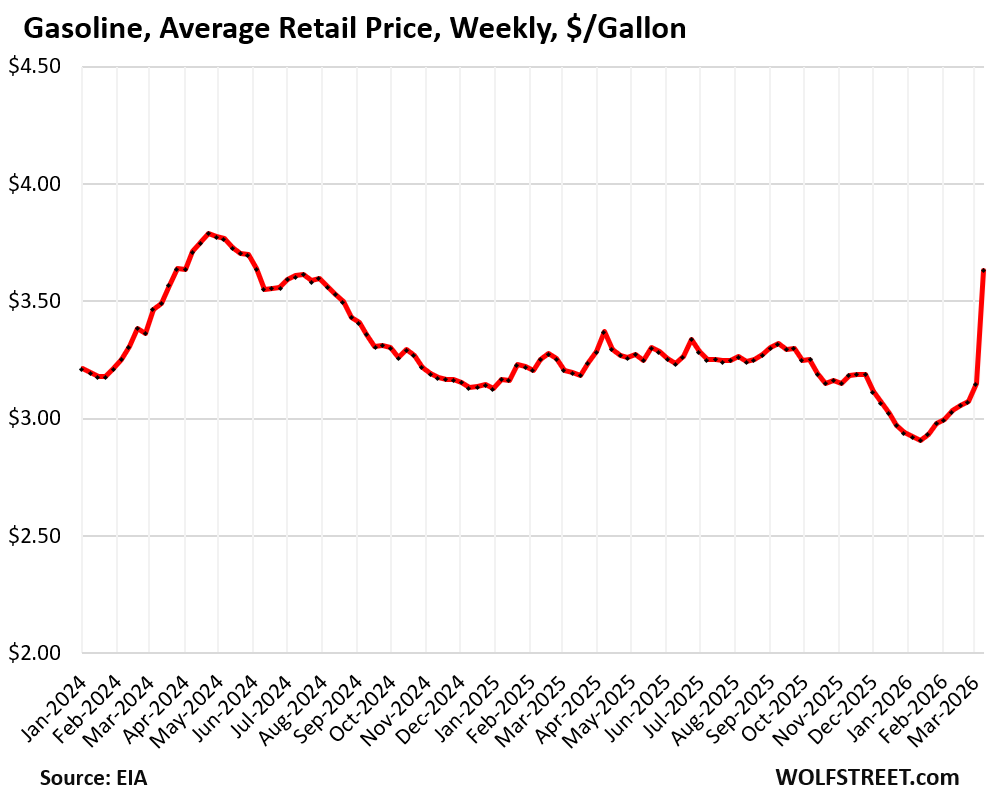
Gasoline prices started rising in mid-January, then leaped in early March, and spiked in the week ended on Monday. These price changes in March will be reflected in the inflation indices for March, to be released in April:
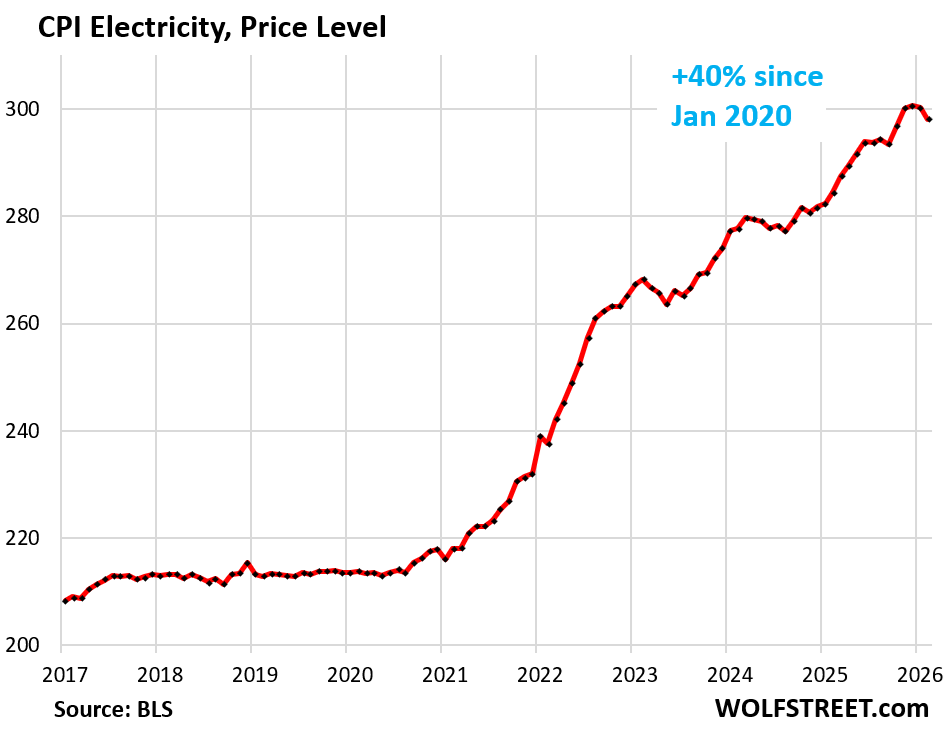
The increase in February of the price of gasoline has already entered into the CPI for gasoline, which jumped by 3.3% from January, not seasonally adjusted, and by 0.8% seasonally adjusted, according to the Bureau of Labor Statistics yesterday.
This increase in February reduced the year-over-year decline to -5.6% (from -7.5% in the prior month).
It is this long wobbly decline from mid-2022 through early January 2026 that contributed to cooling inflation and that papered over the surge in other energy costs. And that decline is now flipping into an increase.
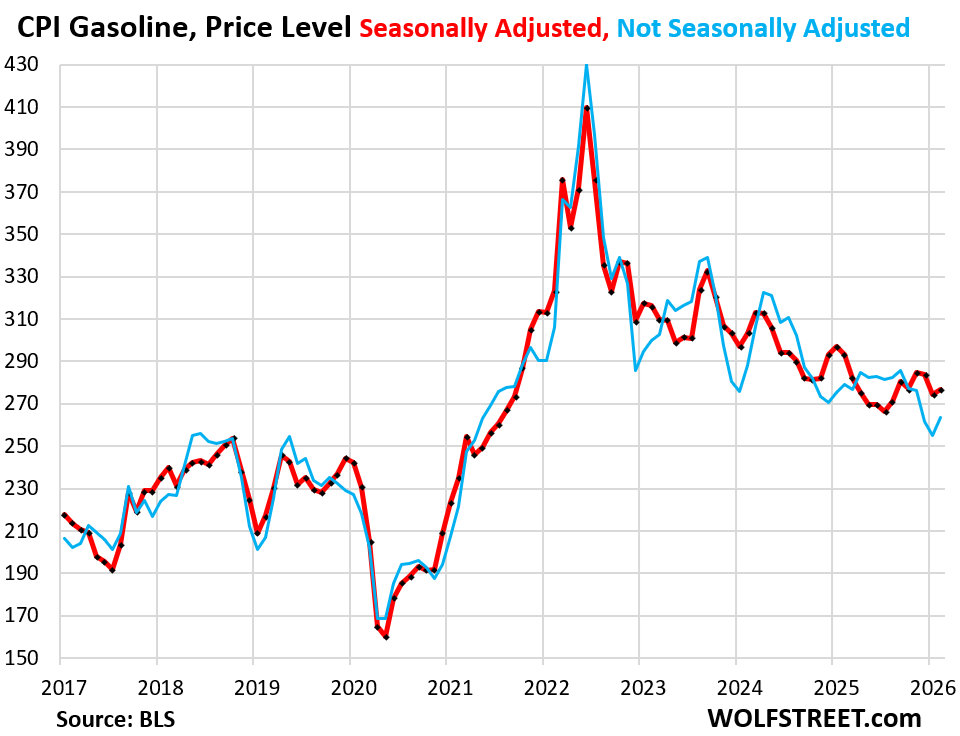
Utility natural gas: The CPI for utility natural gas piped to the home spiked by 3.1% in February from January and by 10.9% year-over-year. Since January 2020, it has surged by 60%.
A harsh winter in part of the country plays some role here, but the CPI for utility natural gas is seasonally adjusted and so it already accounts for roughly the average weather in February.
It wasn’t just the harsh weather in February: utility natural gas has been soaring year-over-year at double-digit rates since April 2025. On a month-to-month basis the price started taking off in late 2024.
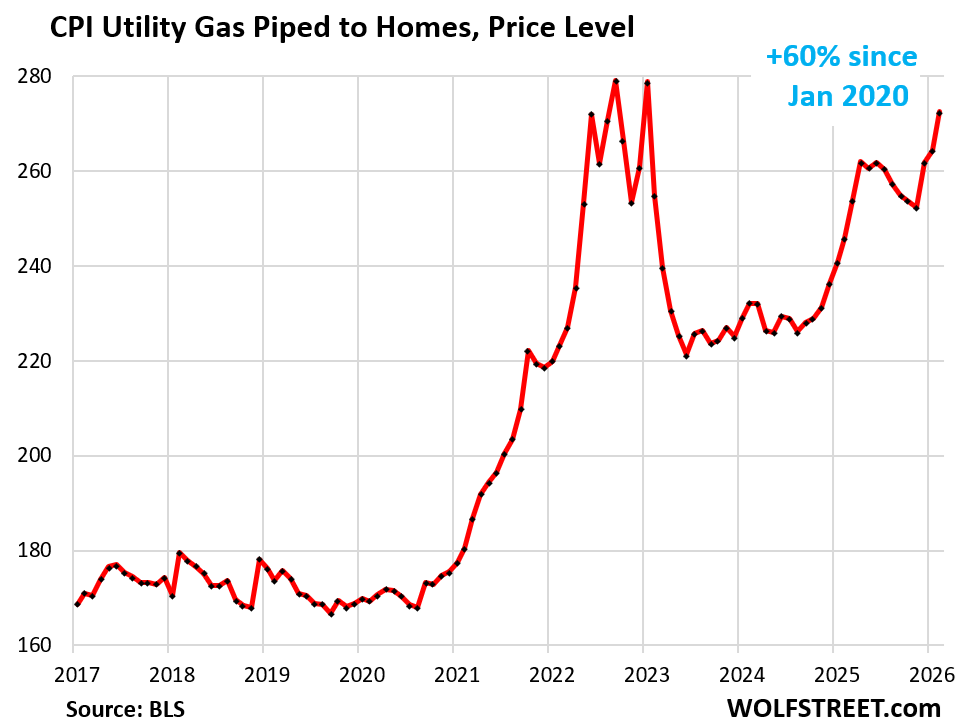
Electricity costs for households soared from record to record, starting in 2021. The CPI for electricity is up by 40% since January 2020.
In February, the CPI for electricity declined for the second month in a row from the record in December, but was still up by 4.8% year-over-year.
The price that households pay for electricity on their monthly bills – the fixed fees and charges and the price per kWh used – is largely set by utilities that are monopolies. Some of the utilities are owned by public entities, such as the municipality; some are owned by their ratepayers; others are investor-owned regulated monopolies, and investors come first. The only competition these electric utilities face is rooftop and plug-in solar.
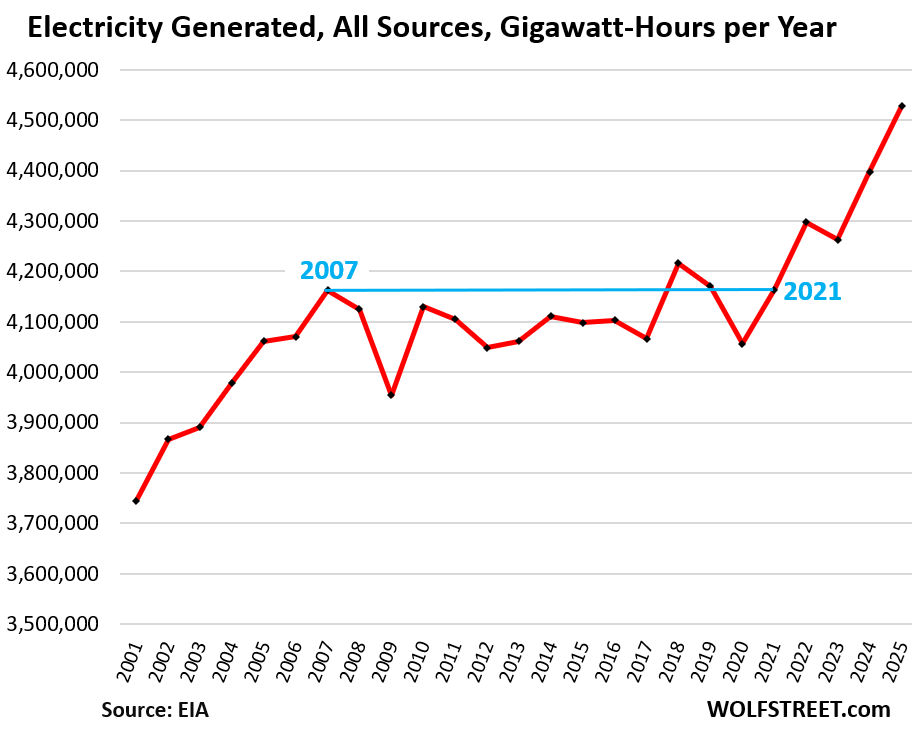
AI data centers are massive consumers of electricity, and US electricity consumption has started to surge. The quantity of electricity generated in the US by all sources rose by 3.0% in 2025 and by 6.2% over the past two years combined, after 15 years of stalling, according to data from the EIA. This additional demand on the grid has started to push up rates.
The AI-infrastructure buildout has accelerated. The size of each new data center is measured by their capacity to consume electricity, such as 500 megawatts, and even 1 gigawatt (about the capacity of a commercial nuclear reactor) or more for the big ones in the pipeline. This has unleashed a mad scramble to supply these data centers with power. Many data center projects are having to include on-site power generation.
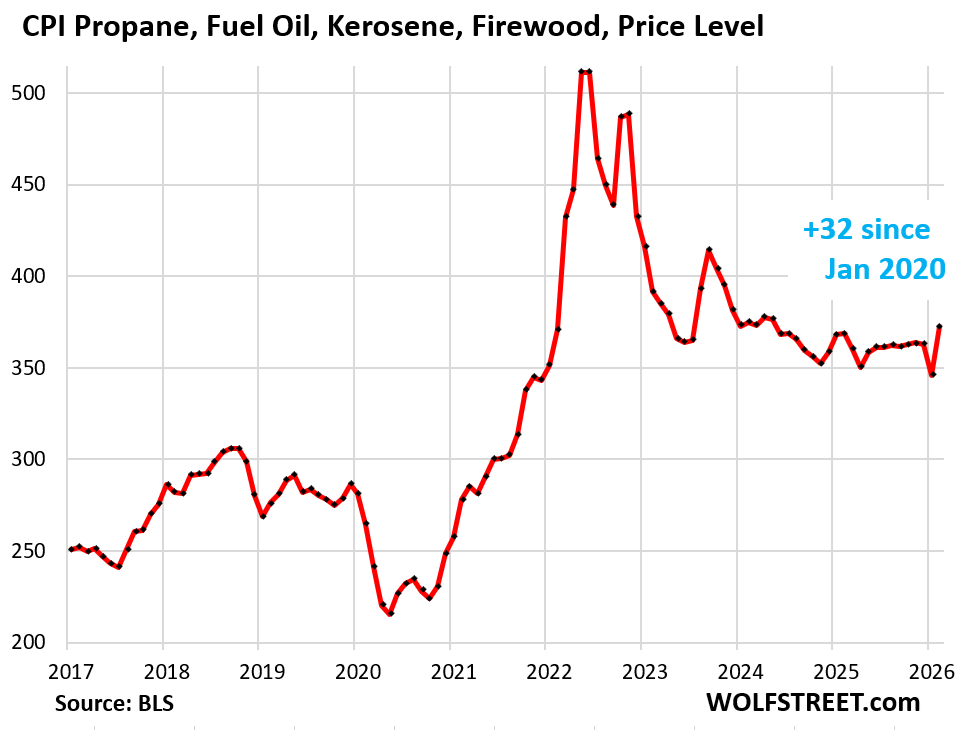
Propane, fuel oil, kerosene, and firewood: The CPI for “Other fuels” spiked by 1.1% in February and by 8.6% year-over-year. It too had plunged off the tip of the spike starting in mid-2022. And that plunge seems to have ended in late 2024.
Propane is widely used for heating by households that do not have access to utility natural gas, such as households in rural areas. In the US, most of the propane is a byproduct of processing natural gas from fracked wells. Some propane is also obtained as part of refining crude oil.
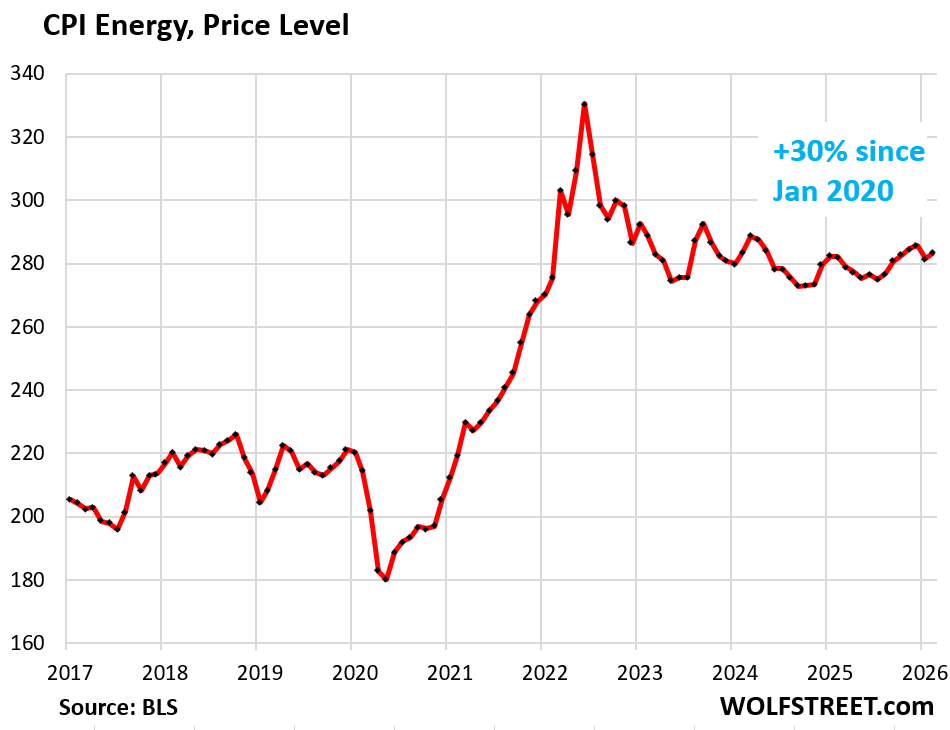
Energy costs combined. The energy CPI, which tracks the above categories, rose by 0.6% in February from January. Year-over-year it was up just a hair, pushed down by the decline in gasoline prices through February. Gasoline accounts for about half of the energy CPI. And the increase of the energy CPI in March will be a sight to behold.
Since January 2020, it has increased by 30%.
Energy inflation, like food inflation, hits the lower income households the hardest, as they spend a substantial part of their budget on food and energy.
In case you missed the other two components of this inflation series:
Enjoy reading WOLF STREET and want to support it? You can donate. I appreciate it immensely. Click on the mug to find out how:


Don’t worry people, I’ll get BLS to change formula to exclude gasoline till it starts falling again.
My inflation numbers will look pretty even as your behind hurts…
Classic
Don’t worry, when gas prices are high “we” make more money.
Idiots.
Always maintain a hedge with oil stocks like Chevron, Exxon, etc. Mideast conflicts are always just around the corner.
Or work in O&G like I do without owning any )&G stock (and immediately sell RSUs).
While everyone has been getting inflation pay raises, we’ve been getting pay reductions as we get ultimately held back by global commodity prices. Nothing like having your Microsoft subscription double because its a monopoly so some Seattle tech bro can line their pockets.
It’s time to EAT baby. No regerts or mercy.
Thanks for driving your lifted truck. My bathroom remodel is going to be sick.
I wish they would ban lifted trucks. Am still driving a 2013 BMW X5 Diesel that gets 30mpg on the road and replaced another older diesel X5 with a Hyundai Santa Fe Hybrid that gets 38.5 mpg everywhere.
We are all in the same boat torpedoed by MAGA man.
Just wait until the molester and thief helps us out with operation epstien fury. We have not seen anything yet. but hey its not a women in the white house and all pets are safe from being eaten and hey were getting a ballroom so there is that.
Can’t AI actually do something positive?
It makes cartoons (AI images), uses our power, takes jobs, Cliff notes all websites.
Yes won a Nobel prize from already common public data that no one took the time to put together. Guess that is something.
Perhaps it could invent cold fusion to power itself? Just saying
LOL! Yeah, kind of like inventing a new monetary system that requires a tremendous amount of power just to be maintained…
I point this out to my favorite bicoin zealot who calls himself a “free market guy” and then asked him; “in a free market do you not believe that all those calories would find more productive applications, like… …oh I don’t know, maybe something like growing food.”
The level of devolution that has occurred in the human population is staggering…
You ever run into a tech guy in the wild or see one live on tv?
They are so power hungry. They don’t care about common sense, people, trust etc etc. all they care about is what they think is “winning”
It’s a weird form of megalomania, it’s pretty sad to see. Tons of people have it nowadays. Very strange, hope there is a cure!
We gotta build more nuclear power plans
“plants” not “plans”.
But then the Fed only looks at prices excluding food and energy when deciding interest rates, doesn’t it? We can forget any rate cuts for the foreseeable future. On the other hand, it would be a brave economist that suggests increasing rates to control inflation in this political environment.
“But then the Fed only looks at prices excluding food and energy when deciding interest rates, doesn’t it?”
No it doesn’t. It looks at both the overall PCE price index, which includes food and energy; and at the core PCE price index which does not include food and energy.
You can look at its Projection materials, where it projects the trajectory of both “PCE inflation” (overall) and “core PCE inflation” (without food and energy):
https://www.federalreserve.gov/monetarypolicy/fomcprojtabl20251210.htm
The reason the Fed and everyone is also looking at core inflation (without food and energy) is because food and energy can have big positive and big negative % change results; energy plunged for a while with big negative values that pushed down overall PCE inflation. But to see the underlying inflation, not just volatility in commodities, everyone also looks at core inflation.
Good, rate cuts are not needed. Rate increases are.
A couple of analysts Bloomberg interviewed on Odd Lots over the last two days have said the situation with Hormuz is a doomsday scenario from a commodities perspective. A lot of the world’s urea fertilizer flows through there, so we’re going to see a hit to crop yields that will show up in food prices throughout the year.
On the oil side, many refineries around the world are reducing production to buy themselves more time to bridge the big supply gap coming their way. Nobody wants to actually shut down a refinery because restarting it takes a lot of time and money. That’s much of what’s causing the massive price spikes in gas/diesel/jet fuel, etc.
One analyst said that, for perspective, the current reduction in oil supply is about the same as the reduction in oil demand during the peak of COVID, so if we were going to retain our current prices through demand destruction alone, we would need to get worldwide demand down to COVID lockdown levels.
He also said that if the US chooses to do export bans, that would help prices in the short run but would eventually cause critical oversupply of some oil products like diesel, which are currently exported. We would run out of storage in a way similar to what’s going on in the gulf right now and have to curtail refinery output, which would result in shortages of other products like gas. He thinks it’s possible but unlikely that this government could effectively manage that crisis.
Meanwhile, Senator Chris Murphy is reporting that, according to the briefings he’s had, nobody really has a plan on how to end the war. “What happens when we stop bombing and they restart production?” The answer appears to be more bombing and an endless war.
And a huge amount of helium also flows thru the straits of Hormuz. Helium that is used in the manufacture of computer chips.
That will just make the huge deposits in Tanzania and Minnesota all the more valuable
I wouldn’t believe a word out of Chris Murphy’s mouth or any politician but the other guys sound smart
Actually I trust that guy more than most.
Matt B – Only 15% of nitrogen fertilizer imports to the U.S. comes from that war region, Qatar at 11% and Saudi Arabia 4%. Half of nitrogen fertilizer used by U.S. farmers is imported mostly from Canada, Russia, Trinadad. The other half comes from US production. Farmers use about 50% of nitrogen from urea, and 40% from anhydrous ammonia. Supply is not a problem in the US this crop year. The “hit” in crop yields will come from outside the US, not here. Also. farmers are much better about timely applications using precision application. Rainfall has as much to do with crop yields than your doomsday fertilizer scenario. Been in the ag business 50 years and seen a lot.
Technically blood is nitrogen.
Known as Bloodmeal
So you’re aware Trump had a sidebar meeting with Putin about 6 mos during a stopover while jetting overseas. Immediately thereafter Russia started storing large volumes of petro and LNG on off-shore shipping storage. Coincidence? Maybe. But under current policy all that fossil fuel can be sold w/o constraints.
I’ll take energy increases at the pump if that’s the price of eliminating a terrorist scourge since 1979.
As for electricity increases, aside from where’s the renewable buffer, anecdotally my costs went up considerably recently due to unusually cold weather.
“Short-term pain leads to long-term gain” is what Team Trump tells us. I can’t see how energy shortages will eventually benefit us though. More and more, I am regretting that I voted for him.
What’s your next step from here on out?
themsicles.
I think you are saying that you have play the cards you have, not the cards you wish you had.
If so, I completely agree.
I don’t agree with many things in life.
So now what? Come up with a plan.
I used both of my current AI favorites to create a five and 10 year plan. Factors include income from 1 person still in workforce, 1 person retired, zip code of residence, energy use and sources, usual food consumption, anticipated real estate changes, anticipated renovations, anticipated maintenance, investments, etc.
AI gave me the three most likely scenarios and how to manage everything through all of them. Your details will be different—make sure you load in your goals and priorities to focus the outcomes in that direction.
Sandy…
My intelligence (if it can be called that) has been working fairly decent for me for quite a few decades. So I will stick with the old school, until my mind and intelligence starts wearing out.
Then I will upgrade to artificial intelligence and see what it gets me… haha
If this Persian Gulf is the “Black Swan” event that pops the housing bubble, then bring it on. We are reading the Bible John in Revelations now, what comes first, the Black Swan event or the Rapture.
I hope its the rapture. I could use some peace and quiet with the Christians gone.
The basics will stay high in price. The luxury goods will stay readily available:
“A quart of wheat for a denarius, and three quarts of barley for a denarius, and do not harm the oil and wine!”
The Black Horse (hydrocarbon energy) has been doing its job well: we’re all on the hook.
The Rapture is the “first Resurrection,” after years of tribulation, before the 10 days of wrath.
Best to lay up treasures in Heaven?
Eventually Trump will ban/severely limit energy exports as that is his primary lever for keeping energy prices under control. I think Jones Act suspensions already issued are a prelude to that.
I see an absolute ban coming for oil and petroleum products (gasoline, diesel, etc.) and a limitation on exports for natural gas and LPG.
Energy crises have heralded major shifts in global economic trends before, and I expect this to be no different. Last time the result was American deindustrializing. Now it’s likely to result in Europe (nearly entirely) and non-China Asia (somewhat) deindustrializing, and American mercantilism alongside that mercantilism actually working.
Having been in the oil business since 1978 and living through $10.00, the initiation of crude contracts on the MERC and every other energy disaster since then, the farce of all this lies in the fact that our domestic oil production is based upon a “world” price.
Our crude production is land locked or off shore and the vast majority never exported. It is the main input to domestic refineries that produce to meet domestic demand for gasoline, diesel, jet A, LPGs, feedstocks, etc.
Domestic demand is not related to international market demand. The pricing scheme is false and deliberately manipulated to benefit domestic producers. How has our domestic demand changed since the start of the Iran mess. Not one iota, yet our domestic production is now more valuable? Poppycock!
Couple this with the fact we are still permitting exporting of finished and raw gasoline, diesel, Jet A, etc. and guess what? Americans, as usual are hosed just like when they buy drugs.
We are not protecting our selves and there should have been an embargo on exports immediately placed when this war started. And who is making more money? Producers and Royalty owners. Refiners still work on the crack spread.
So, America, are you ever going to wake up?
Preach it brother!
It’s big oils turn at the trough.
Big Broccoli, your day is up! 🥦
Should a country that is seeking energy independence export any LNG?
1. The price reflects what utilities charge their customers. Utilities have jacked up the price of natural gas that they pipe into your home. But the US price natural gas in the market is relatively cheap, cheaper than it was decades ago.
2. Overproduction of natural gas in the US caused the price of NG in the US to collapse, and lots of drillers went bankrupt through 2016. A substantial part of this overproduction is due to the fact that NG is a byproduct of fracking for oil, and it’s going to come out of the ground one way or the other, and if there is no market, it’s going to get flared at the well. And that’s what they used to do, which is a terrible waste of a valuable resource.
LNG exports created an outlet for this overproduction. LNG exports require hugely expensive liquefaction facilities and export terminals, the first of which came online in 2016. And more and more have been built since then. So as long as they’re fracking for oil, there’s going to be lots of NG along with it.
The city of Ann Arbor, Michigan recently voted to create a municipal-owned power utility. Will be interesting to watch what happens with electricity prices there.
Municipal power is going to be a huge point of contention for many elections across the country. I’ve talked to people in CA saying they’re ready to vote for anyone that stands up to PG&E and the CPUC, regardless of party line.
Already there in my town.
Prices don’t go lower.
We have municipally owned power in Northern Colorado. We don’t lose power during windstorms. Others do because Xcel doesn’t upgrade their shit.
Now we do see energy increases because we are trying to go to only 10% emissions, and wholesale power prices are rising. They will average about 7% for the coming years…
Is this Wolfman’s way of saying that the Iran situation IS having an effect on the price of gas?
In the US, it’s an INFLATION problem, NOT A SUPPLY problem. In the 1970s, during the Arab boycott, we had a supply problem. No gas for cars! HUGE difference. Now some other countries have a supply problem. The US is awash in supply. I’ve said this from the very beginning, and it’s playing out exactly that way.
MW: Global oil prices climb back above $100 as U.S. waiver on Russian oil sanctions fails to quell supply concerns
Oil prices always rise when global political events turn kinetic.
It would be interesting to track geographically local impacts; for example, CA and EU self-inflicted refining and CAPEX reductions over the years.
MW: Fed’s favorite price gauge shows sticky inflation — and little chance of improvement soon
Climate Alarmists hate plant food
You guys are nuts. Has anyone else taken a look at the snow levels right now? Or the weather forecast?
Current weather events has little to do with long term climate. We are in an interglacial and very lucky to be. I much prefer a warmer earth. Much easier to survive than when it’s covered in ice. Humans have never controlled the climate and never will.
One reason for power outages in wind storms is becoming a preventative measure. Downed power lines and high winds can erase towns.
Not sure what part of NoCo: heckova wind event yesterday though!
Tipsy trailers, dust and the shutdown of interstate commerce! Oh my!
Thankfully no fires though: always fire season now, as seen in La. And Superior Co. (speaking of Excel and wind driven/ power line fires).
Meant to reply to Eric86 above.
Repost it in the correct place and I’ll delete the original.
«Electricity costs for households soared from record to record, starting in 2021. The CPI for electricity is up by 40% since January 2020.»
That is striking but also the most striking thing is that electricity consumption *per person* has slightly declined in the USA or significantly declined in Europe since around 2004, while growing robustly in other countries