
How much job growth is actually needed as population growth slows dramatically?
By Wolf Richter for WOLF STREET.
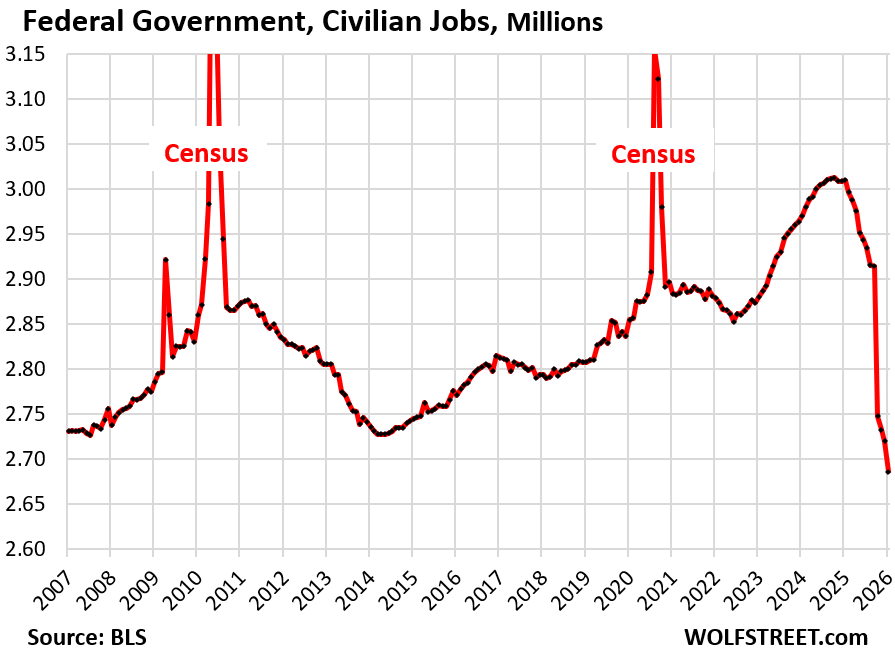
The federal government shed another 34,000 jobs in January as previously departed employees whose separation packages expired at yearend came off the payrolls.
Since the beginning of 2025, the federal government has shed 323,000 employees, or 10.7% of its staff, according to the Bureau of Labor Statistics today (I discussed today’s big annual benchmark revisions of nonfarm payrolls separately here).
Companies that lost government contracts, or whose contracts were reduced or paused, also laid off people. But those were private-sector jobs; they’re not included here; they’re included in private-sector employment below.
State governments shed another 18,000 employees in January. Since the beginning of 2025, they have shed 62,000 workers. Local governments added 10,000 jobs in January and 157,000 since the beginning of 2025.
Employment at all levels of government sank by 42,000 in January and by 166,000 since the beginning of 2025, having flipped from being a big job creator in the prior two years.
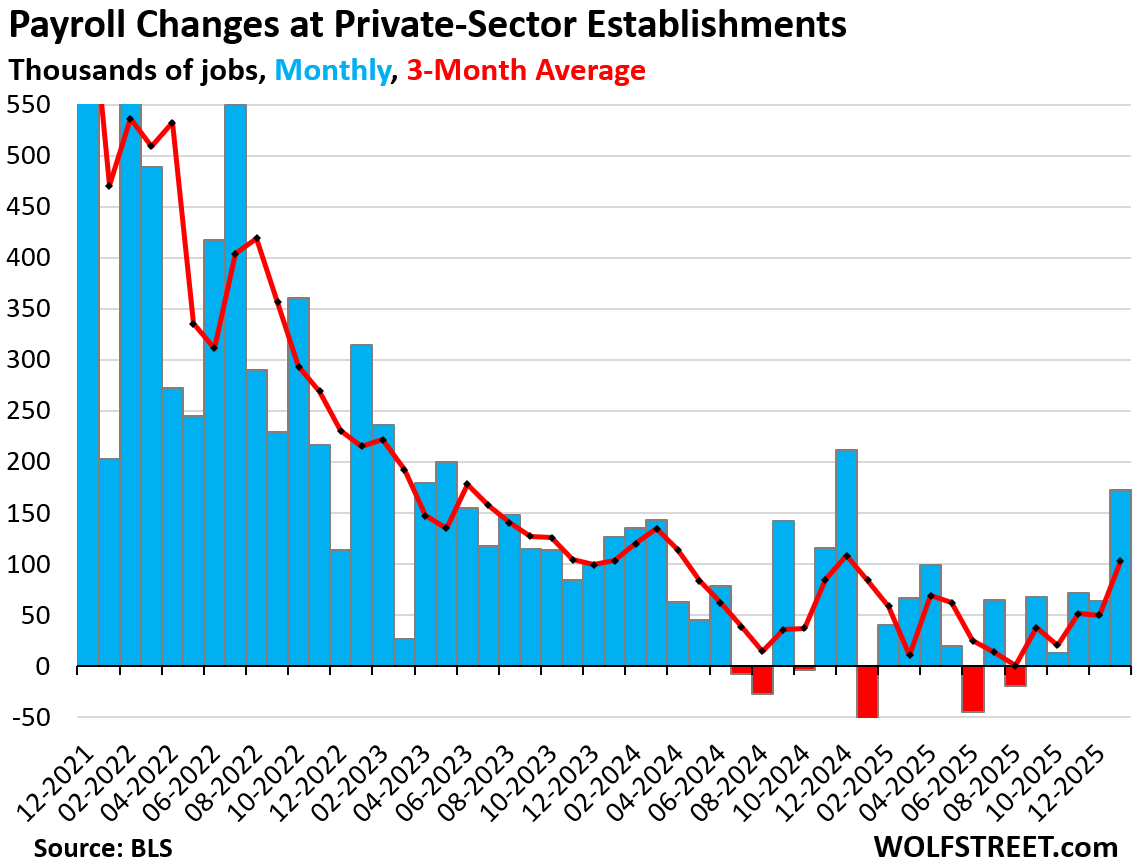
But the private sector added 172,000 jobs in January, the most in over a year (blue columns in the chart).
The three-month average, which irons out the month-to-month squiggles, hit a low point in August at zero jobs added, and has zigzagged higher since then, to 103,000 jobs by January (red line).
Since the beginning of 2025, it added 539,000 jobs. Since the beginning of 2024, it added 1.56 million jobs, with six of those months showing job declines, much weaker than previously reported, according to today’s revised figures.
But private sector job growth has ramped up in recent months.
The Fed should keep its eyes on private-sector jobs for its monetary policy decisions. While the drop in government employment impacts the unemployment rate, consumer spending, and the economy, it is the result of a political decision by the White House, and not the result of weak demand, slow consumer spending, or other economic weakness that might be considered a reason for rate cuts.
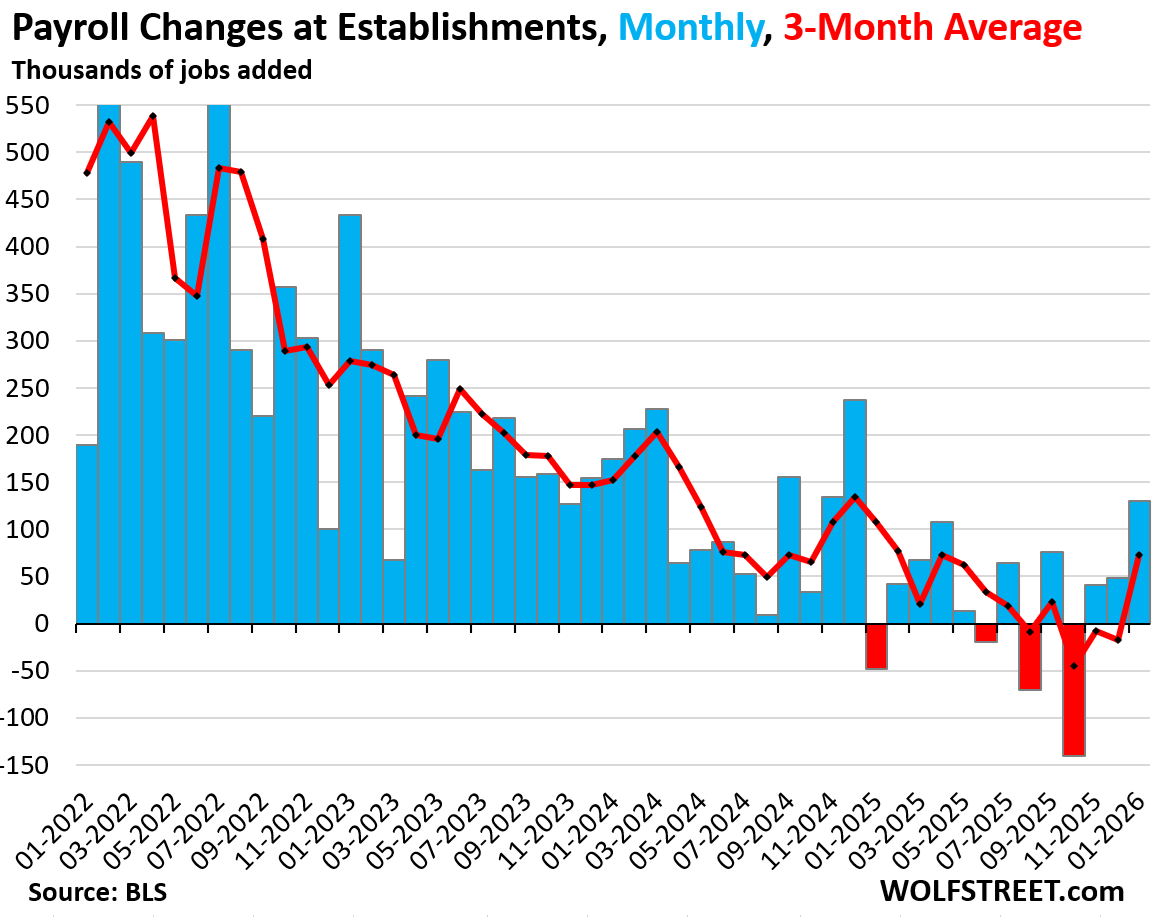
Total nonfarm payrolls, including governments, rose by 130,000 in January. For the past three months combined, total nonfarm payrolls rose by 219,000 jobs, for a three-month average job growth of 73,000 (red line in the chart below).
Year-over-year, total nonfarm employment rose by only 359,000.
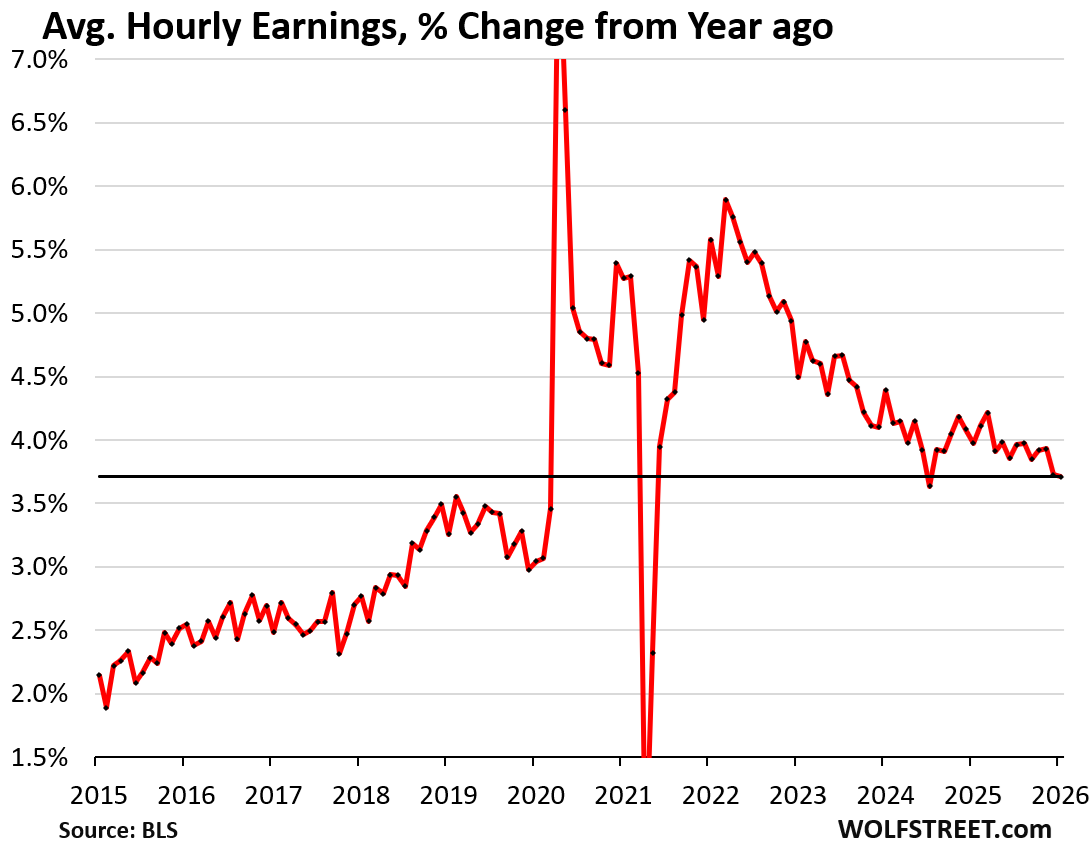
Average hourly earnings rose by 0.41% in January from December (+5.0% annualized), after barely edging up in the prior month. The three-month average, which is more useful, rose by 3.5% annualized.
Year-over-year, average hourly earnings rose by 3.7% in January.
How much job growth is needed as population growth slows?
The crackdown on illegal immigration has dramatically slowed overall population growth. The Census Bureau estimates that, with current trends, Net International Migration (immigration minus emigration) could turn “negative” in two years, with more people leaving than coming.
Net International Migration in the 12 months to July 1, 2025, plunged by over half to 1.26 million people, but that period was a mix of six months of Biden’s immigration policies and six months of Trump’s immigration policies.
For the 12-month period through July 2026, the total population would increase by only 756,600, of which 518,000 from natural growth (births minus deaths) and the rest from Net International Immigration, according to projections by the Census Bureau, indicated in light blue in the chart below (my discussion: Population Growth Slows to Crawl, Net Migration May Turn “Negative”).
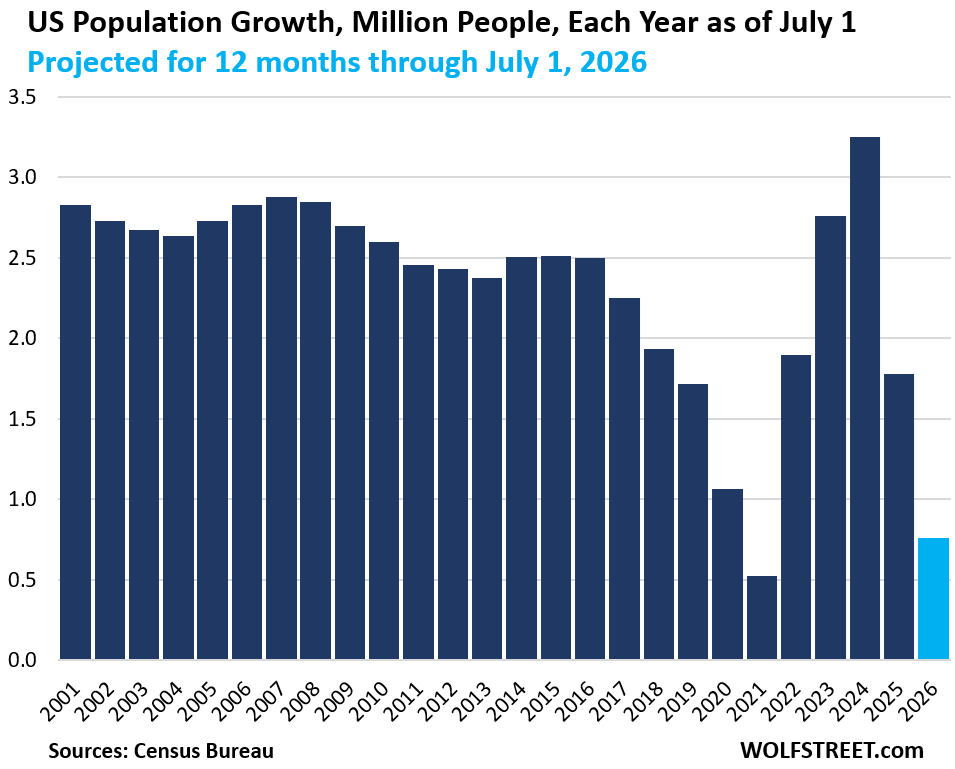
How much job growth is required to maintain or even tighten full employment under these conditions? Only part of the population growth of 756,000 would be in the labor force.
So maybe, as has been suggested, a growth rate in nonfarm payrolls of 50,000 jobs per month would maintain or tighten the currently already low unemployment levels.
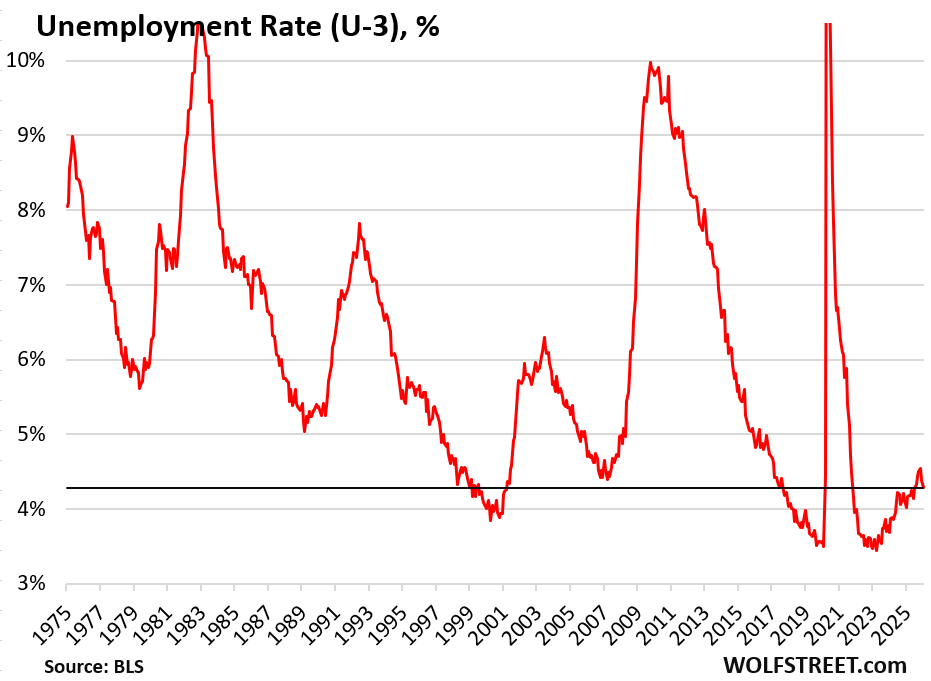
The unemployment rate dropped to 4.28% in January, the second month of declines, the lowest since July, and at the low end of the historical range.
The unemployment rate reflects the number of unemployed people who are actively looking for a job divided by the labor force (people who are working or are looking for a job):
- The number of unemployed fell by 141,000, second month of declines, to 7.36 million, the lowest since July.
- The labor force jumped by 387,000 people: on a big gain in total jobs, including farm work and self-employment, and the drop in the number of unemployed.
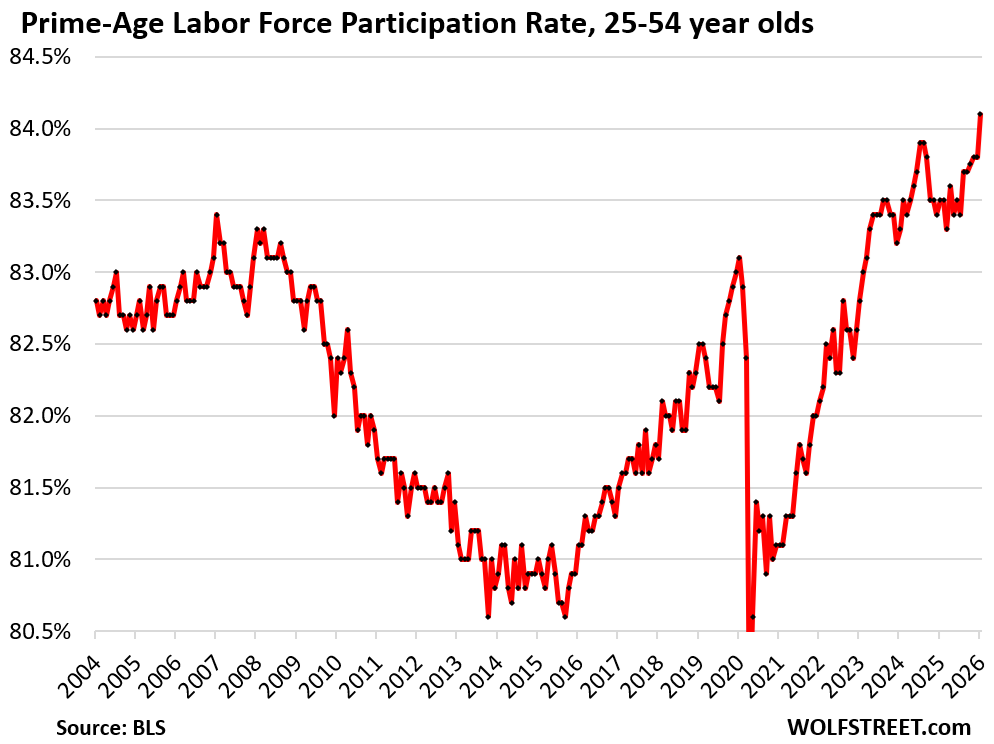
The prime-age labor force participation rate (25-to-54-year-olds) rose to a multi-decade high of 84.1%.
The prime-age labor force participation rate eliminates the issue of the retiring boomers. The overall labor force participation rate shows the percentage of the population that either has a job or is looking for a job. When people retire and stop looking for a job, they exit the labor force but remain in the population until they die. The surge of boomer retirements, which started about 15 years ago, has pushed down the overall labor force participation rate, as these retired boomers are still in the population but no longer in the labor force.
The prime-age labor force participation rate is a cleaner depiction of participation in the labor market, than the overall participation rate, and speaks of a lot of strength in the labor market that has been changing dramatically since early 2025 due to the crackdown on illegal immigration, which has slowed the growth of supply of labor.
Enjoy reading WOLF STREET and want to support it? You can donate. I appreciate it immensely. Click on the mug to find out how:


According to AI, this hasn’t happened in at least 50 years. Economic implications guesses on housing stock availability/prices, wages for manual labor, traffic, health care availability, school enrollments, social spending, etc.?
“The Census Bureau estimates that, with current trends, Net International Migration (immigration minus emigration) could turn “negative” in two years, with more people leaving than coming.”
I’m not sure they want to leave. Just fyi
so it’s more of an “engineered by self” problem.
I’m pretty sure 65% of the population of the us is indifferent to removing huge swaths of the us population.
It seems counter productive.
Especially if we need to rebuild us manufacturing to counter china, we’re gonna need low priced workers to run the factories.
I literally just had this conversation with my coworker today.
He has refused to work for his neighbor for some drywall repair, several times. (Citing ideological differences).
After my coworker asked why he didn’t hire “an American” the reply was that it was “too expensive.”
Ehh… “services inflation continues to rage as wage growth continues to outpace…” Or whatever (not that Wolf needs headline suggestions).
I see myself in the mirror in your comment. I am 100% for deportations, but recently hired a group of Mexicans who do some serious electrical rehab, at about 65% less than a big name contractor.
I know a smalltown builder who paid $18K last summer to frame a 1,600 SF house on a crawl space with about 500 additional SF in carport & modest porches. That’s about two weeks work for a 3-man crew or about $600 a day. Working 10 hours a day is $60 an hour. I would imagine there are tons of able-bodied Americans who would take these jobs, if builders were forced to use American labor & wouldn’t have to pay higher wages.
Once cherry picked example doesn’t represent the big picture here. Unfortunately, Trump hasn’t seized upon the opportunity to pitch America a rebirth of American labor used to build houses.
Ben: $600/day comes out to $12k/month, or about $144k/yr. After taxes and depreciation on equipment, you might keep half of that. Three quarters with creative accounting.
10 years ago, a good number for a young hard-working subcontractor was $1k/day. Specialty trade such as siding, decks, windows/doors, etc. Roofers and framers made less, but still did well. $500/day for the guy still starting out. I’m afraid the kids these days are harder to motivate with $1k.
People want a respectable wage for the job they are doing or service they are providing.
On the flip side people complain when they have to pay someone a respectable wage for the job they are doing or service they are providing.
Perplexes me.
Ben,
You are ignoring the overhead. It takes money to advertise for thise jobs, get them, estimate them, plan for them, manage them, etc. Plus there is the cost of materials.
Just from experience in a slightly different construction field (low voltage) if that 18k was just for labor than at best the workers were making $35 per hour. There is a good likelyhood it was far lower. Maybe only $20 per hour.
I work in maintenance, and to get me or anyone else I know to do one of these jobs that’s closer to actual construction, I think you’d have to give us 4-day workweeks or a lot of vacation, or something like that. I think the consensus view is that, no matter the pay rate, it’s not worth it because you don’t have the time or energy to actually spend the money, or you’re dealing with some kind of injury. I’m at the entry level on the pay scale and I still can’t even get close to spending all the extra money I make, and they’re confused why I keep refusing promotions. This is a relatively easy job and we still seem to have about as many voluntary demotions as promotions in this company.
China has more industrial robots than the rest of the world combined. They lead in most critical technologies and are catching up on the rest. They own many supply chains. You are not going to “counter” them with “cheap” labor that will only further drag down infrastructure costs and elevate social spending.
spoke with my son yesterday. said he’s doing handyman work on side(he’s 27 and works full time-living wage)
I asked how much he charges – $50-75 an hour
said I couldn’t afford him anymore – he laughed
I trained him during covid
“China has more industrial robots than the rest of the world combined.”
Well they have the nominally largest manufacturing base, so like everything with China, if you look at absolute numbers it’s impressive, but on a per-capita or per-output basis it’s less so. The NAFTA, EU, Japan/Korea manufacturing bases are much more intensively robotized and the robots are much more capable.
Average GM assembly worker makes about $50K per year. Tack on another $25K per year in benefits (estimates vary depending on estimates, e.g., pension, buyouts, medical, union expenses, …). Not bad for a job in a climate controlled environment, 15-minute relief each hour, break times, lunch times, vacation pay, holiday pay, furlough pay that requires an IQ of 70.
Except that it’s a rapidly declining occupation due both to the supply side (automation, outsourcing) and the demand side (vehicles last much longer, and an older+smaller population needs fewer of them, with the neutron bomb of autonomous driving rising above the horizon. In 20 years few will own their own car and private sales will be 10% of today’s levels.
“ we’re gonna need low priced workers to run the factories.”
Not true. Lots of factories run lights
out and low priced workers have high costs to the safety net. Hopefully the days of cost shifting
to the taxpayer are coming to an end.
Actually those are Rare types of factories. Prob incredibly expensive as well.
Factories need people.
People is how you get your stuff.
It’s not magic
I used to setup MRP/ERP systems for biggies
I always had job to make sure lines ran efficiently
troubleshooting was my specialty
you think AI bots gonna fix stuff
might need UHAUL to throw out all damaged goods/products you hoped to sell
Your comment is a good example of how pro-nouns are bad practice.
“According to AI, this hasn’t happened in at least 50 years”.
I had to read your entire comment to make a guess that “this” in your mind meant net negative immigration. But that’s just my guess. Others might guess differently.
AI took this line straight from the Census Bureau report. And yes, “this” is negative net immigration.
Sure looks like an acceleration of growth is happening.
Powell won’t cut, so assuming the economy is clearly humming by June when Warsh takes over, that’ll be an interesting time at the Mariner Eccles building .
Mr. Wolf writes: “The Fed should keep its eyes on private-sector jobs for its monetary policy decisions.” Jerome Powell had spoken endlessly of Labor/Job imbalance as the driver of inflation. Inflation has increased again and this private sector job increase is the evidence behind that inflation. All in all, this continuing teasing of the labor/job imbalance, through job creating stimulus of apparent easy monetary conditions, is just more year after year tiring news of a Federal Reserve policy that is maintaining inflation, either by design or incompetence.
Wolf!! You provided Excellent data points. My only concern is AI on high tech jobs. I feel for the 20 year old pursuing CS degree. CS is the best occupation remuneration wise. I retired as a Software Engineer. It gave me great lifestyle. I advise every youngster to pursue coding. Now I don’t know what to advise.
Yes, they have a problem.
I would advise basic human connection, but maybe they will automate that too.
Parasocial is already the watchword in today’s entertainment. Look to the social media influencers speaking to the camera, intimately to “you”. Look at the podcast news hosts speaking so much about their personal lives, what they did over the weekend, etc. The horse is well out of the barn on this one.
Anesthesiology is where it’s at.
Meh. Puts me to sleep.
Rikki healing!
No tools needed and no touching!
Haha
I respectfully suggest one of the hard sciences – physics for example. This teaches the currently understood model of our universe, how it behaves, and thus allows us to manipulate matter and energy flows to achieve specific outcomes. It’s a broad church permitting many onward options.
Whilst there may not be many pure physics job options open presently, it demonstrates the student’s ability to deal in broad, abstract and complex concepts; to stay the course on tough, mentally grueling subjects; and to render more rigorous assessments on some of the more wilder ideas for future ‘tech’.
Other suggestions, electrician or plumber. Skilled services sector workers are ageing out and there’s a dearth of new entrants. They were all sold a ‘bill of goods’ that getting any degree is the gateway to +$100k jobs.
My advice to my 19yr son is: continue with a business and accounting degree at the local community college; continue to engage in your current occupation that you enjoy; and figure out how to make a living from it. He declined my advice to become a semiconductor engineer like his dad. You just can’t tell your kids anything – they are determined to do it their way!
Physics, Economics, Math, chemistry, medicine are all actually intertwined and 90% of your education could push you into any of those. It’s just what one is passionate about.
I sorta “hear” from people that engineers think they know more than they do about subjects they haven’t mastered. But who knows ;).
Speaking as a retired engineer from the energy business I think we as a profession know that we need all of the engineering disciplines and we can not be responsible for all tasks. I am just the opposite I want qualified engineering designers in their respective fields for any tasks including home repairs and maintenance. Home remodeling cars decks lawns etc. As a professional engineer we know our limitations. If not people get killed .
As an active engineer in the environmental sector, BS ini is spot on. Engineers are trained, after learning first principles in their discipline, to tackle problems beginning from first principles. Engineers have defer to specialists or risk killing people, as BS ini states. We have skin in the game with licensure. Someone gets hurt or killed and we’re at fault? Prison time, baby.
I’m biased, but I think civil and environmental engineering are two of the best engineering disciplines to pursue as a career because they essentially teach you how the world works. Pretty much neglects electricity and the minutia of gadgets and gizmos (mechanical engineering), admittedly.
All prior responses are fair. Anything that has actual human interaction involved.
Medical fields will see increasing demand. Aesthetician (cosmetics, not anesthesia, see above), entertainer, any trades including and especially related to tech.
The manager of the property I work at is excited to implement a software tracking system for maintenance schedules and work. I hear a tech-age manager blushing over an app that will just list all the work that needs to be done.
I am pretty sure the app will not be changing any lightbulbs, patching or painting any walls or completing any remodel work.
The manager does not pay enough people the sufficient wage to do the work. I don’t believe the app will resolve this issue.
IMHO, once the boomers have mostly passed away, healthcare will be laying off people, that might be in 20 years.
Maybe by then, Elon’s prediction that will be no work will be in effect, and its doesn’t matter anyway.
“once the boomers have mostly passed away,”
By then, millennials, the largest ever generation, will be retiring and needing more healthcare, piling on top of GenXers clogging up hospitals and waiting to get treatment. Generations are a flow.
@Wolf
The generation sizes are similar, but millennials will be much healthier in old age. Rate of smoking is about 25% of boomers+ban on indoor smoking. Much better environmental standards–no asbestos in the school/workplace, etc. Healthier diets, earlier detection of disease, etc. Not sure if the overall size of the medical system with shrink, but in any case more will be invested in marginal care relative to boomers.
Nope in the energy operating business we have had asset integrity plans for decades generating required maintenance. That’s not “ai” our maintenance workers would have to input the finished tasks which was the primary source of error. AI will allow them to just speak into a phone. Many tasks will become automated that are difficult (data entry) because they are mundane .
“Medical fields will see increasing demand.”
Basic care in a nursing home, maybe, but diagnostics is one of the first things AI is taking over and falling prices for testing and test interpretation (AI) will ultimately lead to far less visits to the doc to figure out what’s wrong. Meanwhile GLP-1 and collapsed smoking rates (alcohol on a similar path) means that many fewer lifestyle illnesses will require treatment.
On a Reddit Claude forum an advanced senior coder just hired a junior coder.
The junior coder can only use AI to do his job.
This alarmed the senior coder.
I left software engineering 27 years ago. Now that I see how Indians have taken over the industry and don’t hire Americans, I have no regrets.
The big corps/hi-tech industry may dis agree with you as they are still clamoring for more and more work visas citing scarcity of qualified Americans.
Ram,
This kind of happened in the 90s but with outsourcing to India. They turned all programmers here into programmer/analysts. No matter how good AI gets if you put garbage in you get garbage out. As always, critical thinking and being accurate and concise will still be in demand. My thought on software anyway as that is what I did for 75% of my career.
AI isn’t omniscient as headlines say. However, in capable hands it’s very powerful. There are billions of lines of unreadable code out there that AI can decipher, but a human is still required. Also, businesses using poorly performing one size fits all solutions can now create custom streamlined software. Opportunity abounds.
“How much job growth is needed as population growth slows?”
As a non-capitalist (in a hyper capitalistic environment) I have often questioned how much (continuous and accelerating) growth is needed (period).
The best answers usually lean toward the globally competitive economy/ political system and/ or the insatiable appetite of the “haves” and “have mores.” I can see that growth is beneficial, and I also suspect that the ways it has been brought about in recent years (decades) are not as healthy or widely beneficial as a more “organic” approach.
“The prime-age labor force participation rate (25-to-54-year-olds) rose to a multi-decade high of 84.1%.”
Must be fake news! Remember? NOBODY wants to WORK anymore!?! OR, are more people required to work, even without the blessings of family formation etc.?
I’m wondering where hyper capitalism is as USA is socialism for the wealthy and not free market. The obsession with growth is attempting to inflate away debts due to plundering of future generations but all the wealth effect meddling is causing economic cancer.
Interesting data on prime age participation rate. I’d love to see data on how many jobs need to be replaced each month from death, retirement, layoffs, terminations and how that plays into the nonfarm payrolls. What’s the big deal about exclusion of farm payrolls?
RE: retirement
It seems not that long ago when there was panic over a coming wave of Boomers retiring and the impact it might have on the overall job market.
I guess that impact never arrived.
According to the Feb 5 article on this site, job openings were at a 3mo average of 6.97 million. Also “Job openings are mostly the result of quits, layoffs & discharges, and other separations (retirements, deaths while employed, etc.), all of which are tracked by today’s JOLTS”
Are you questioning why there are still people unemployed, if there are enough job openings to welcome them? It might be ability matching requirements. How many of the unemployed are not employable?
I tried to reply to Johnny Bubs above but failed. He asked for “data on how many jobs need to be replaced each month from death, retirement, layoffs, terminations” and I responded with JOLTS data.
Yes, things can get confusing here. It helps if you put the commenter’s name in your comment.
Also, if there is no reply button, scroll up to the next reply button and reply to it. That will put your comment somewhere below the person’s comment that you’re replying to. And that, along with a name, usually makes it somewhat clearer.
It seems possible that private hiring is picking up due to the expected positive demand effects of the BBB tax cuts.
That the rich people buy more jets?
Most of the job growth is in healthcare and social assistance. We have a rapidly aging population with low birthrate so it makes sense.
Would love to see Wolf opine on the sector breakdown of the jobs report. To my understanding, the only sector showing significant growth is healthcare, while every other sector is flat or negative for the last 12 months. Combined with an aging population, this is the opposite of a rosy picture presented in some of the articles published recently.
“Would love to see Wolf opine on the sector breakdown of the jobs report.”
No, you just want to troll my site with BS. Every few months, I post an article with 20 charts of jobs by industry, and almost no one reads them, you don’t either or else you wouldn’t have posted this BS, that’s why I do them rarely, because they don’t stop the flow of BS anyway. People just love dragging headline bullshit into here. Somehow they get a kick out of it.
Jobs in Construction, Utilities, Leisure & Hospitality, and Other services (a big catch-all category) all surged to all-time highs.
Jobs in professional services had been dropping for a couple of years, but for the last three months started rising again (+105,000 jobs in three months).
Manufacturing is all about automation. Every manufacturer is constantly trying to automate away human jobs. This is a huge trend that has been going on for decades. Industrial robots cost the same anywhere, and the US can compete with China in a mostly automated plant. But it can never compete using sweatshop labor. So even as factory construction has surged, it will not lead to a hiring boom; it will lead to a boom for engineers and for automation equipment.
Not sure how you can call it a surge for any of the other sectors. When factoring labor force growth over 12 months (around 0.7% seasonally adjusted for Jan 2026), none of the other sectors outpace this after taking into account survey confidence intervals (p < 0.05 that industry job growth is net positive after adjusting for total labor force growth).
Typed the sign wrong for p factor on my phone but I’m sure you know what I mean
Would like to know how you calculated Rho for your confidence interval. What values were used for sample sizes?
Steve,
What the f**k does my comment above have to do with “labor force”? That’s a completely different data set than nonfarm payrolls. Different survey, different recipients. Nonfarm payrolls, which is what I’m talking about, come from employer data. It’s NOT total workers in the US. It’s people on the payrolls of nonfarm companies. Labor force comes from household surveys, anyone out there. And the households survey data is going to get hugely adjusted next month by the annual revisions to the population change.
Economists from the Austrian School postulate that government spending and employment should be excluded from measurements of economic activity.
Government spending drags down the economic wellbeing of citizens as a whole. Similar to the broken window fallacy: Someone breaks the baker’s window. The glazer gets more business, but it’s a net loss to the economy as a whole.
@Milton F- Government spending to feed, educate and keep children out of poverty has been well established to elevate the economic wellbeing of the populace. Something like 4:1 ROI iirc. But its not a next quarter number go up situation, so people lose sight of it.
Hmmm. I know this article is meant to be positive but I found it very depressing. The commentary here is excellent by exploring the extremes in both directions. I’m pretty sure we are entering an extended period of negative growth at ALL levels of society. All I can do is watch though and luckily I watch from a safe place.
Very interesting article Mr. Richter. That opening chart is an eye popper.