
Across the US, after a mindboggling Condo Bubble, from Manhattan (-19%) to Oakland (-29%), from Cape Coral (-30%) to Seattle (-14%).
By Wolf Richter for WOLF STREET.
Some people buy condos to live in an urban center, close to work, or along the shore, with big views, nice amenities, and no maintenance, repairs, and yardwork. Others buy condos as rental properties or short-term vacation rentals. Condos are a popular way for mom-and-pop investors to get into multifamily. Others, especially nonresident foreign investors, buy condos to park some cash in the US and watch the price appreciate without ever doing anything with the condo. Others buy condos as a vacation home.
The first category – condo owners who live in their units – are like other homeowners: They don’t move that often and provide some stability. But the other categories can make condos very speculative, with big manias followed by big crashes.
An example of such mania-followed-by-crash is Killeen, TX, where condo prices have collapsed by 46% over the past three years through November, including by 24% year-over-year – a condo rug-pull, so to speak. But Killeen is too small (160,000 population) to be included on the list here of the bigger markets.
In the 28 bigger markets on this list (mostly cities, but also five counties, and one metropolitan statistical area), prices of mid-tier condos have dropped from 12% to 30% from their respective peaks through November. Each of them is depicted with a chart below, plus some additional data.
And then there are a bunch of markets where condo prices have dropped less than 12%, and didn’t make the cutoff. I listed over 30 of them here, but without charts.
All prices here are for mid-tier condos (the middle third by price in each market).
And one more thing… Condo prices in the cities of Phoenix, Mesa, Chandler, Scottsdale, Glendale, and Gilbert, AZ, have moved nearly in lockstep, all of them down either 12% or 13%, rounded, and they used to be on this list individually, but they’re all in the huge Phoenix-Mesa-Chandler metropolitan statistical area (MSA); so instead of showing them individually with similar-looking charts and percentage changes, this list now shows the Phoenix-Mesa-Chandler MSA, the only MSA in this lineup. If some of those cities start diverging strongly from other cities in the MSA, I may revert to separate charts for some of the cities.
The 28 bigger markets where condo prices fell 12% to 30% from their peaks:
- Cape Coral, FL: -30% (2022)
- Oakland, CA: -29% (2022)
- St. Petersburg, FL: -27% (2022)
- Austin, TX: -25% (2022)
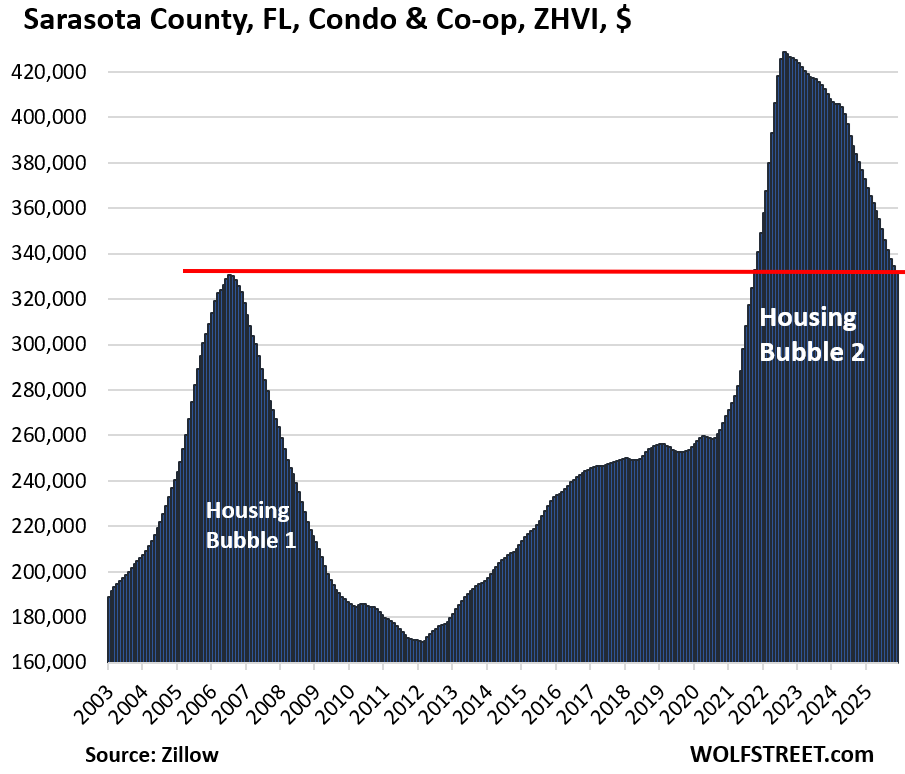
- Sarasota County, FL: -23% (2022)
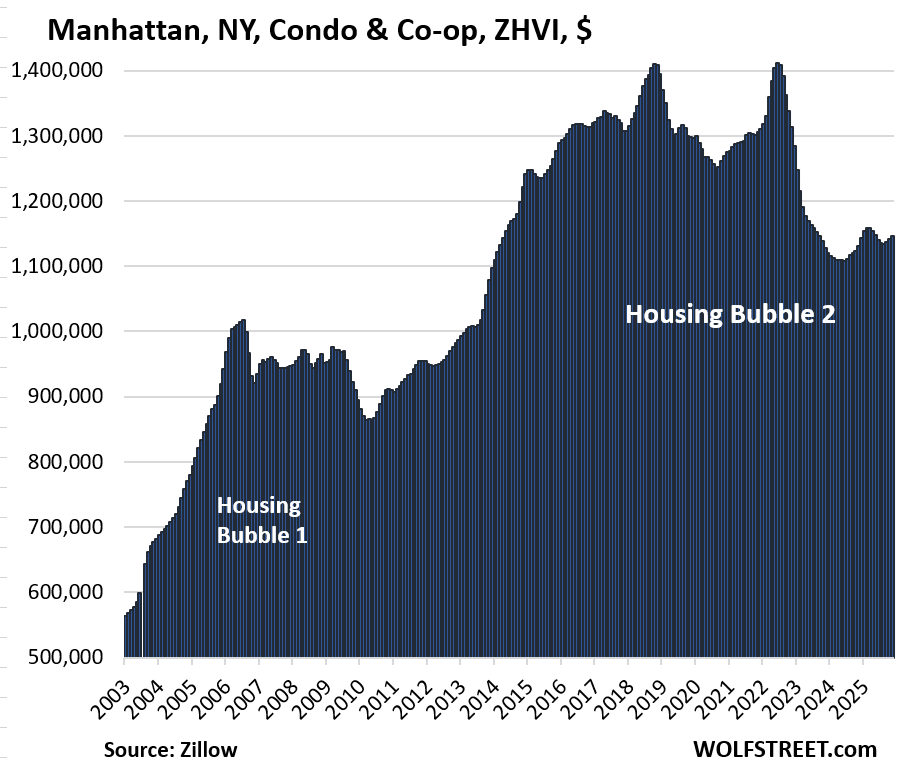
- Manhattan, NY: -19% (2022)
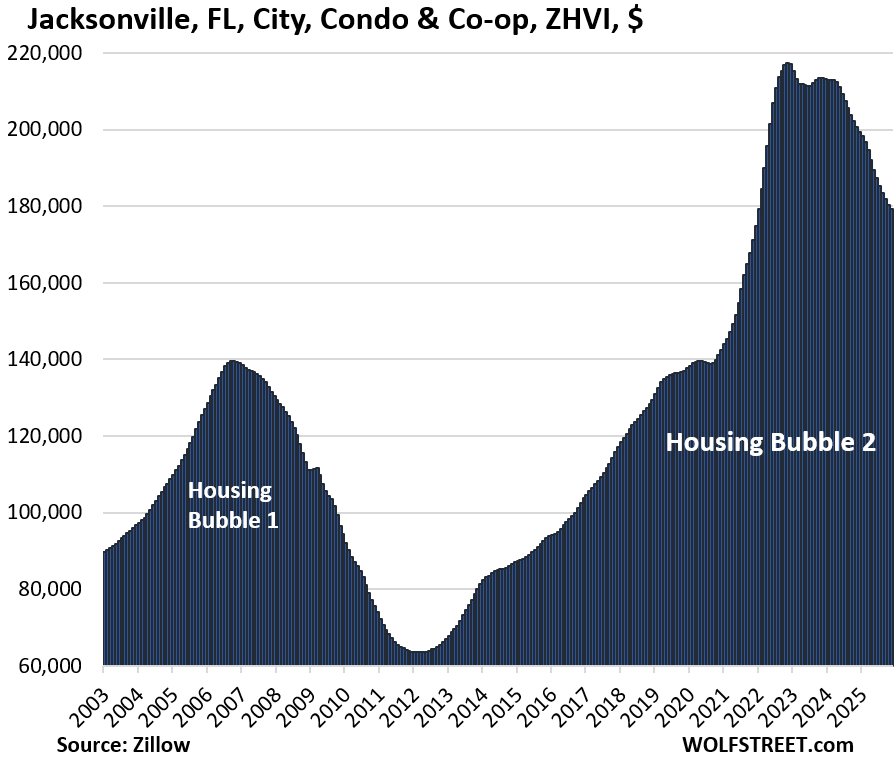
- Jacksonville, FL: -18% (2022)
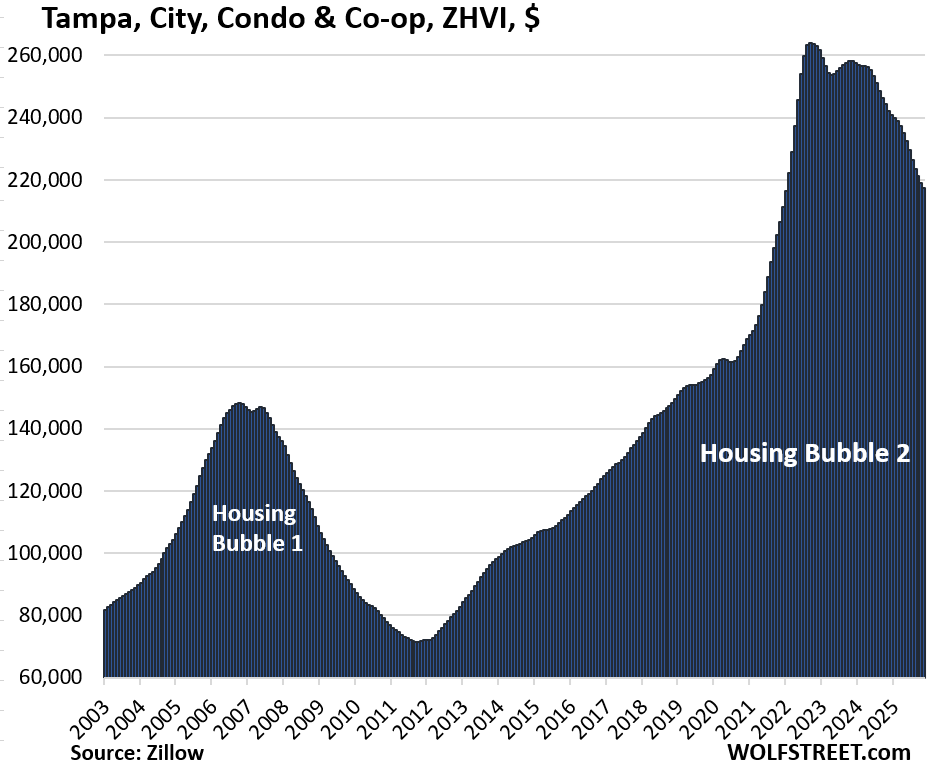
- Tampa, FL: -18% (2022)
- Collier County (Naples), FL: -17% (2022)
- Arlington, TX: -16% (2024)
- Detroit, MI: -16% (2021)
- San Francisco, CA: -15% (2022)
- Denver, CO: -15% (2022)
- Aurora, CO: -15% (2022)
- San Mateo County (northern Silicon Valley), CA: -14% (2022)
- Queens, NY: -14% (2022)
- Seattle, WA: -14% (2022)
- Reno, NV: -14% (2022)
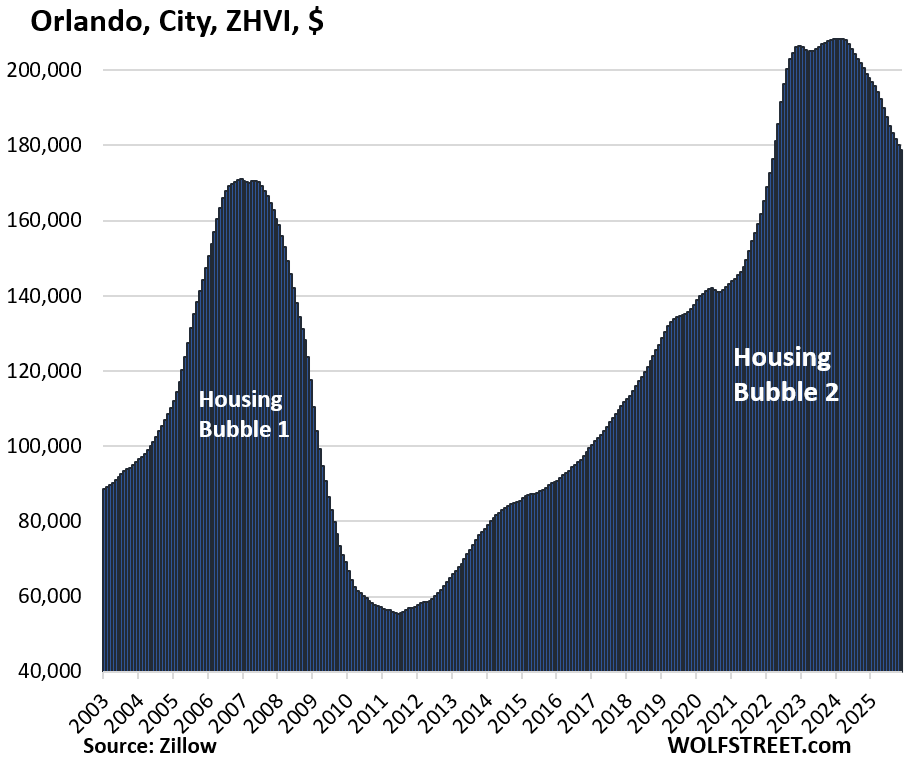
- Orlando, FL: -14% (2024)
- Garland, TX: -14% (2022)
- Port Saint Lucie, FL: -14% (2024)
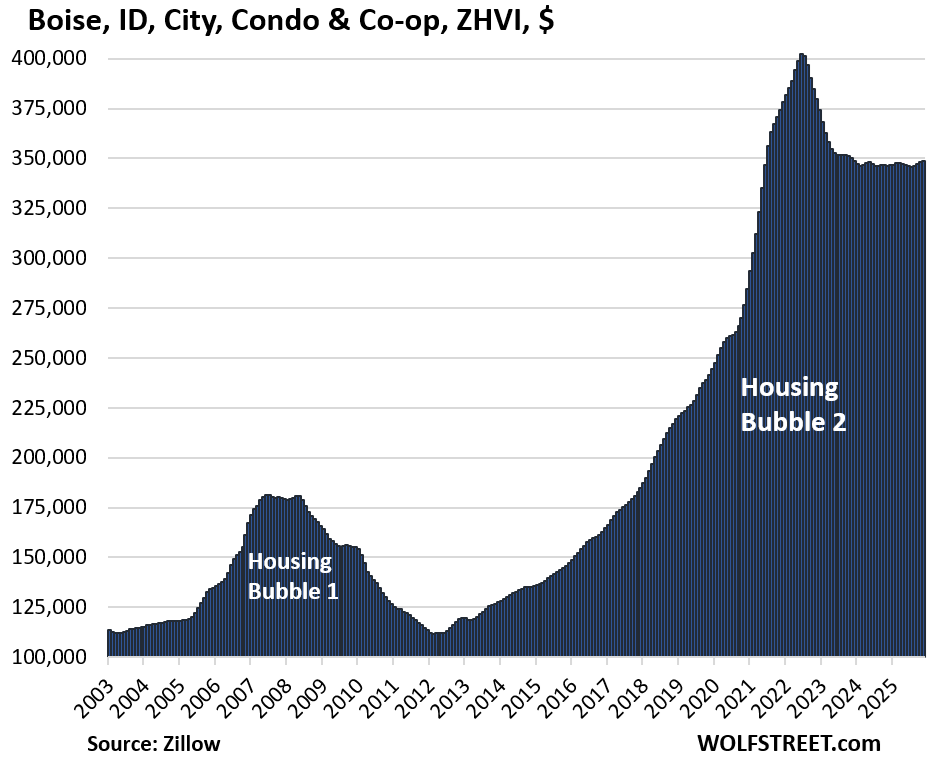
- Boise, ID: -13% (2022)
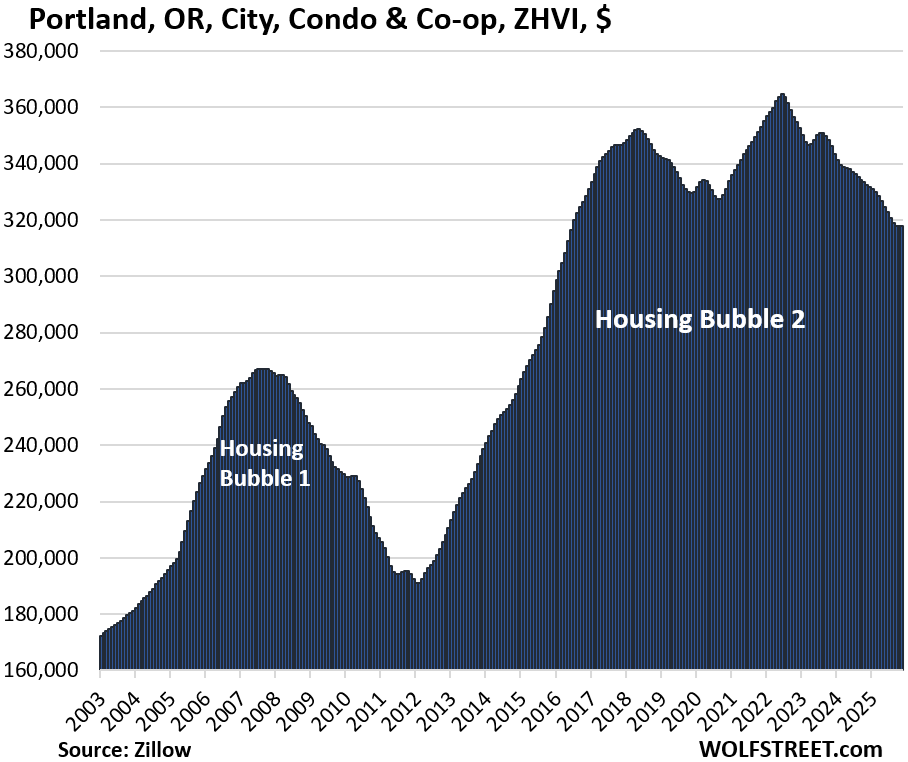
- Portland, OR: -13% (2022)
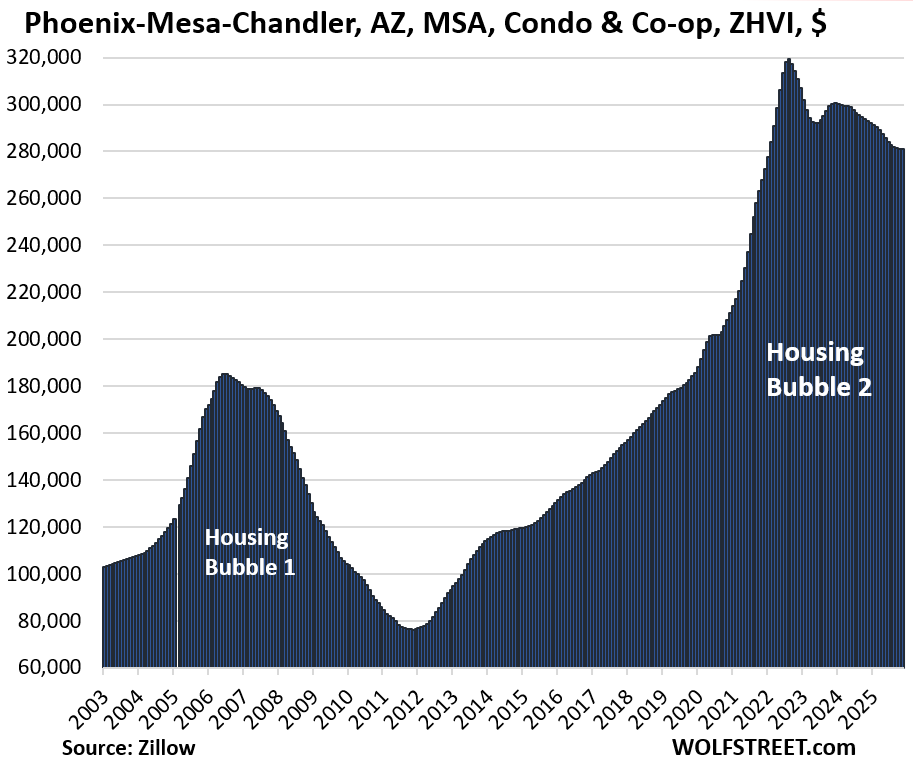
- Phoenix-Mesa-Chandler, AZ: -12% (2024)
- Fremont, CA: -12% (2022)
- Raleigh, NC: -12% (2022)
- Plano, TX: -12% (2022)
- San Antonio, TX: -12% (2024)
The biggest year-over-year price declines of condos.
These are the markets, among our 28 markets, with the biggest year-over-year price declines in November.
- St. Petersburg: -16.0%
- Lee County (Cape Coral, Fort Myers): -14.3%
- Arlington, TX: -13.4%
- Oakland, CA: -13.1%
- Sarasota County: -12.0%
- Jacksonville, FL: -10.7%
- Tampa, FL: -10.2%
- Orlando, FL: -10.2%
- Garland, TX: -9.8%
- Collier County (Naples): -9.4%
- Port Saint Lucie, FL: -9.4%
- Aurora, CO: -8.2%
- Plano: -8.1%
- Denver, FL: -6.9%
- Houston: -6.7%
- San Mateo County (northern Silicon Valley): -6.6%
- Raleigh: -6.1%
- San Diego: -6.1%
- Dallas: -5.9%
- Austin: -5.7%
- Los Angeles: -5.3%
- Miami: -5.3%
- Long Beach: -5.3%
- Atlanta: -5.1%
Some cities that didn’t make the -12% cut-off for the list:
There are many bigger markets where mid-tier condo prices have declined from their respective peaks in 2022, 2023, or 2024, but not enough to make the -12% cut-off. Here are some salient examples (year of peak):
- New Orleans, LA: -11% (2022)
- Corpus Christi, TX: -11% (2023)
- Houston, TX: -11% (2024)
- Colorado Springs, CO -10% (2024)
- Sacramento, CA: -10% (2024)
- Stockton, CA: -10% (2022)
- Dallas, TX: -10% (2023)
- Lubbock, TX: -10% (2022)
- Huntsville, AL: -10% (2022)
- Salt Lake City, UT: -9% (2022)
- Henderson, NV: -9% (2022)
- Spokane, WA: -9% (2022)
- Modesto, CA: -9% (2022)
- Washington, DC: -8% (2022)
- Atlanta, GA: -8% (2023)
- Las Vegas, NV: -8% (2022)
- Fort Worth, TX: -8% (2024)
- San Diego, CA: -7% (2023)
- Miami, FL: -7% (2023)
- Memphis, TN: -7% (2024)
- Nashville, TN: -7% (2022)
- Oklahoma City, OK: -7% (2023)
- St. Louis, MO: -7% (2023)
- San Jose, CA: -6% (2022)
- Los Angeles, CA: -6% (2022)
- Honolulu, HI: -6% (2022)
- Long Beach, CA: -6% (2023)
- Vancouver, WA: -6% (2022)
- Madison, WI: -6% (2024)
- Minneapolis, MN: -6% (2021)
- Marietta, GA: -6% (2024)
- Madison, WI: -6% (2024)
Methodology and data: These prices here are seasonally adjusted three-month averages of “mid-tier” condos and co-ops from the Zillow Home Value Index (ZHVI), which is based on millions of data points in Zillow’s “Database of All Homes,” including from public records (tax data), MLS, brokerages, local Realtor Associations, real-estate agents, and households across the US. It includes pricing data for off-market deals and for-sale-by-owner deals. These are not median prices.
Aftertaste of the price explosion: Condo prices in many of these cities had exploded by 50%, 60%, 70% or more in the two years from mid-2020 through mid-2022, driven by mindboggling absurd buying behavior, investor-mania, and Free Money.
In the 10 years to the peak, prices had soared by 180% (Oakland), 200% (Jacksonville, Tampa), 260% (Arlington, TX), 300% (Detroit, Aurora, Chandler), and 350% (Phoenix, Mesa). And by 500% in San Bernardino, CA, where prices have just started to decline and haven’t made any of the lists yet. Now these bubbles are deflating.
In some densely populated markets, such as Manhattan or San Francisco, condos and co-ops make up a big part or the majority of home sales.
The Condo Bust by market:
The tables for each market below show from left to right: price decline from the peak, change from prior month (MoM), change year-over-year (YoY), and remaining increase since January 2000.
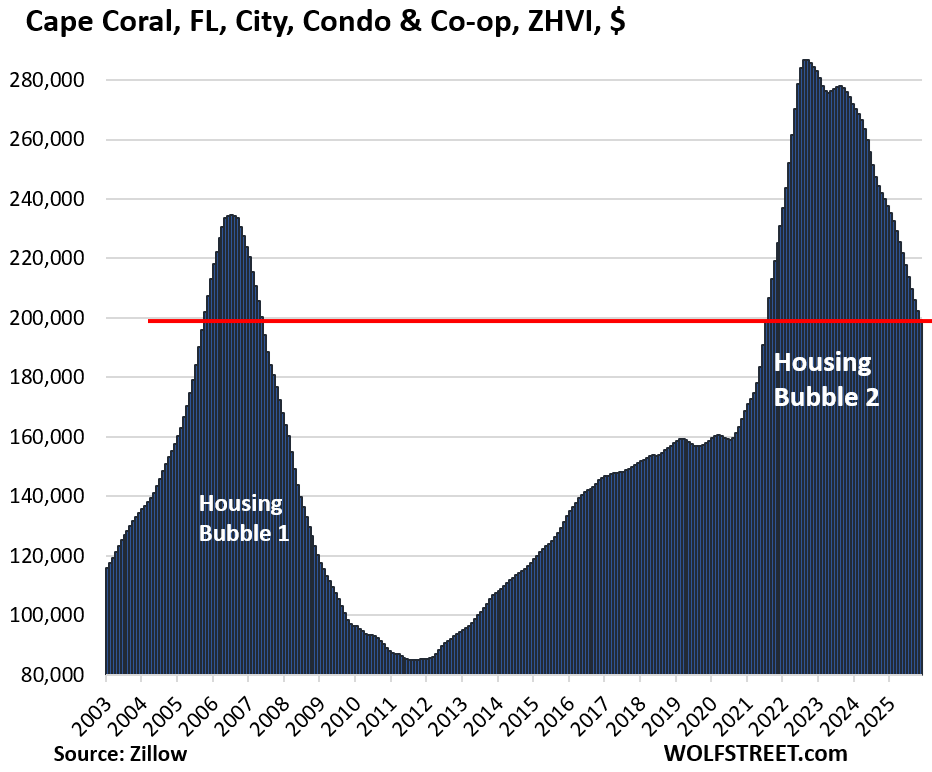
| Cape Coral, FL, City, Condo Prices | |||
| From July 2022 peak | MoM | YoY | Since 2000 |
| -30% | -1.5% | -16.9% | 137% |
Prices are where they’d first been in October 2005, so over 20 years ago, well below the peak of Housing Bubble 1 in mid-2006. And it continued in November, with a month-to-month drop of 1.5%, seasonally adjusted:
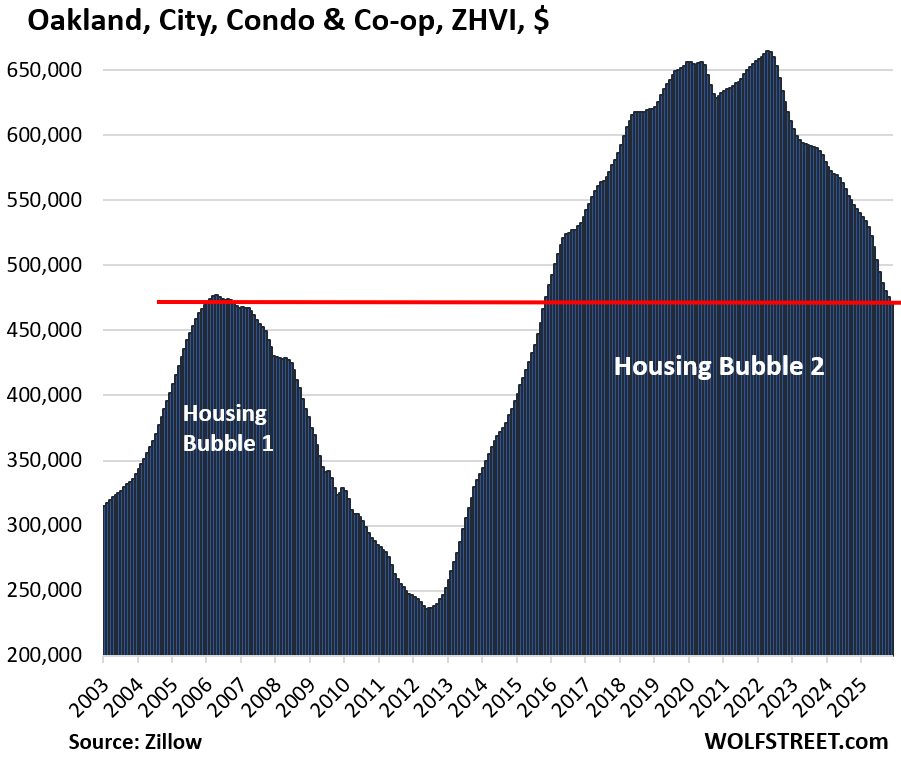
| Oakland, CA, City, Condo Prices | |||
| From May 2022 peak | MoM | YoY | Since 2000 |
| -29% | -0.7% | -13.1% | 149% |
Lowest since September 2015, a decade ago, and below the peak of Housing Bubble 1 in mid-2006, nearly 20 years ago!
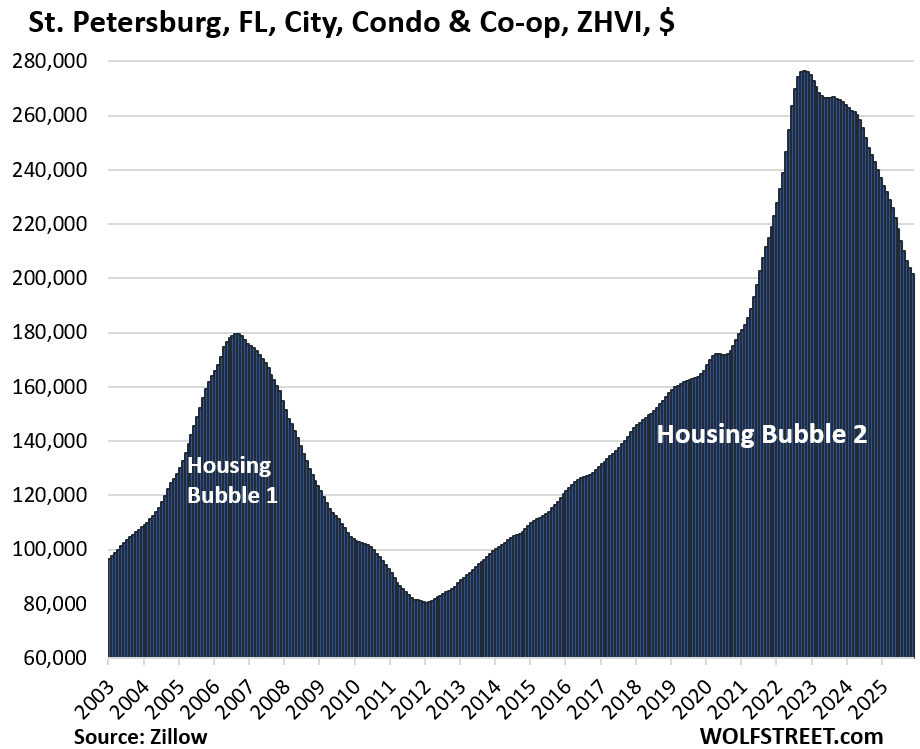
| St. Petersburg, Fl, City, Condo Prices | |||
| From Oct 2022 peak | MoM | YoY | Since 2000 |
| -27% | -1.0% | -16% | 187% |
Prices have dropped to where they’d first been in July 2021 after some massive month-to-month declines.
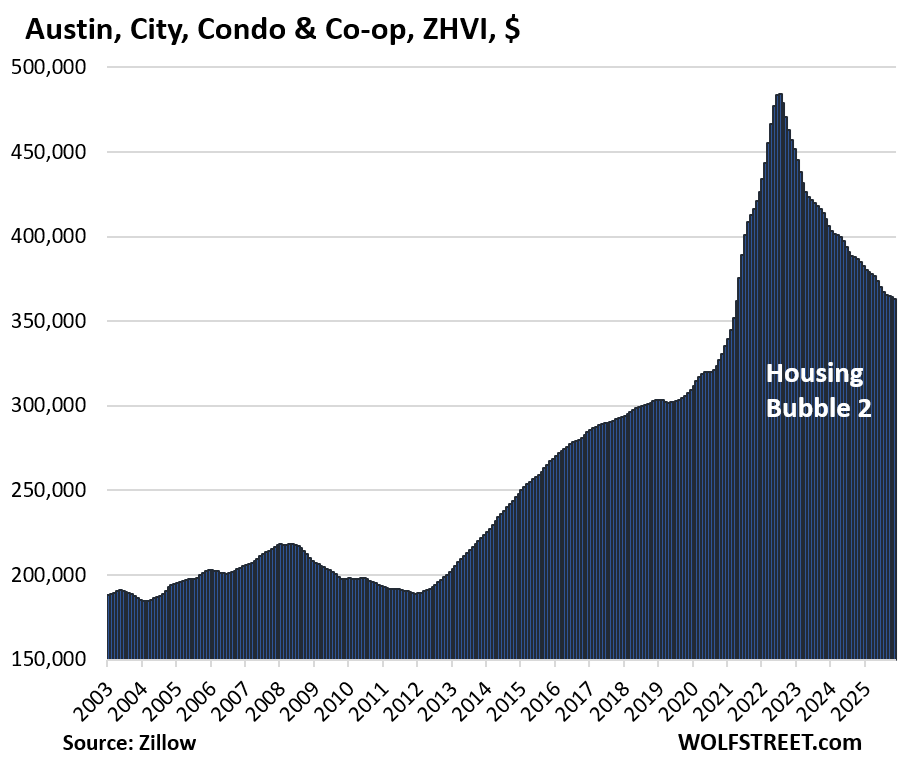
| Austin, TX, City, Condo Prices | |||
| From Jul 2022 peak | MoM | YoY | Since 2000 |
| -25% | -0.3% | -5.7% | 112% |
Lowest since April 2021.
| Sarasota County, FL, Condo & Co-ops Prices | |||
| From Jun 2022 peak | MoM | YoY | Since 2000 |
| -23% | -0.8% | -12.0% | 134% |
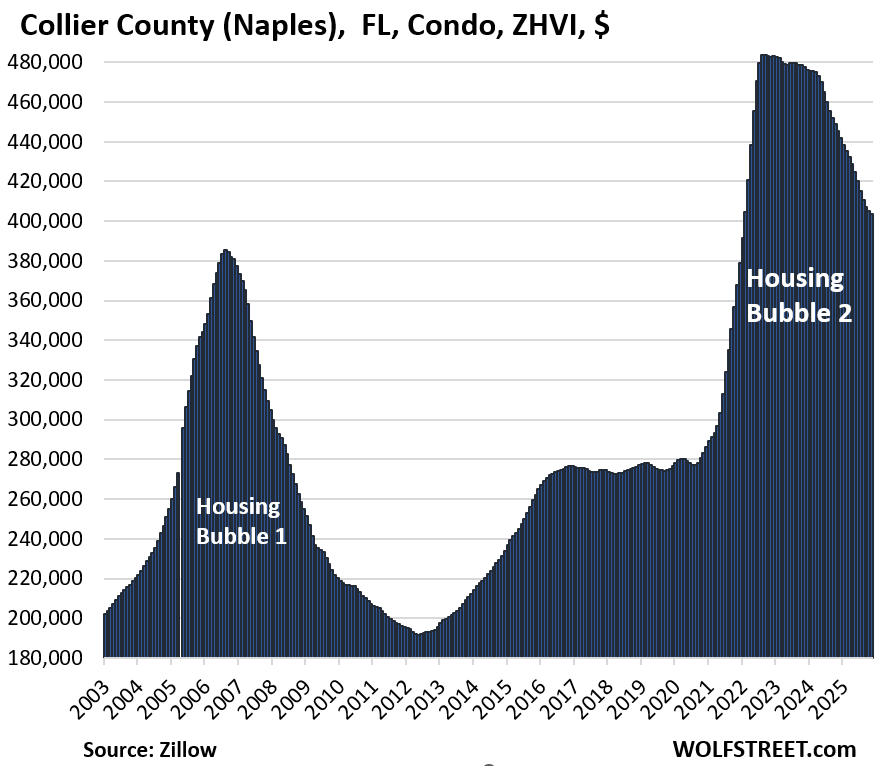
Prices are almost back where they’d been at the peak of Housing Bubble 1.
| Manhattan, NY, Condo & Co-op Prices | |||
| From Jun 2022 peak | MoM | YoY | Since 2000 |
| -19% | 0.4% | 1.4% | 211% |
Prices in the Borough of Manhattan (New York County) are where they’d first been in April 2014.
| Tampa, FL, City, Condo Prices | |||
| From Sep 2022 peak | MoM | YoY | Since 2000 |
| -18% | -0.7% | -10.2% | 260% |
| Jacksonville, FL, City, Condo Prices | |||
| From Nov 2022 peak | MoM | YoY | Since 2000 |
| -18% | -0.6% | -10.7% | 150% |
| Collier County (Naples), FL, Condo & Co-ops Prices | |||
| From Jun 2022 peak | MoM | YoY | Since 2000 |
| -17% | -0.4% | -9.4% | 158% |
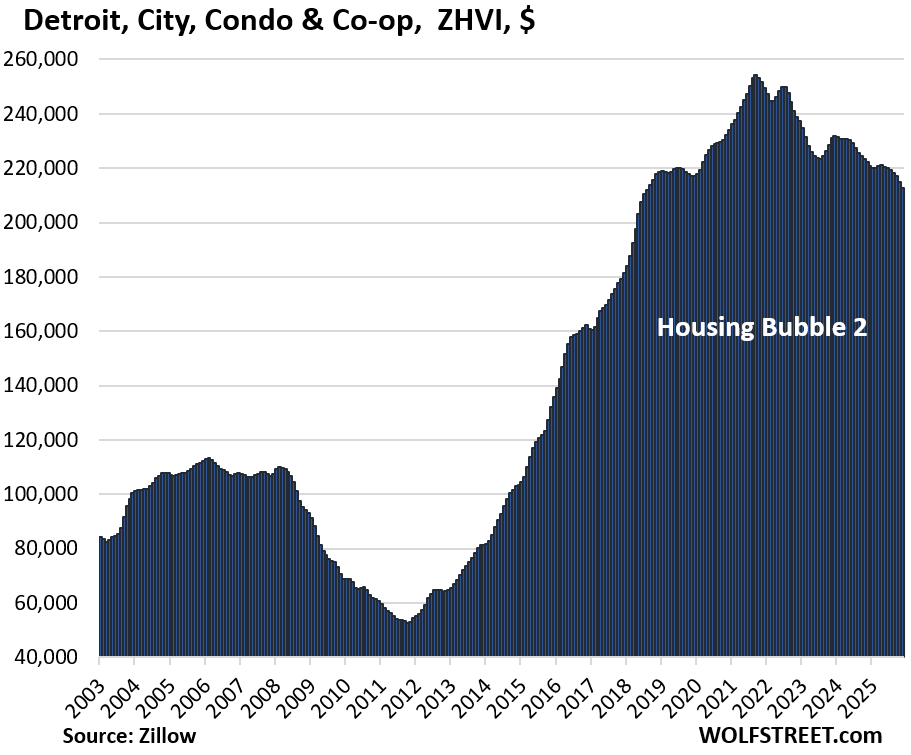
| Detroit, MI, City, Condo Prices | |||
| From Sep 2021 peak | MoM | YoY | Since 2000 |
| -16% | -1.0% | -4.3% | 258% |
Lowest since September 2018.
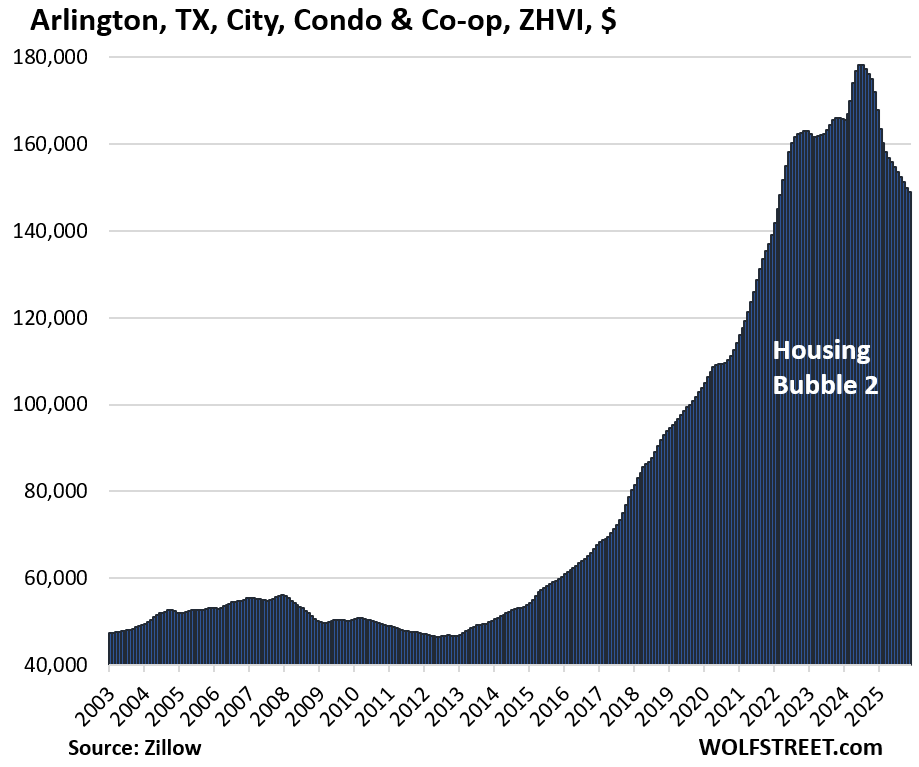
| Arlington, TX, City, Condo Prices | |||
| From Jun 2024 peak | MoM | YoY | Since 2000 |
| -16% | -0.6% | -13.4% | 231% |
In the decade between 2012 and 2022, prices had shot up by 278%. In just the four years between mid-2020 and mid-2024, prices exploded by 63%.
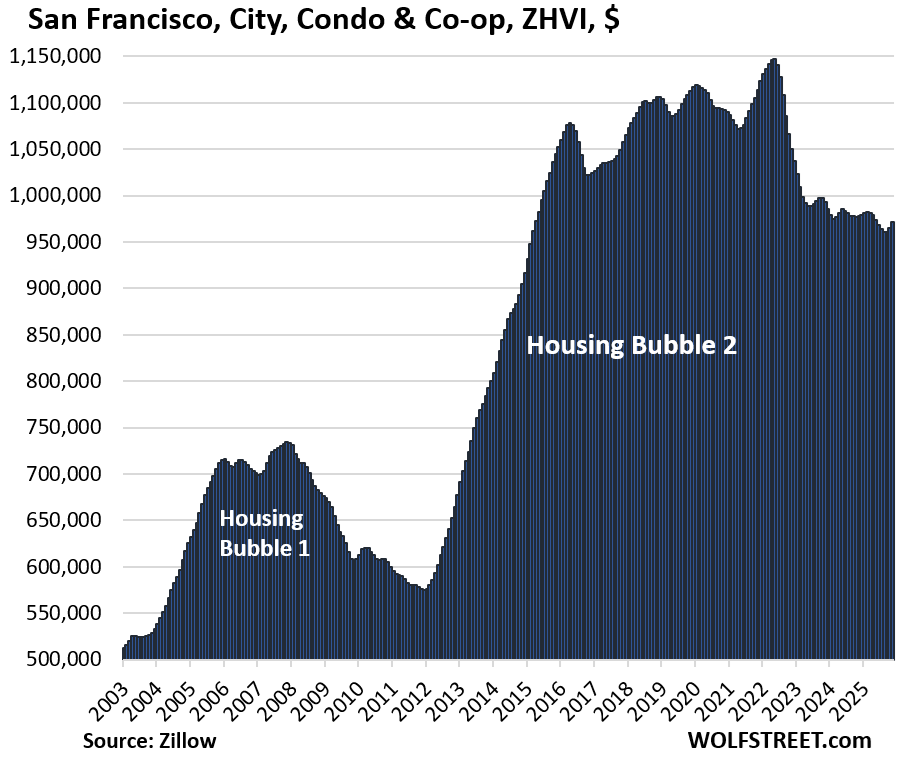
| San Francisco, CA, City, Condo Prices | |||
| From May 2022 peak | MoM | YoY | Since 2000 |
| -15% | 0.7% | -0.6% | 142% |
Prices are where they’d been in mid-2015. Between 2012 and 2022, prices shot up by 86%:
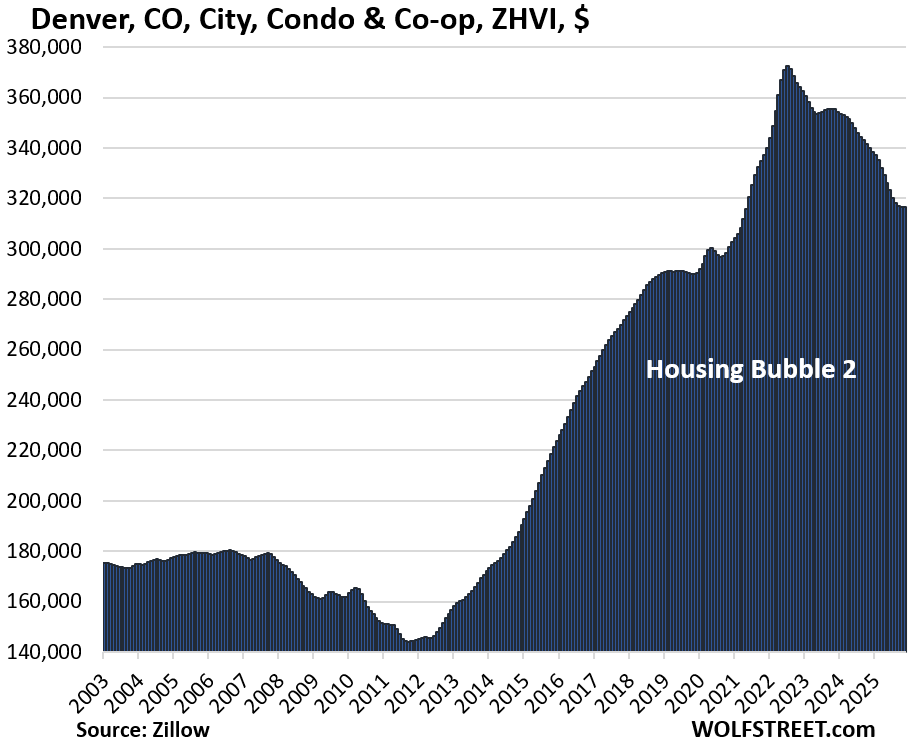
| Denver, CO, City, Condo Prices | |||
| From Jul 2022 peak | MoM | YoY | Since 2000 |
| -15% | 0.0% | -6.9% | 137% |
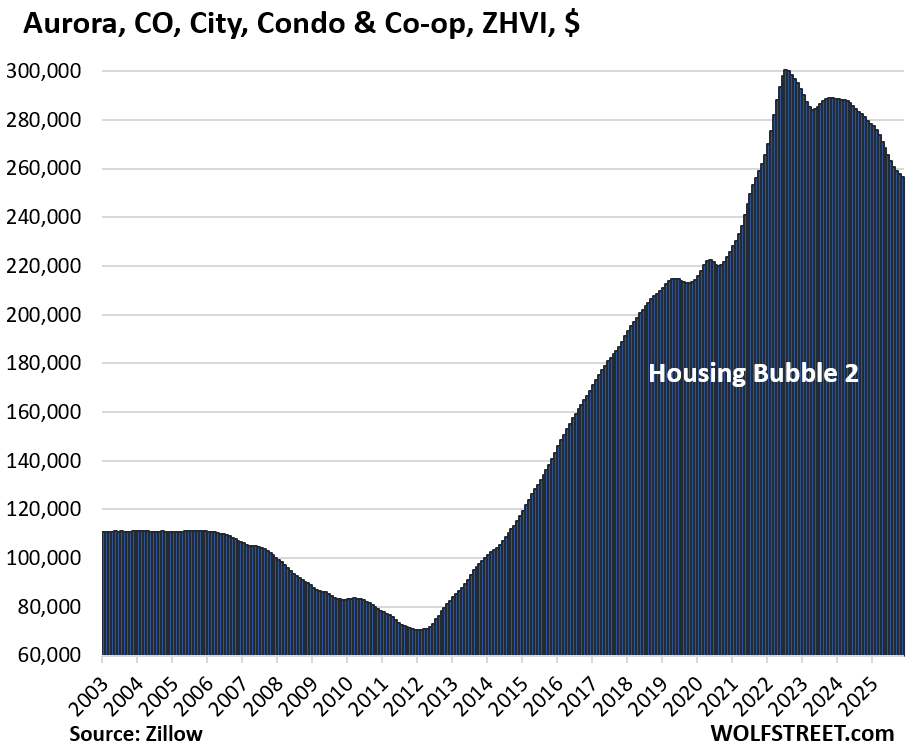
| Aurora, CO, City, Condo Prices | |||
| From Jul 2022 peak | MoM | YoY | Since 2000 |
| -15% | -0.4% | -8% | 202% |
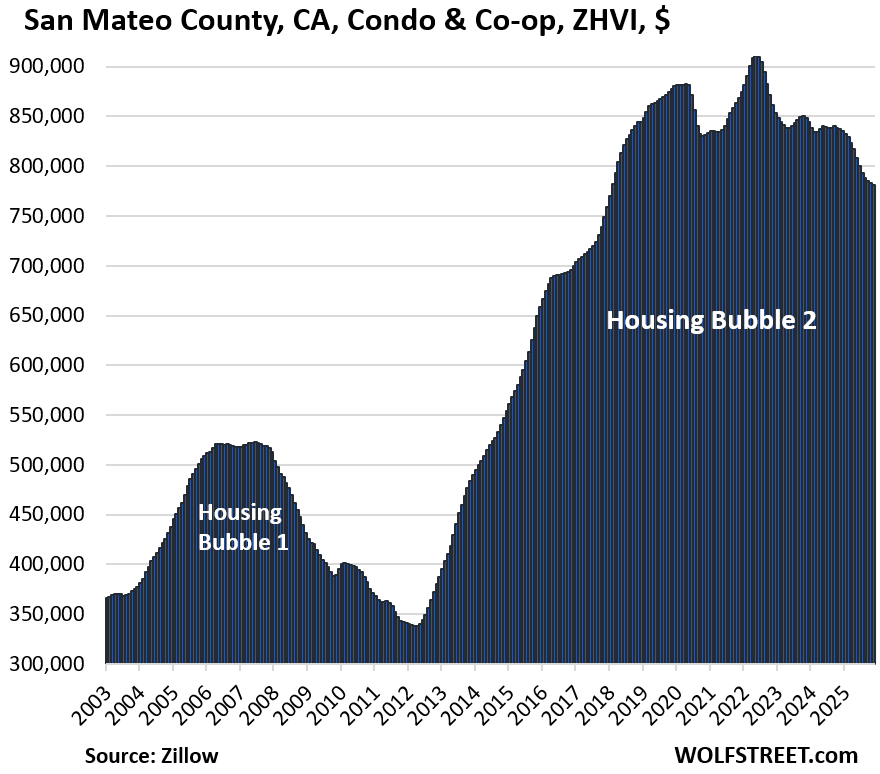
| San Mateo County, CA, Condo & Co-op Prices | |||
| From Jun 2022 peak | MoM | YoY | Since 2000 |
| -14% | -0.2% | -6.6% | 197% |
San Mateo County, just south of San Francisco County, encompasses the northern part of Silicon Valley. There are no big cities in San Mateo County, but lots of smaller ones, packed together. The southern part of Silicon Valley is in Santa Clara County, whose biggest city is San Jose, which I track at the city level (condo prices -6.3% from the peak in 2022, -6.1% YoY).
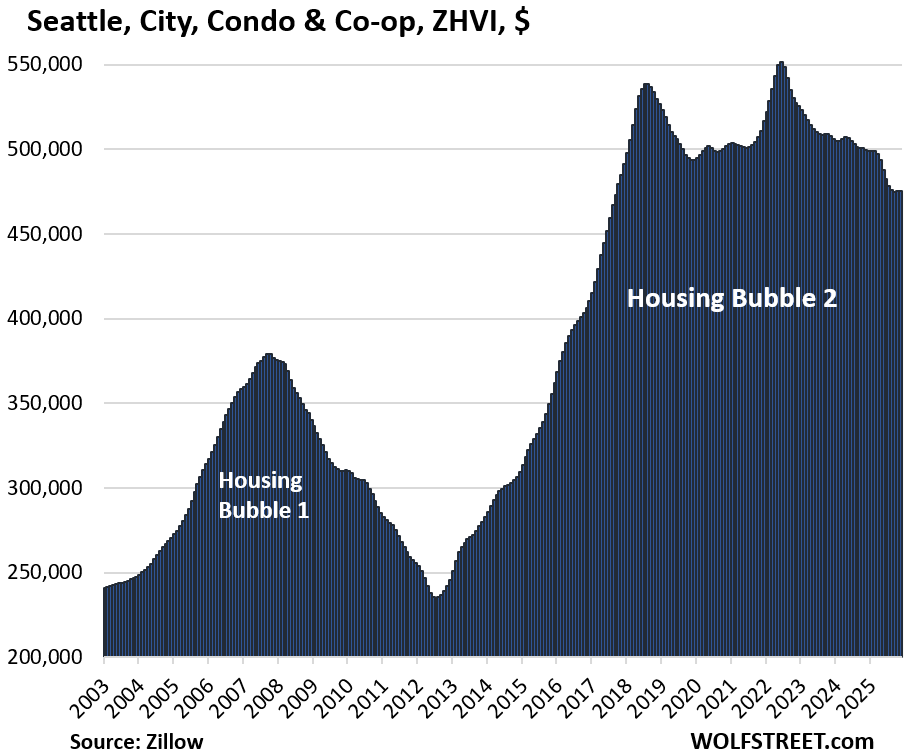
| Seattle, WA, City, Condo Prices | |||
| From Jun 2022 peak | MoM | YoY | Since 2000 |
| -14% | 0.1% | -4.9% | 136% |
Prices are where they’d first been in September 2017.
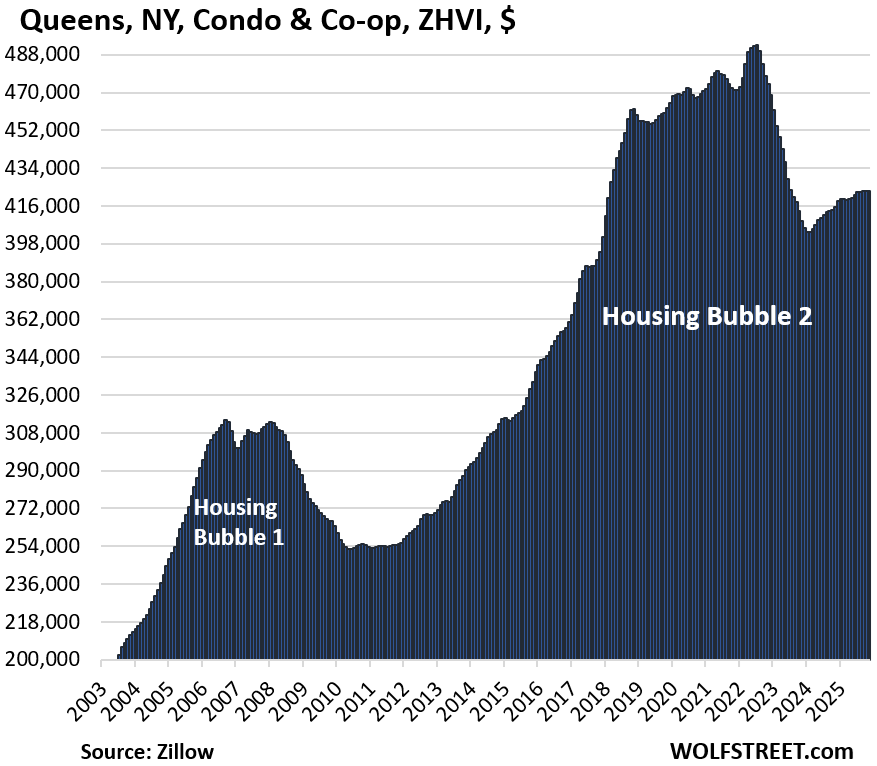
| Queens, NY, Condo & Co-Op Prices | |||
| From Jun 2022 peak | MoM | YoY | Since 2000 |
| -14% | 0.0% | 1.9% | 191% |
Prices in the NYC Borough of Queens (Queens County) are back where they’d first been in March 2018.
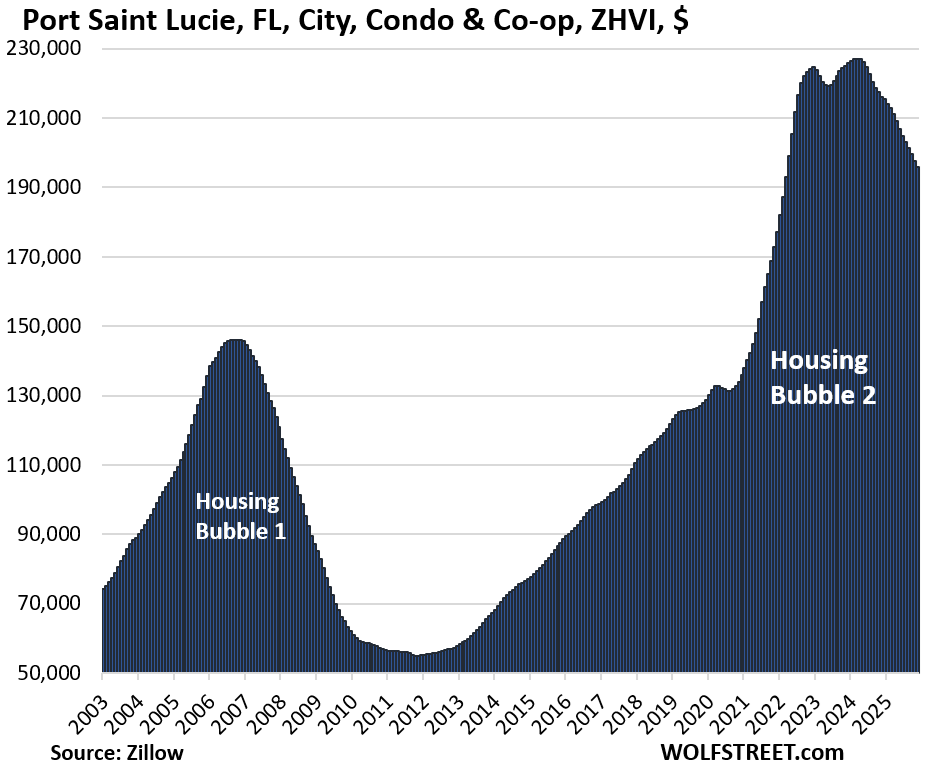
| Port Saint Lucie, FL, City, Condo Prices | |||
| From July 2022 peak | MoM | YoY | Since 2000 |
| -14% | -0.9% | -9.4% | 236.1% |
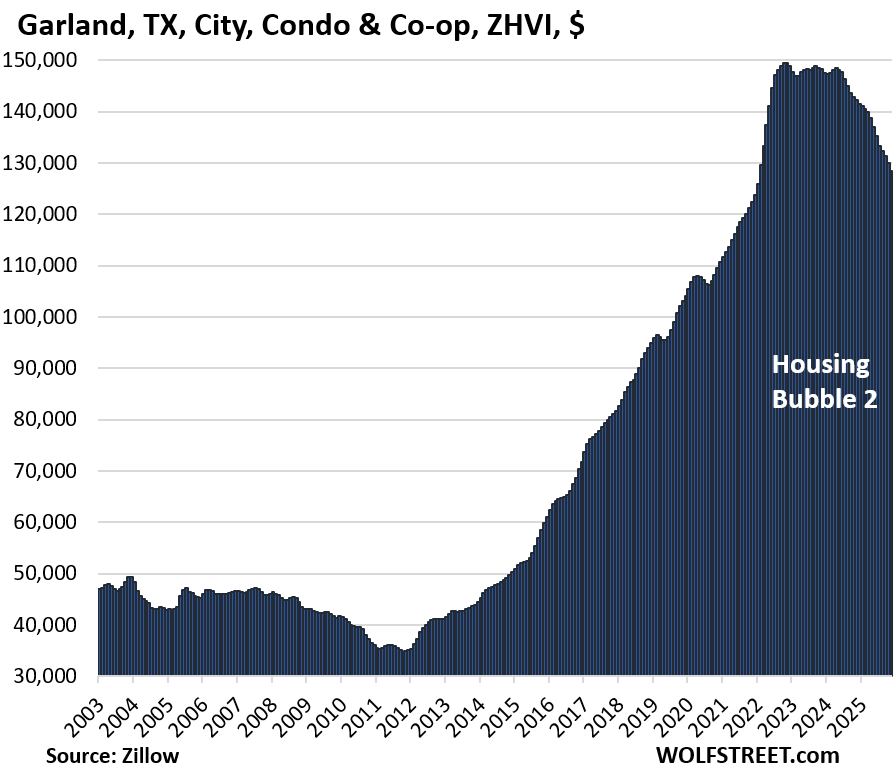
| Garland, TX, City, Condo Prices | |||
| From July 2022 peak | MoM | YoY | Since 2000 |
| -14% | 0.1% | -4.4% | 196.5% |
In the decade between 2012 and 2022, prices had more than quadrupled (+320%).
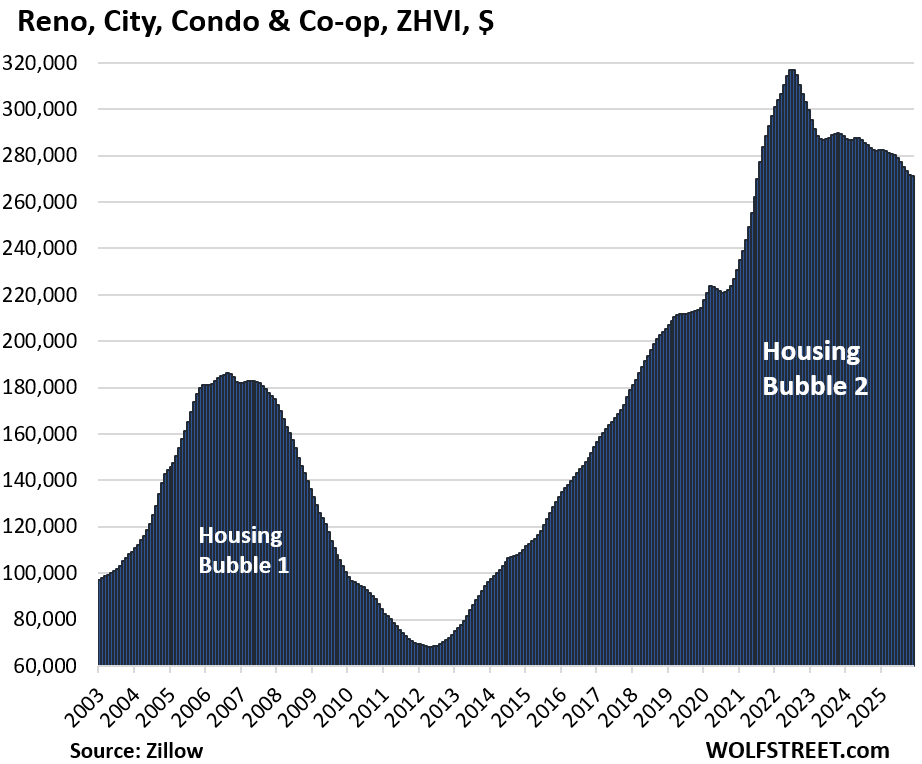
| Reno, NV, City, Condo Prices | |||
| From Jun 2022 peak | MoM | YoY | Since 2000 |
| -14% | -0.2% | -3.9% | 244% |
| Orlando, FL, City, Condo Prices | |||
| From Jan 2024 peak | MoM | YoY | Since 2000 |
| -14% | -0.7% | -10.2% | 156.4% |
| Boise, ID, City, Condo Prices | |||
| From Jun 2022 peak | MoM | YoY | Since 2001 |
| -13% | 0.2% | 1% | 221% |
| Portland, OR, City, Condo Prices | |||
| From Jun 2022 peak | MoM | YoY | Since 2000 |
| -13% | 0.1% | -4.4% | 110% |
Prices are where they’d first been in mid-2016.
| Phoenix-Mesa-Chandler MSA, AZ, City, Condo Prices | |||
| From Aug 2022 peak | MoM | YoY | Since 2000 |
| -12% | -0.1% | -4.1% | 210% |
The Phoenix metropolitan statistical area includes the cities of Phoenix, Mesa, Chandler, Scottsdale, Glendale, Gilbert, Tempe, and many others. Condo prices have moved very similarly. So it makes sense to show prices at the MSA level.
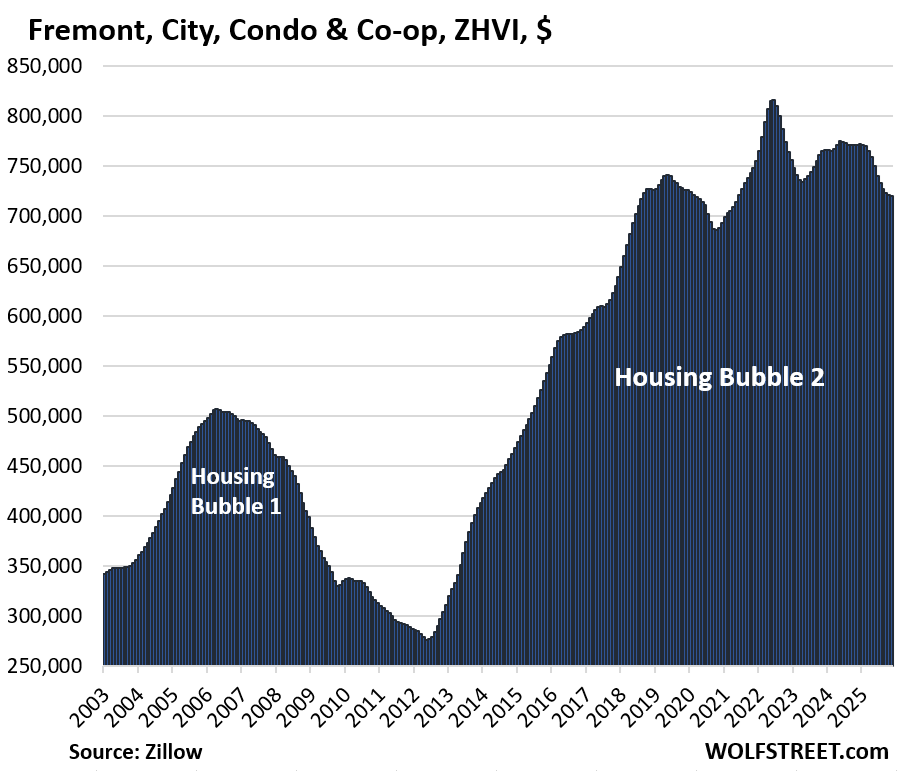
| Fremont, CA, City, Condo Prices | |||
| From May 2022 peak | MoM | YoY | Since 2000 |
| -12% | -0.2% | -6.7% | 208.0% |
Home to Tesla’s first manufacturing plant. Prices are back to mid-2018 levels. But they had nearly tripled in the decade from 2012 to 2022!
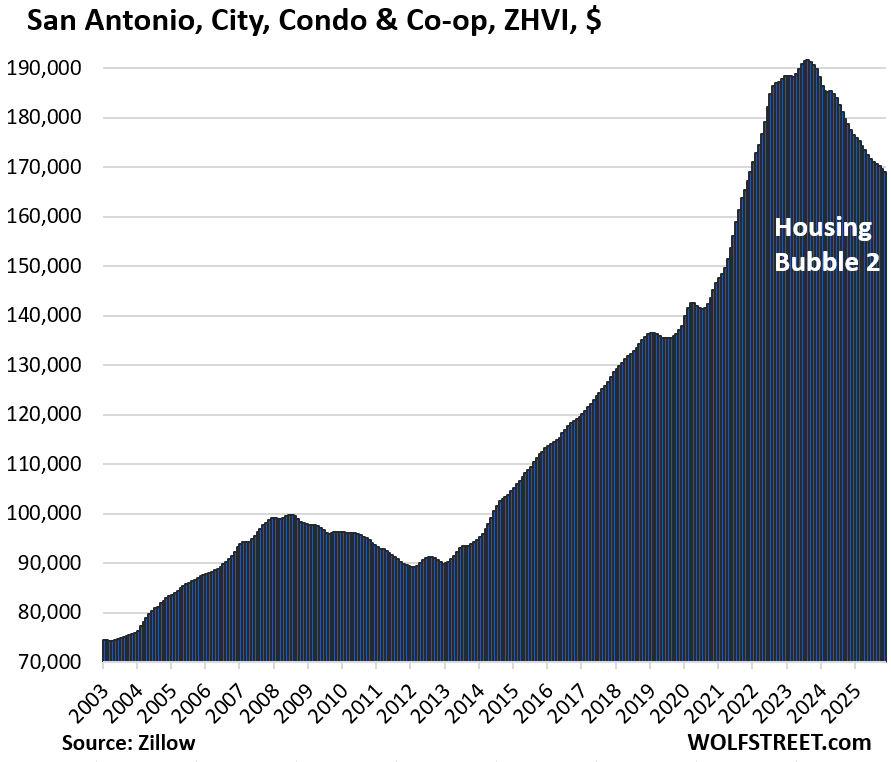
| San Antonio, TX, City, Condo Prices | |||
| From Aug 2023 peak | MoM | YoY | Since 2000 |
| -12% | -0.3% | -4.8% | 129% |
In the decade between 2012 and 2022, prices had spiked by 115%.
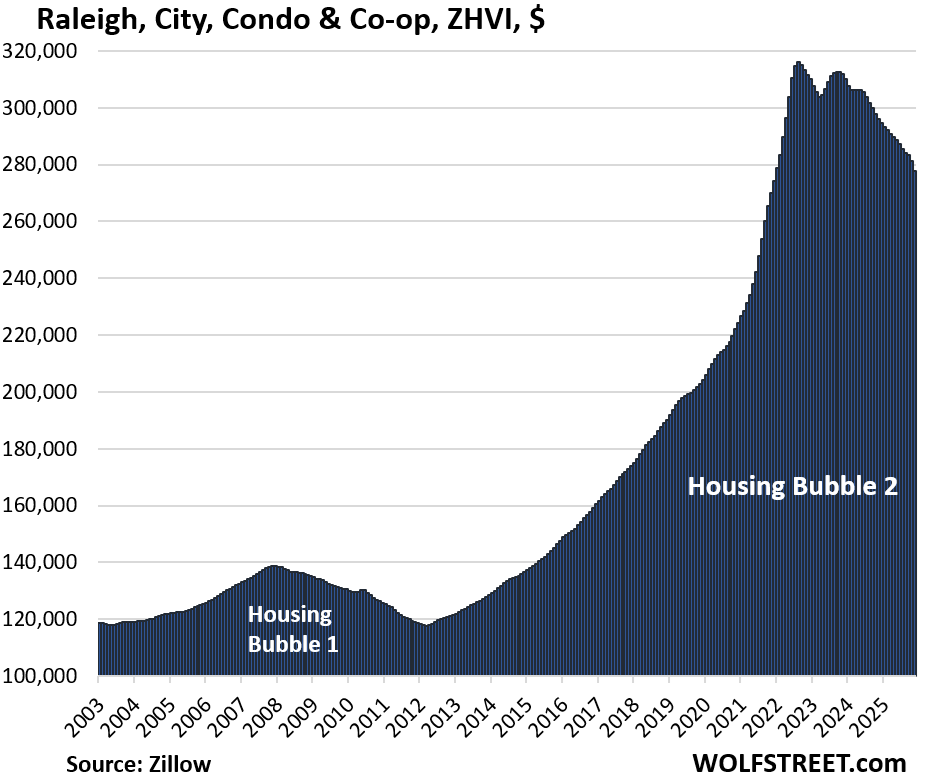
| Raleigh, NC, City, Condo Prices | |||
| From July 2022 peak | MoM | YoY | Since 2000 |
| -12% | -1.2% | -6.2% | 144.1% |
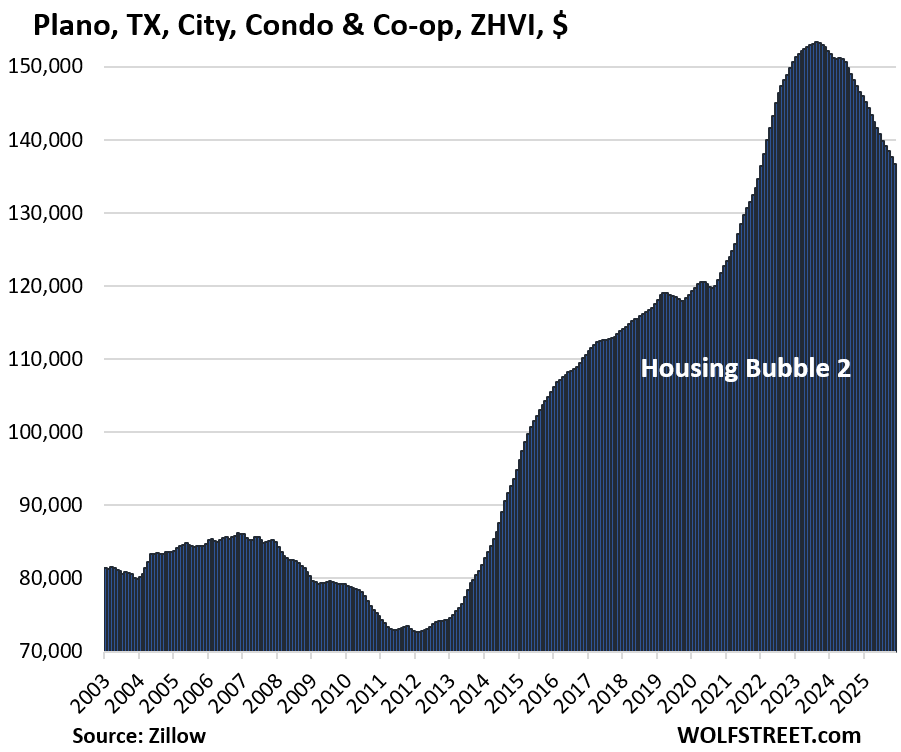
| Plano, TX, City, Condo Prices | |||
| From Aug 2023 peak | MoM | YoY | Since 2000 |
| -12% | -0.5% | -8.1% | 134% |
Condos confront a pile of special issues:
- Over the long term, land appreciates, most buildings depreciate to zero and are eventually torn down. The land that big condo buildings sit on can be very valuable, but each condo owner only owns a tiny slice of it. The rest of their investment is in the building. A single-family house may sit on less valuable land, but the homeowner gets 100% of any appreciation of the land.
- Prices that exploded over the past few years ended up being way too high, once the mania settled down.
- Hefty special assessments – or the threat thereof – for long-neglected major repairs dog some older condo buildings.
- Big increases in HOA fees at many properties, partly driven by spiking insurance costs in natural disaster zones, add substantially to the monthly costs of condos.
- If a condo building is on Fannie Mae’s Blacklist, financing a unit in that building gets very difficult, and sales may be limited to cash buyers who’ll exact their pound of flesh.
- The Free Money has ended, and mortgage rates are roughly back to a normal range.
- Foreign-based owners who’ve had it may want to sell. And there are fewer foreign-based buyers.
- Investors in condos as rental properties are facing stiff competition from a wave of newly completed higher-end apartment buildings that developers are trying to find tenants for.
And in case you missed it: Lennar Further Cuts Average Sales Price of New Homes, to Lowest since 2017, -25% from Peak: That’s what this Housing Market Needs
Enjoy reading WOLF STREET and want to support it? You can donate. I appreciate it immensely. Click on the mug to find out how:


So, those who bought a condo in 2023 are now underwater. They just need to hold on long enough to come out ahead in Bubble III.
Medicare is like “captain I dunno knu ef aye cun huld!”
🚑
“The cure for high prices is more high prices!!”
Commercial 4ral estate has taken a beating, and now we’re starting the free fall for real estate, it’ll be interesting and sad to see how far down the hill the prices roll.
Is anyone studying the 1929 debacle? Even though history doesn’t repeat itself, it sure does rhyme…
YMMV….
The good ole sunk cost fallacy. Instead of letting go of a losing bet, cling on in hopes of better prices.
Great point re: condo complex insurance increases. Luckly I got out of my WSOMA loft in 2021, since then the HOA has increased 60% due to insurance. The earthquake and liablilty has just gone crazy. We don’t have the wildfire hazard but wow the other components are zooming. I think the insurance companies are trying to cover their rears and running scared. The HOA is getting to the point where it is almost like monthly single family home maintenance budget, and thats not the reason people want condos, they wanted to get away from home owership typle costs.
I sold a townhouse in Fremont in 2019. I served in the HOA board. At that time we had earthquake insurance because the Hayward Fault was across the street. It was over 50%. Despite adequate reserves, the cost of insurance, maintenance, and landscaping pushed the cost to nearly $600 at that time compared to $325 when I bought in 2009. I wouldn’t be surprised if the HOA dues are now closer to $1000. The buyer of my unit sits on a $10,000 tax bill and $12,000 in dues. That’s just crazy.
Condos are the canary in the coal mine. The canary is knocked over, almost dead. Better run and run fast. It says a dead canary was a sign of one of two possible things – carbon monoxide, or methane. Housing (the main mine shaft) is next. Either we all fall asleep as goners or are blown to pieces.
Run, and don’t stop running until you see the sun. Grab that little canary and put him in your pocket on the way out.
That Cape Coral chart says condos are chips in a casino.
This stuff is really nuts.
“That which cannot go on…stops.”
The amazing thing is that the exact same people laying out hundreds of 100ks for a Cape Coral condo, apparently had zero knowledge of the actual Cape Coral condo price history…
Although…again this is an illustration of why price data standing alone (without sales transaction volume data – which I know can be hard/impossible to get) is at a minimum theoretically capable of creating misleading impressions.
Bubble 1 in Cape Coral might have involved hundreds of transactions/transactors.
Bubble 2 might have involved a couple dozen.
Or not.
Without the transaction volume data, who knows?
Easily accessible real estate data has made leaps and bounds over the last 20 years.
But it is still far from complete.
The over correction is gonna be stunning.
Overcorrections always happen, don’t they ?
2008 here we come…
That cake started baking in 2016/2017…
The value of at least trying to use some sort of valuation metric (even if incomplete or potentially limited) is that at a minimum you can at least get a sense of when the market is wandering into dangerous territory.
And respond based on personal appetite for risk.
The market can stay pretty irrational for lengthy periods of time (looking at you Mag 7/Nifty 50/SP 500…) but, using metrics, those who are more conservative can get off the ice when the hoi polloi start holding RiverDance auditions on the self-same ice.
Sure, you might miss out on maximalist gains in the interim (if you, by some miracle, time everything perfectly).
But people also miss out on gamboling naked in the lion habitat at the local zoo (which I’m sure is also…exhilarating).
Nah, this time is different as they all say and many will take it to their graves in SoCal as for whatever reason most out here think they are immune this time around…
Wonderful article, it sounds like music to my ears!
Are these numbers corrected for inflation and devaluation of the USD ?
If not places like Oakland are underwater compared with 25 years ago and not 149% up
Home owners there do have one positive that is that property taxes have gone up only 1% vs the much higher real inflation . Although in Oakland it must be added that they found a way around it by adding ‘fees’ and increasing the % the property taxes is based on.
“Are these numbers corrected for inflation and devaluation of the USD ?”
Comments like this always drive me a bit nuts (variation – “Are you adjusting grossly engorged government spending for…inflation?”.
Certain sectors (housing, government) are so huge and semi-central to the economy as a whole, that increased spending in those sectors (frequently the result of foolish “ideas” or outright bent means) is the *origin* of the economy-wide inflation in large part.
This is sort of a like an arsonist complaining about all the fires.
If the yardstick is made of rubber, your measurements are inaccurate.
But yeah, stay nuts while at the end of the day you are wondering why your assessments where wrong.
I know someone who sold her house in a few years back in Oakland and part of the proceeds parked in gold and silver instruments, not trusting it to the rubbery USD she told me.
You would classify her gain as just gamblers luck?
Your point on land appreciation is well taken, but probably not widely understood. In January 2008 the real property tax assessments in Fairfax County, VA used a new method of land/house allocation. They valued all land (improved and unimproved) based on sales data for unimproved lots.
Under this approach, the total assessment increased only slightly, but the % of the total valuation assigned to improvements dropped significantly. There were widespread protests about this new approach and almost immediately the County went back to the old allocation procedure where the value of improved land is understated and the value of improvements is correspondingly overstated.
I think we can officially declare that Florida is in the midst of bubble popping times.
Ok, so when do we buy a condo?
Apparently…2011.
It always amazes me the number of people very eager to get into leveraged knife juggling…despite the recent documented history of leveraged knife juggling.
Gotta be a pony in there somewhere…
“Obviously today!” Overhappy Realtor
btw Realtors accept tips 😂
The Florida condo decline is heavily driven by the recent past major hits from hurricanes.
Condo owners only “own” the inside of their unit, thus all outside building and common area insurance is handles through the HOA. So little owner control of that cost.
I would hazard a guess that the price drop is driven more by speculators who bought units for rental and can no longer make the numbers work with the much higher insurance required by the HOA. Just a hunch.
Condo collapse in Florida killed 98. It’s easy to forget that, it was light years ago, way back in June 2021. But Guido DeSantis has not forgotten and if you’re buying or selling a condo in the Sunshine State you may have problems that run much deeper than Realtor’s commissions, mortgages, Fannie Mae’s
“blacklist,” home owner’s associations, property taxes, insurance, maintenance, trash collection, inspections and certifications. You may have the Florida Legislature as an undeclared but not so silent participant in the transaction.
Good Luck.
Since 2018 Fla property insurance has zoomed ,
Fla property taxes has zoomed ,HOA fees have zoomed , the cost to make repairs has zoomed and mortgage interest is higher .
Every costs are higher to much higher than 2018. Why are Fla condo prices higher than 2018?
I rent a condo for the winter on the beach in Fla . Supposedly it would cost
Around 600,000 dollars
HOA fees are 1,100/month
Property taxes are ~4,000/year
Property insurance for the inside of the condo are ~ 1,000/ year .
If I paid 600,000 in cash , my costs would be ~
18,200/year .I estimate that this unit could rent out for 35,000-40,000$ /year . Thus , I would make ~
16,800 -21800 /year on a 600,000 investment or ~ 2.8%-3.65%/year .And that does not assume future increases in property taxes and HOA fees.
If I bought this condo with a mortgage and rented it out , it would generate a negative return .
Will be a interesting year economically and wonder what the housing market will be like,perhaps a return to sanity where I may end my buyers strike,doubtful but possible.
Jake,thanks for thinking about the canary,he saved many lives!
Fun stuff to watch.
Unless of course you own a Condo and need to unload it…. Then it might make a person sad.
Dang…did I read correctly 500 percent increase
In 10 years in San Bernardino of all places?
Over the years I have worked there off and on, and um…. only thing I can say is Dang !
I would never have guessed it would be a that desirable of destination to drive prices at that pace. Would never have guessed.
6 of the top 10 in Florida.
Radioactive.
One month ago, reports were that the election of Mamdani in NYC had immediately revived the FL real estate market.
Back when I lived in my FIRST condo, my lawyer told me this joke.
Q – What’s the difference between a Condo and a venereal disease?
A – You can get rid of a venereal disease.
———
My second condo, where I live now, is just shelter. I don’t care about its value because I don’t consider it an investment.
I loved my condo, but I was lucky. And I knew I was lucky and never forgot that I was lucky.
I 100% agree.
I’ve been extremely lucky in life. Born just at the right time, in the right place, to a typical middle class family.
Pure luck. And I am thankful for it.
In some ways, as a person there is not much choice in life until you are very old.
anon,
Good for you. Must be nice. I wasn’t lucky in that respect. I grew up relatively poor (no house, no car, no TV even until I was 15) in a family where violence and denigration against us kids were the norm, and when I was 17, I fled what was often a hell hole of a family and came alone to the US to try to have better luck somewhere else, and when I was 20 and in college in the US, my parents got killed in a plane crash in Turkey.
But I was lucky with my condo later in life, because I pursued it for two years because the developer had collapsed amid fraud allegations, and the bank foreclosed on the condos, and I bought from the bank at about half the cost of the developer’s loan against it, and then the bank collapsed and was taken over by the FDIC, and my neighbor bought his condo from the FDIC for 20% less than I’d paid a year earlier. And then I lived there for 12 years and sold it on my own without listing it at big profit, and the buyers (their estate) sold again 14 years later at a 30% loss, not counting the improvements they’d made. That’s where I was lucky with the condo… that I didn’t sell 14 years later than I actually sold.
Here is how I was not so lucky in the early part of my life… just read the first few chapters for free by clicking on “Read free sample” under the book cover:
https://www.amazon.com/gp/product/B00613TA56
You would have to put a gun to my head for me to sign up for a condo for FREE. HOA dues = big effin’ NO WAY. The people who run these things have the worst personality disorders known to mankind. And they are a special kind of stupid when it comes to financial matters.
Speaking of HOA dues, I have a friend who owns a condo in Windemere Florida. His monthly HOA dues are $566.00 a month, $6,792.00 per year! I’m blown away by that number!
If it includes all wind insurance, roof work, maintenance of common areas, a pool, gym, tennis court, lawn maintenance and so forth, it’s really not that remarkable.
How much would a person pay for all of those things?
“Over the long term, land appreciates, most buildings depreciate to zero and are eventually torn down. The land that big condo buildings sit on can be very valuable, but each condo owner only owns a tiny slice of it. The rest of their investment is in the building. A single-family house may sit on less valuable land, but the homeowner gets 100% of any appreciation of the land.”
The real estate bubble is always in the land. Raw land prices are much more volatile than completed houses. We need a massive land price crash of 90%, and for prices to stay there.
I can’t speak for urban land prices, but out here in flyover anything over 5 acres is still climbing.
No shortage of corporate, land flippers, and finance guys chasing hard assets.
And no, I’m not a realtor….just a dirt digger.
Empty land prices in NM and Colorado have already fallen since peak, by about 15%.
I want to buy a condo as a winter retreat in the Southwest, but the HOAs, taxes, etc as well utilities add up. The prices will have to drop by another 50-75% before I even consider buying.
Wolf, these graphs are great and I appreciate your consistent housing analysis format.
I’m curious how the condo dynamics compare to the single-family-home dynamics; but I suppose it’s not easy to compare apples-to-apples this way because your SFH markets are usually metro areas, where most of the condo charts are cities or counties.
Someone above made a comment about condos being a canary in a coal mine for housing; I’d like to see some charts that test or illustrate that idea. Do SFH price movements typically lag condos? Could you use the Phoenix area as a test case, maybe, since that’s a metro area?
I track the declines in SFH prices by bigger cities separately, and will publish an update over the next few days. The declines have been less big than in the condo market, but are substantial already.
And you’re right, SF homes and condos are not always in the same neighborhood, especially when it comes to condo towers. They’re generally in areas where SF homes are not.
Wolf – can you do an analysis of ski resort real estate market performance? I have read that prices are crashing in these cities in Colo in this order:
10. Pagosa Springs
9. Durango
8. Silverthorne
7. Crested Butte
6. Steamboat Springs
5. Breckenridge
4. Telluride
3. Edwards
2. Vail
1. Aspen
So I just checked Durango, Steamboat Springs, and Truckee (CA). In terms of the mid-tier homes that I’m tracking, overall home prices (SFH and condos combined) are not crashing. In Durango and Steamboat Springs, they’re at a record. In Truckee, they’re down some, but not hugely.
Obviously it is not an American city , but the condo market in Toronto is akin to the apartment situation in China . So called investors in Toronto
paid super high prices for small condos hoping to sell to another “ investor”. Failing that they have tried to rent out their condo. But the amount of rent required to cover their costs is much higher than the current rental market for these small condos , so “ investors in these condos are either
Letting them remain empty or defaulting on their obligations
The “dog crate” condos as Ron Butler calls them. I was following a new recent large project Phase 1 where they actually intended to sell studios (no bedroom) for ~$440K (~440 sq ft) with maintenance fees >$500 and no parking. Parking was only offered to 2 bedroom+ and would cost your $50K. They only had 10% interest so abandoned the project – Quadreal with BC pension money. I think quite a few of the condos that are going up now are going to have major issues getting the buyers to close especially with resale market pricing much lower /sqft.
The big move in those markets is to convert condo buildings to rental apartment buildings during the development and construction process, so when they hit the market, it will be as a rental apartment building. This is creating a lot of rental supply in Toronto and Vancouver. And that’s a good thing too. Oversupply is a good way to address affordability.
Correct Wolf. My friend runs a firm that was intending to build stacked condos in a town outside Toronto (Ajax) and the city was allowing them to increase density then the correction began and they now pivoted to I believe CHMC supported rental build out. Investors will have to wait longer for their money but in the end they will be good supposedly. Construction already started there. Lots of other condo towers being built now in GTA not sure what will happen. Ellis Don cancelled a few projects but towers are still going up. Thanks for all your insights BTW.
/James
I was hoping, Wolf, that you were going to have a Christmas article saying that Santa Claus is offering homes and condos at 50% off of current prices….moree than 50% in places like S.F. Never underestimate Santa.
One can hope. Maybe next year? At these current prices, I only see Grinches.
The charts need to account for the accelerating decay of the USD as an accounting unit. Wolf, I know you often push back on this point because housing is the largest household expense, but even if it is overweighted at roughly one-third of the CPI basket, the remaining two-thirds have increased far more, making current burst far worse than it appears in inflated dollars.
USD is the best dirty shirt in the fiat room and if you follow Brent Johnson from Santiago Capital there is a dollar milkshake theory where the USD will outlast them all. Gold is telling a different story. We are moving into an era of fiscal dominance perhaps. The central bankers have zero concern for the non asset holders. They have ignored asset inflation while suppressing rates for 2+ decades. My long energy/gold theme took a while to play out post COVID but it did well and probably will do well going forward.